Elevate & Ensure Workplace Safety with ISO 45001 Consultancy & Training
Stay One Step Ahead with ISO 45001 Certification
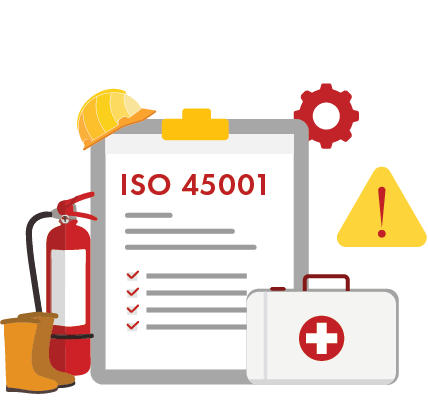
ISO 45001 is an internationally recognized standard that sets forth the requirements for implementing an occupational health and safety management system (OHSMS) within an organization. It is necessary as it provides a framework for organizations to proactively manage occupational health and safety risks, ensuring a safe and healthy workplace for employees and other stakeholders. The standard outlines requirements for organizations to establish and maintain an OHSMS, including hazard identification, risk assessment, and implementing controls to mitigate risks.
Requirements of the standard include establishing clear health and safety policies, conducting regular hazard assessments, providing employee training, and conducting incident investigations. Compliance with ISO 45001 offers numerous benefits, including reduced workplace accidents and injuries, improved employee morale and productivity, enhanced regulatory compliance, and cost savings associated with reduced absenteeism and worker compensation claims. Overall, ISO 45001 certification demonstrates an organization’s commitment to prioritizing the health and safety of its workforce, leading to a safer and more sustainable work environment.

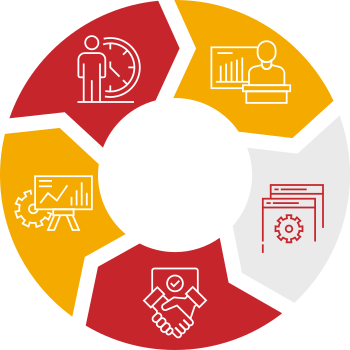
4C's Route
of Transformation
Gap Analysis
We identify the organisation's strength and current status; understand the gap in line with the required standard for respective departments, processes and personnel, and accordingly formulate the Growth Plan.
Awareness Training
Awareness Training modules are custom designed for APEX Committee and Core Team which covers standard overview, roadmap for certification and observations and examples gathered from the gap analysis.
Documentation
We prepare the Management System Documentation as per the requirements of ISO and Management System Standards after taking due consideration of the Gap Analysis results.
Implementation & Monitoring
Function specific guidance and periodic monitoring to implement the Documented System.
Internal Auditor Training
Train and Lead Cross Functional Internal Audit Team to effectively audit implemented system.
Management Review
Assist Top Management to review effectiveness of implemented system, internal
audit results, Management System Policy, Objectives and Targets.Registration Audit
Co-ordination with certification agency for
audits and up gradation of systems till certification.System Value Management
Periodic monitoring, review, training and up-gradation of Management system to sustain & improve effectiveness, planned internal audit to measure effectiveness & assistance in surveillance audit.
our clients





Get your Organization
equipped with ISO 45001
ISO 45001 certification ensures safer workplaces, reduces accidents, boosts employee morale, and fosters regulatory compliance, empowering companies globally to prioritize occupational health and safety.
Optimizing Industries with
Effective Transformation

Engineering & Manufacturing

Services Industries

Food Industries

Chemical & Pharmaceutical

Automobile Industries
Power Plants

IT Industries

Educational Industries

World-class ISO 45001 Consultant
With a team of 20+ expert consultants, 4C leads the way in providing professional, industry-specific and accurate consultancy services. With a simplistic approach combined with an integrated excellence model, the team of 4C consultants readies your organization for growth and enables it to adopt and maintain the best of global practices.


Result-driven OHSAS Training
Upskill your workforce with professional training that helps them acquire an in-depth understanding of various standards that empower the business. With flexible options of in-house training, public training and live online training, ensure process and operational excellence with complete proficiency and convenience. Major types of training include Internal Auditor Training, Awareness Training and Implementation Training.

Benefits that usher Growth
- Ensures a safer work environment by identifying and mitigating occupational health and safety risks,
- Reduce workplace accidents, injuries, and illnesses, resulting in fewer disruptions and costs,
- Demonstrates compliance with health and safety regulations,
- Enhances an organization’s reputation,
- Streamlined processes and improved risk management.

From The Excellence Enablers
4C Consulting provides an extensive range of strategic consulting and advisory services that lead to sustainable business excellence. We work closely with small and large businesses, understand their strength, manage their risk through futuristic strategies and ensure business continuity through sustainable process improvement.
ISO 45001 Certification
ISO 45001 Audits
Training Hours

Implement ISO 45001 Seamlessly
with Expert Guidance
© 2026 4C Consulting.
All Rights Reserved.