How Integrating ISO 9001 and ISO/IEC 17025 Drives Scalable Laboratory Growth
27th Jan, 2026
Laboratories operating in regulated environments are assessed on more than their ability to produce technically valid test or calibration results. As laboratories expand their scope of accreditation, increase sample volumes, add parameters, or serve global customers, expectations extend beyond technical competence to include consistency, governance, risk control, and service reliability.
ISO/IEC 17025 establishes the foundation for laboratory accreditation by defining requirements for technical competence, impartiality, and validity of results. It ensures confidence in measurements and testing outcomes. However, ISO/IEC 17025 is not designed to function as a complete organisational management system. Its primary intent is accreditation compliance within defined technical scopes.
As laboratories grow, limitations emerge when technical control systems are not supported by structured organisational governance. Challenges related to process consistency, customer communication, documentation control, risk management beyond testing activities, leadership accountability, and scalability are not fully addressed by ISO/IEC 17025 alone.
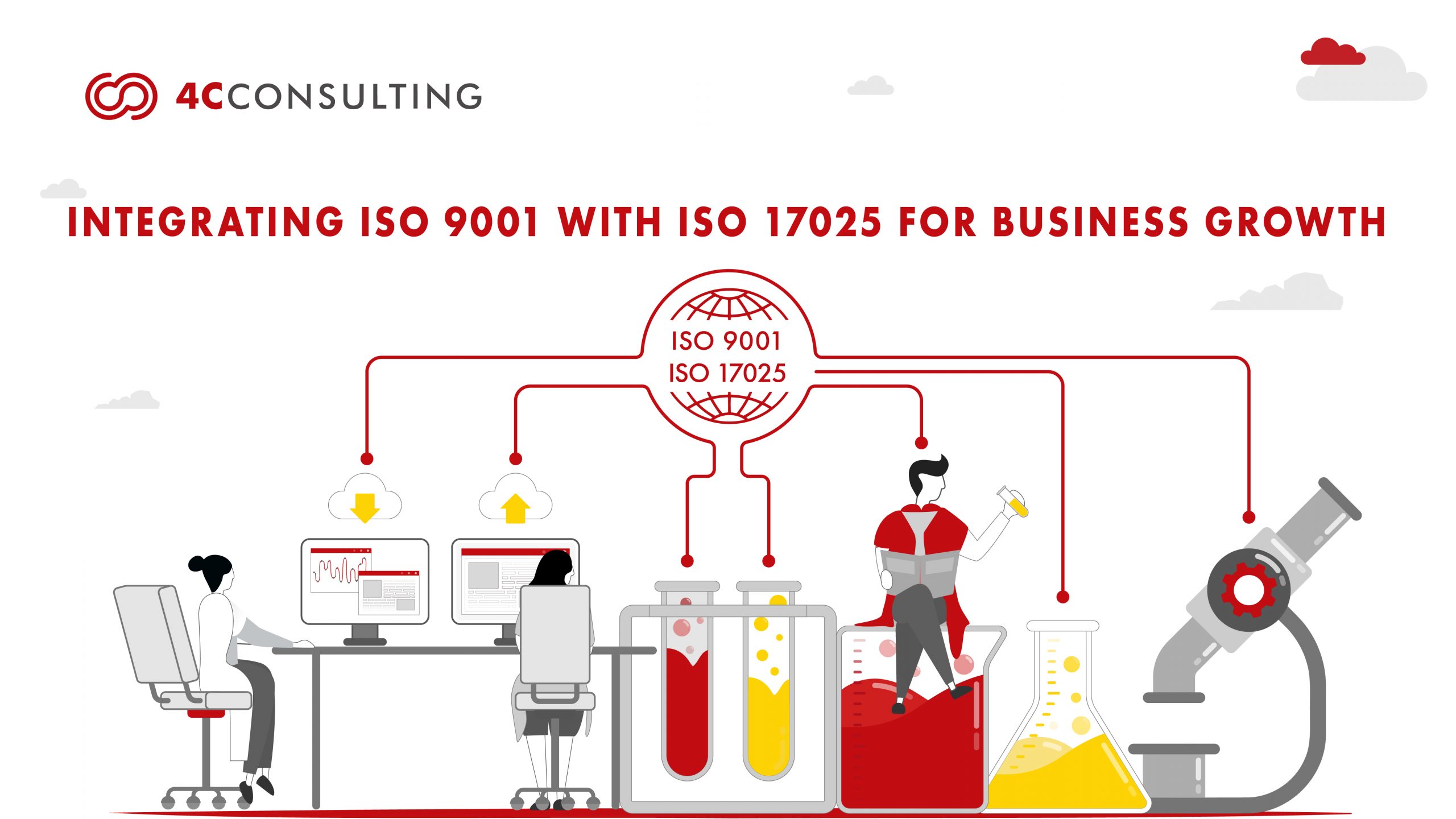
Integrating ISO 9001 with ISO/IEC 17025 enables laboratories to operate under a single, integrated Quality Management System (QMS) that aligns technical competence with organisational management. When implemented correctly, this integrated approach supports sustainable laboratory growth without compromising accreditation integrity, technical validity, or regulatory compliance.
What Is ISO/IEC 17025 and Its Role in Laboratory Accreditation?
ISO/IEC 17025:2017 is the internationally recognised standard for testing and calibration laboratories. It specifies requirements for technical competence, impartiality, confidentiality, and consistent operation to ensure laboratories generate accurate, reliable, and technically valid results.
The primary purpose of ISO/IEC 17025 accreditation is to demonstrate that a laboratory is competent to perform specific tests or calibrations within an approved scope. Accreditation bodies assess laboratories against this standard to confirm that results can be trusted by regulators, customers, and other stakeholders. Key elements governed by ISO/IEC 17025 include:
- Validation and verification of testing and calibration methods.
- Measurement traceability and evaluation of measurement uncertainty.
- Control of equipment, reference standards, and calibration integrity.
- Technical competence, training, and authorisation of personnel.
- Impartiality, confidentiality, and risk to objectivity.
- Assurance of valid results through quality control activities.
ISO/IEC 17025 also contains management system requirements; however, these requirements are intended to support technical operations and sustain accreditation. They do not extend to comprehensive organisational governance, enterprise risk management, customer satisfaction monitoring, or continual improvement across all laboratory functions.
As a result, laboratories relying solely on ISO/IEC 17025 often experience gaps when operations scale, when customer expectations evolve, or when laboratories expand across multiple locations or disciplines..
Struggling to scale your lab in ISO and NABL compliance?
What Is ISO 9001 in a Laboratory Context?
ISO 9001 is a globally adopted Quality Management System standard applicable to organisations across all sectors, including testing and calibration laboratories. Unlike ISO/IEC 17025, ISO 9001 focuses on how an organisation plans, controls, measures, and improves its processes to consistently meet customer and regulatory requirements.
In a laboratory context, ISO 9001 governs organisational processes that sit beyond technical testing activities, including:
- Leadership responsibility and accountability.
- Process interaction and workflow control.
- Customer requirement identification and review.
- Document and record control across functions.
- Risk-based thinking applied to all processes.
- Corrective action, performance evaluation, and continual improvement.
The purpose of ISO 9001 is to embed a process-driven, risk-based management framework that enhances consistency, efficiency, and customer satisfaction. For laboratories, this ensures that quality is not limited to test accuracy but extends to service delivery, turnaround time, communication, documentation integrity, and decision-making.
When applied correctly, ISO 9001 provides organisational discipline and management maturity that complements the technical rigour of ISO/IEC 17025.
| Difference Between ISO/IEC 17025 and ISO 9001 for Laboratories |
| Aspect |
ISO/IEC 17025 |
ISO 9001 |
| Primary Purpose |
Demonstrates technical competence and validity of results |
Governs overall quality management and organisational processes |
| Applicability |
Testing and calibration laboratories |
All organisations, including laboratories |
| Focus Area |
Methods, calibration, equipment, and technical accuracy |
Process control, planning, governance, and improvement |
| Certification Type |
Accreditation for specific test scopes |
Quality management system certification |
| Business Management |
Limited organisational governance |
Strong focus on operational consistency and growth |
| Risk Management |
Primarily technical and impartiality risks |
Risk-based thinking across all processes |
| Customer Focus |
Reliability of test results |
Fulfilment of customer and regulatory requirements |
This distinction highlights why ISO/IEC 17025 alone is insufficient to manage organisational complexity as laboratories grow.
Why Laboratories Need to Integrate ISO 17025 And Iso 9001 Certifications?
ISO/IEC 17025 ensures confidence in measurement outcomes but does not function as a complete laboratory management system. ISO 9001 complements ISO/IEC 17025 by providing structured controls for leadership, process management, customer engagement, and continual improvement.
When laboratories integrate ISO/IEC 17025 with ISO 9001, technical controls are supported by disciplined organisational governance. This integration enables laboratories to scale operations, manage risk consistently, and maintain accreditation stability. Integration is not about duplicating documentation. It is about aligning technical processes with organisational decision-making and management controls under a single QMS.
Common Challenges in Integrating ISO 9001 and ISO/IEC 17025
Despite clear structural compatibility, laboratories often struggle to integrate ISO 9001 and ISO/IEC 17025 effectively due to execution gaps rather than standard limitations. The most critical challenges are outlined below.
- Treating ISO 9001 as an Add-On to ISO/IEC 17025
Many laboratories view ISO 9001 as a supplementary requirement instead of a management backbone. This results in ISO 9001 being limited to documentation, without influencing leadership involvement, process governance, or organisational performance.
- Parallel Systems and Duplication of Controls
Separate procedures for document control, corrective actions, internal audits, and management review create redundancy. This leads to inconsistent implementation, increased audit workload, and confusion among laboratory personnel.
- Misalignment Between Technical and Process Owners
Technical teams focus on test validity and compliance, while management teams focus on delivery and customer requirements. Without alignment, process ownership becomes fragmented, weakening the effectiveness of the integrated system.
- Inadequate Integration of Risk-Based Thinking
Risk assessment is often limited to technical risks such as equipment failure or method deviation, while operational, compliance, and customer-related risks required by ISO 9001 are not systematically addressed.
- Resistance from Laboratory Personnel
ISO 9001 is frequently perceived as administrative overhead by technical staff. When its relevance to workload control, consistency, and error reduction is not communicated, implementation becomes procedural rather than practical.
- Weak Management Review Integration
Management reviews may focus only on accreditation status and test performance, ignoring ISO 9001 inputs such as customer feedback, process effectiveness, resource planning, and continual improvement opportunities.
- Lack of Leadership Ownership
Integration fails when responsibility is confined to the quality or technical manager. Effective integration requires active leadership engagement to align strategic objectives with laboratory operations.
How to Integrate ISO 9001 and ISO/IEC 17025 Effectively
- Establish a Single Integrated Quality Management Framework.
Define one overarching QMS where ISO 9001 governs organisation-wide processes (leadership, risk, objectives, improvement) and ISO/IEC 17025 governs laboratory-specific technical competence. This avoids parallel systems and conflicting controls.
- Align Process-Based Thinking with Laboratory Workflows.
Map laboratory activities sample receipt, testing, calibration, reporting into process flows consistent with ISO 9001’s process approach. Each lab process should have defined inputs, controls, risks, outputs, and performance indicators.
- Integrate Risk-Based Thinking Across Technical and Business Risks.
Use a common risk management methodology to address both operational risks (customer satisfaction, delivery timelines, resource planning) and technical risks (measurement uncertainty, method validity, equipment failure).
- Harmonise Documentation and Record Control.
Create a unified document control system covering procedures, work instructions, test methods, forms, and records. ISO 9001 controls structure and versioning, while ISO/IEC 17025 defines technical record requirements and retention.
- Integrate Internal Audits and Management Review
Plan integrated internal audits that cover ISO 9001 clauses and ISO/IEC 17025 requirements in a single audit programme. Management reviews should evaluate laboratory performance, customer feedback, risks, nonconformities, and improvement actions together.
- Build Competence Through Role-Based Training
Define competency requirements that address both management system awareness (ISO 9001) and technical competence (ISO/IEC 17025). Training effectiveness should be evaluated using both quality and technical performance outcomes.
Key Benefits of ISO/IEC 17025 and ISO 9001 Integration
- Process Control Across Laboratory Operations: ISO 9001 extends process control beyond testing and calibration. Activities such as sample receipt, scheduling, procurement, subcontracting, reporting, corrective action, and customer communication are defined, monitored, and measured. This ensures consistency, traceability, and repeatability across all laboratory functions.
- Unified Documentation and Record Control: An integrated QMS aligns ISO/IEC 17025 technical documentation with ISO 9001 document control requirements. Procedures, formats, reports, and records follow a common structure, approval workflow, and revision control system, reducing documentation-related nonconformities during audits.
- Structured Customer Requirement Management: ISO 9001 formalises the identification, review, and monitoring of customer requirements. When integrated, customer feedback and complaints are directly linked to technical investigations, root cause analysis, and corrective actions, strengthening confidence among clients and accreditation bodies.
- Defined Roles, Authority, and Accountability: Integration clarifies responsibilities across technical management, quality functions, and operational leadership. Authority levels and escalation mechanisms are documented, reducing dependency on individuals and improving continuity during personnel changes.
- Audit and Expansion Readiness: A single management system simplifies internal audits, management reviews, and external assessments. Laboratories are better prepared for NABL assessments, customer audits, regulatory inspections, scope extensions, and multi-site expansion without system disruption.
How We Help You Integrate ISO 9001 and ISO/IEC 17025?
At 4C Consulting, we support laboratories in integrating ISO 9001 and ISO/IEC 17025 to create a single, robust Quality Management System that aligns technical competence with organisational governance. With over 20+ years of consulting experience and 500+ extensive ISO implementation expertise, our team helps laboratories streamline processes without compromising accreditation requirements. We ensure ISO 9001 strengthens leadership involvement, process consistency, and risk-based thinking, while ISO/IEC 17025 continues to govern technical validity, impartiality, and measurement reliability. Our approach focuses on eliminating duplication, aligning documentation, and integrating audits and management reviews under one framework. From gap assessment and system design to NABL-aligned implementation and audit readiness, 4C delivers end-to-end integration support that enables laboratories to scale operations with confidence.

Frequently Asked Questions:
ISO 17025 vs ISO 9001 differs primarily in scope and purpose. ISO/IEC 17025 focuses on laboratory accreditation standards and technical competence for testing and calibration activities. ISO 9001 governs organization-wide quality management systems, addressing leadership, process control, risk-based thinking, and continual improvement across all functions.
To understand how to combine ISO 9001 and ISO 17025, laboratories must implement a single integrated quality management system. ISO 9001:2015 provides the organizational management framework, while ISO/IEC 17025:2017 governs technical and accreditation requirements. Integration avoids duplication and improves compliance management.
A laboratory quality management system is a structured framework that controls technical, operational, and managerial processes in laboratories. When aligned with ISO 9001 quality management system principles and ISO 17025 management requirements, it ensures technical validity, process consistency, and regulatory compliance.
Yes, both are internationally recognized ISO certification standards, but they serve different purposes. ISO 9001 is a certifiable standard for quality management systems, while ISO/IEC 17025 is an accreditation-based standard for laboratories. Together, they strengthen laboratory accreditation and organizational governance.
Apart from NABL-ISO/IEC 17025, laboratories working with medical devices or in-vitro diagnostics often implement ISO 13485. While ISO/IEC 17025 focuses on technical competence and laboratory accreditation, ISO 13485 governs quality management systems for medical device–related testing activities. Together, these standards help laboratories meet regulatory expectations, ensure compliance, and support sector-specific accreditation and certification requirements.
ISO 17025 management requirements include document control, corrective action, internal audit, management review, and risk-based thinking related to laboratory operations. These requirements support accreditation but are not designed to manage broader organizational processes, which is why ISO 9001 implementation is often required.
ISO 9001 implementation strengthens leadership involvement, the process approach, compliance management, and continual improvement across laboratory functions. When integrated with ISO 17025 implementation, it supports scalability, operational excellence, and consistent service delivery beyond technical testing activities.
Compliance management ensures that ISO standard requirements, regulatory obligations, and accreditation conditions are consistently met. An integrated QMS allows laboratories to manage ISO 9001 and ISO 17025 obligations under a single system, reducing audit risk and improving operational control.
Yes, integration improves market competitiveness by demonstrating both technical credibility and robust quality management systems. Laboratories gain competitive advantage through consistent service quality, global recognition, improved customer confidence, and readiness for audits and scope expansion.
Integrating ISO 9001:2015 with ISO/IEC 17025:2017 involves aligning organizational processes with laboratory technical controls. ISO 9001 governs leadership, a risk-based approach, and improvement, while ISO/IEC 17025 ensures technical validity and accreditation compliance within a unified management system.
Jigar Doshi is a Vice President at 4C Consulting with expertise in Operational Excellence, ISO 27001, NABL, SOC 2, IATF 16949, and AS 9100. He helps organizations strengthen operational performance, information security, quality systems, and industry-specific compliance frameworks. With expertise across diverse management standards, Jigar focuses on helping businesses establish robust systems that improve performance, compliance, and organizational excellence.