EcoVadis Evidence Explained: How ISO Documentation Strengthens Your Score?
13th Feb, 2026EcoVadis is now one of the most widely used sustainability assessment platforms globally, with more than 150,000 companies assessed across 180+ countries and 200+ industries. As sustainability expectations from customers, OEMs and procurement teams continue to rise, EcoVadis scorecards are increasingly used to evaluate supplier governance maturity and ESG risk exposure.
EcoVadis performance data consistently shows that average sustainability scores remain below the midpoint of the rating scale. This indicates that while many organizations have sustainability policies and management systems in place, they often struggle to present clear, structured and assessment-ready evidence that demonstrates how sustainability is governed, implemented and improved in practice.
A common area of confusion is the role of ISO standards within the EcoVadis assessment process. EcoVadis is not a certification scheme and ISO certificates alone do not influence scores. Instead, EcoVadis evaluates documented sustainability practices using a Policy, Action and Result methodology. When implemented effectively, ISO management systems generate exactly this type of evidence but only when the documentation is aligned with EcoVadis assessment expectations. This blog explains how EcoVadis evaluates evidence and how ISO documentation can be structured to strengthen sustainability scores.
What Is EcoVadis?
EcoVadis is a sustainability assessment platform used by organizations to evaluate the environmental, social, ethical, and supply-chain practices of their suppliers and business partners. Rather than functioning as a certification standard, EcoVadis provides a rating and scorecard that reflects how systematically sustainability risks are identified, managed and monitored within an organization.
The assessment focuses on 4 sustainability themes:
- Environment
- Labour & Human Rights
- Ethics
- Sustainable Procurement
Each EcoVadis assessment is based on factors such as company size, industry sector and geographic risk exposure. This risk-based approach ensures that sustainability expectations are proportionate and relevant, while still requiring organizations to demonstrate structured governance, operational controls and measurable outcomes across the assessed themes.
.
Unsure whether your ISO documentation aligns with EcoVadis requirements?
What Is the EcoVadis Sustainability Assessment?
The EcoVadis assessment evaluates how systematically sustainability is managed within an organization, rather than how extensively it is described in policy documents. The focus is on governance maturity, implementation discipline and performance monitoring across environmental, social, ethical and supply-chain practices.
To ensure consistency, EcoVadis structures its evaluation around 21 sustainability criteria, distributed across the four assessment themes. These criteria define the areas where organizations are expected to demonstrate formal controls, operational processes and measurable oversight, forming the foundation of the EcoVadis scoring methodology.
EcoVadis applies a risk-based and sector-specific approach, meaning that expectations differ for a manufacturing organization, an IT services provider or a logistics company. Evidence relevance and depth are evaluated within this framework.
How EcoVadis Scoring Actually Works
EcoVadis scoring Methodology follows a structured Policy–Action–Result (PAR) methodology.
- Policies demonstrate formal commitment and governance intent.
- Actions demonstrate implementation through processes, controls, and responsibilities.
- Results demonstrate performance monitoring, outcomes, and continuous improvement.
This approach ensures that sustainability management is assessed as an operational system rather than a documentation exercise. Documents that show actual implementation and performance carry significantly more weight than high-level policy statements.
What Are EcoVadis Evidence Requirements?
EcoVadis evidence requirements are centred on one core principle: sustainability practices must be demonstrable, not declarative. Under the EcoVadis scoring methodology, organizations are not evaluated on claims or intentions, but on documented evidence that shows how sustainability commitments are governed, implemented, and monitored in practice.
EcoVadis evidence is expected to demonstrate three fundamental aspects:
- Formal governance through approved policies and defined responsibilities.
- Implementation through procedures, controls, training, and operational records.
- Oversight and improvement through monitoring, reviews, corrective actions and performance data.
Importantly, EcoVadis does not assess documents in isolation. Evidence is reviewed in context to determine whether it reflects an active management system or a static documentation set. Documents that demonstrate consistent application, periodic review, and linkage to operational decision-making align more closely with EcoVadis scoring expectations.
This is also where a common misconception arises. Certificates, labels, or standalone declarations are not treated as sufficient evidence within the EcoVadis scoring methodology. Assessors look beyond formal recognition to evaluate the underlying documentation, records, and results that demonstrate how sustainability risks are managed over time.
How ISO Standards Acts as EcoVadis Evidence
ISO management system standards are designed to establish structured governance, defined control mechanisms, and continual improvement processes within organizations. While ISO certification itself does not influence EcoVadis scoring, the documentation generated through ISO implementation aligns closely with EcoVadis evidence requirements when it reflects actual governance and operational practice.
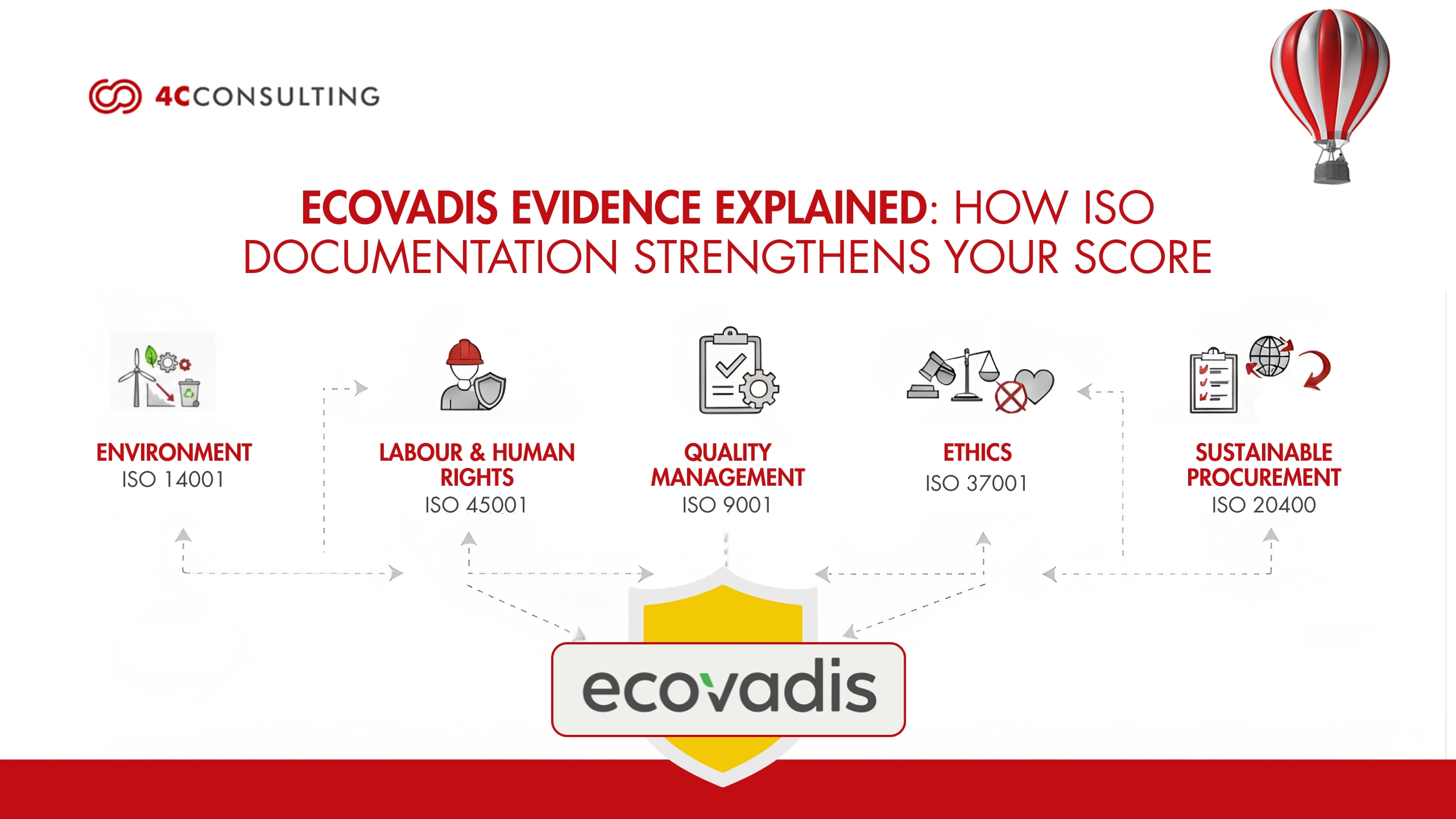
Only the standards that generate evidence related to sustainability governance, ethics, risk management and supply-chain practices contribute meaningfully. Common examples include:
- ISO 9001 for organizational governance and process control.
- ISO 14001 for environmental management.
- ISO 45001 for occupational health and safety.
- ISO 37001 for anti-bribery management.
- ISO 27001 for Information Security Management System
- ISO 20400 for sustainable procurement practices.
When implemented beyond certification maintenance, these management systems produce controlled, traceable documentation that EcoVadis assessors recognise as credible evidence of structured sustainability management.
Which ISO Documentation Supports EcoVadis Evidence
ISO documentation supports EcoVadis assessments by providing structured, verifiable supporting evidence across both sustainability themes and assessment stages. EcoVadis does not evaluate ISO standards or certificates themselves; it evaluates the policies, records, and performance data generated through ISO-based management systems.
ISO Documentation Across EcoVadis Evidence Stages
| EcoVadis Evidence Stage | What EcoVadis Evaluates | ISO-Generated Supporting Documentation |
| Policy | Formal commitment & governance intent | Approved policies under ISO 14001, ISO 45001, ISO 37001, ISO 20400 |
| Action | Implementation & operational control | Risk assessments · SOPs · Training records · Operational controls · Supplier management records |
| Result | Performance & improvement | KPIs · Trend analysis · Improvement objectives · Corrective action effectiveness |
When selected and presented correctly, this documentation structure directly supports EcoVadis scoring logic by demonstrating governance intent, operational implementation, and measurable outcomes.
ISO Documentation Mapped to EcoVadis Pillars
| EcoVadis Pillar | ISO Standard | Supporting Evidence |
| Environment | ISO 14001 | · Environmental policy
· Aspects & impacts register
· Legal compliance tracking
· Environmental performance data |
| Labour & Human Rights | ISO 45001 | · OH&S risk assessments
· Incident records
· Training logs
· Corrective actions |
| Ethics | ISO 37001 | · Anti-bribery policies
· Ethics training records
· ABMS risk assessments
· Supplier Due Diligence |
| Sustainable Procurement | ISO 20400 (Guidance) | · Sustainable Procurement Risk Register
· Supplier evaluation criteria
· ESG risk screening
· Supplier corrective action records |
This mapping demonstrates how ISO-based documentation supports EcoVadis sustainability themes and extends governance beyond internal operations into supplier and partner ecosystems.
Practical EcoVadis Documentation Guidance Using ISO Systems
- Prioritise Evidence of Implementation:
Select ISO documentation that demonstrates both commitment and implementation, as EcoVadis expects to see a clear connection between policy intent and operational evidence. For example, an ISO 14001 environmental policy establishes direction and accountability, but it should be supported by an aspects and impacts register, defined controls, assigned responsibilities, review frequency and monitoring records that show how the policy is applied in practice. Policies without supporting records indicate limited execution, while records without an approved policy framework suggest weak governance alignment. The strongest submissions therefore link policy commitments to procedures, operational controls and documented review mechanisms within the defined assessment scope, ensuring traceability, ownership and periodic evaluation.
- Align Documents to Specific Assessment Criteria:
Each document should be mapped to the EcoVadis criterion it supports. If the assessment addresses occupational safety controls, ISO 45001 hazard identification and risk assessment records provide direct support. Submitting documents that do not clearly relate to the assessed criterion reduces scoring effectiveness. Relevance is evaluated at question level, not at system level. Clear alignment reduces the risk of evidence being disregarded or misinterpreted.
- Demonstrate Ongoing Management:
EcoVadis evaluates whether sustainability controls are maintained over time. Submitting performance data across multiple periods, updated objectives, or closed corrective actions demonstrates continuity. One-time records or undated documents indicate limited management maturity. Evidence should show periodic review and follow-up. Where applicable, management review outputs or trend summaries help demonstrate sustained oversight.
- Provide Limited Context for Uploaded Evidence:
Uploaded documents should be accompanied by concise explanations identifying what the document demonstrates. For example, an ISO 37001 risk assessment may be referenced as evidence of identified bribery risks and defined mitigation controls. This supports accurate interpretation without influencing scoring. Context should remain factual and limited to explaining scope, applicability, and relevance to the assessment criterion.
- Limit Submissions to Material Documentation:
Excessive documentation can obscure key evidence. EcoVadis assessments benefit from a focused set of documents that directly support responses. For instance, a completed supplier ESG evaluation record is more effective than multiple generic procurement procedures. Materiality and clarity support consistent scoring. Redundant or marginally relevant documents increase review complexity without adding assessment value.
How ISO Documentation Strengthens EcoVadis Scores Over Time
- Supports Progressive Score Improvement:
When ISO documentation is consistently updated and aligned with EcoVadis criteria, organisations typically see gradual score improvement across assessment cycles. Updated KPIs, revised risk assessments, and closed corrective actions demonstrate increasing control maturity. Static documentation often results in repeated scores, which is a common mistake observed in EcoVadis reassessments.
- Improves Evidence Maturity Year on Year:
ISO systems require periodic reviews, internal audits, and management oversight. This naturally generates refreshed evidence for each EcoVadis cycle, such as updated objectives, revised procedures, or expanded scope coverage. Organisations that reuse outdated documents without showing evolution often underperform despite having formal systems in place.
- Reduces Repeated Assessment Gaps:
Many EcoVadis score stagnation issues arise from recurring gaps within the same criteria. Aligning ISO documentation reviews with EcoVadis feedback enables systematic gap closure. This helps avoid common mistakes such as resubmitting identical evidence without addressing prior assessor comments or scoring limitations.
- Prevents Parallel Compliance Efforts:
Managing ISO compliance and EcoVadis assessments separately often leads to duplication and inconsistency in documentation. Integrating EcoVadis requirements into existing ISO review and audit cycles improves consistency and reduces effort. Organisations that fail to integrate these processes frequently struggle with fragmented evidence and uneven scoring.
- Strengthens Internal Governance Discipline:
ISO documentation defines responsibilities, approval mechanisms, and review frequencies across functions. Using this documentation as the primary source for EcoVadis evidence reinforces accountability and ownership. Strong internal governance supports more predictable EcoVadis outcomes and reduces last-minute evidence collection.
- Improves Responsiveness to Assessor Feedback:
EcoVadis feedback highlights specific areas where evidence depth or maturity is insufficient. ISO management systems provide a structured mechanism to address these gaps through corrective actions and management reviews. Organisations that formally link assessor feedback to ISO improvement actions typically show stronger progression in subsequent assessments.
- Supports Scope Expansion Without Score Dilution:
As organisations grow, expand locations or onboard new suppliers, EcoVadis assessment scope often increases. ISO systems help manage this expansion through controlled documentation, standardised processes, and consistent monitoring. Without this structure, scope expansion can dilute evidence quality and negatively impact scores.
How 4C Consulting Supports EcoVadis & ISO Alignment
4C Consulting supports organisations in managing EcoVadis assessments through a structured, evidence-based approach focused on governance alignment, documentation clarity and performance improvement. With over 20+ years of consulting experience, 1000+ ISO implementations and 500+ Clients. 4C helps organisations align existing management systems with EcoVadis expectations across Environment, Labour & Human Rights, Ethics and Sustainable Procurement. Our work prioritizes evidence mapping, gap closure and supplier-related ESG controls, enabling organisations to remain audit-ready, improve assessment consistency and strengthen EcoVadis performance over time rather than treating the assessment as a one-off exercise.

Frequently Asked Questions:
The EcoVadis assessment process involves completing a tailored questionnaire based on company size, industry, and location, followed by the submission of supporting documentation. EcoVadis analysts then review evidence using a policy-action-result framework and issue a scorecard reflecting performance across four sustainability themes. Assessments are typically renewed annually.
EcoVadis is not a certification and not a CSR standard. It is a sustainability rating and assessment platform used by customers and procurement teams to evaluate supplier ESG performance. EcoVadis does not issue certificates of compliance.
ISO standards define management system requirements or guidance that organizations implement internally. EcoVadis evaluates how sustainability-related practices are governed, implemented, and monitored using documented evidence. ISO certification does not guarantee a high EcoVadis score, but ISO-generated documentation can support EcoVadis evidence requirements when aligned correctly.
EcoVadis does not score ISO certificates on their own. Assessors evaluate the underlying policies, records, controls, and performance data generated through ISO implementation. Certificates may support credibility, but scoring is based on evidence quality, relevance, and maturity.