
Table of Contents
- What is Lean?
- What is Six Sigma?
- What Does Lean Six Sigma Focus On?
- Lean vs Six Sigma vs Lean Six Sigma: A Comparative Overview
- Six Sigma Case Study: Motorola
- Lean Six Sigma Case Study: General Electric (GE)
- When Should You Choose Lean, Six Sigma or Lean Six Sigma?
- How 4C Consulting Helps You Achieve Operational Excellence
- FAQs
Lean vs Six Sigma vs Lean Six Sigma: What’s the Difference?
8th May, 2026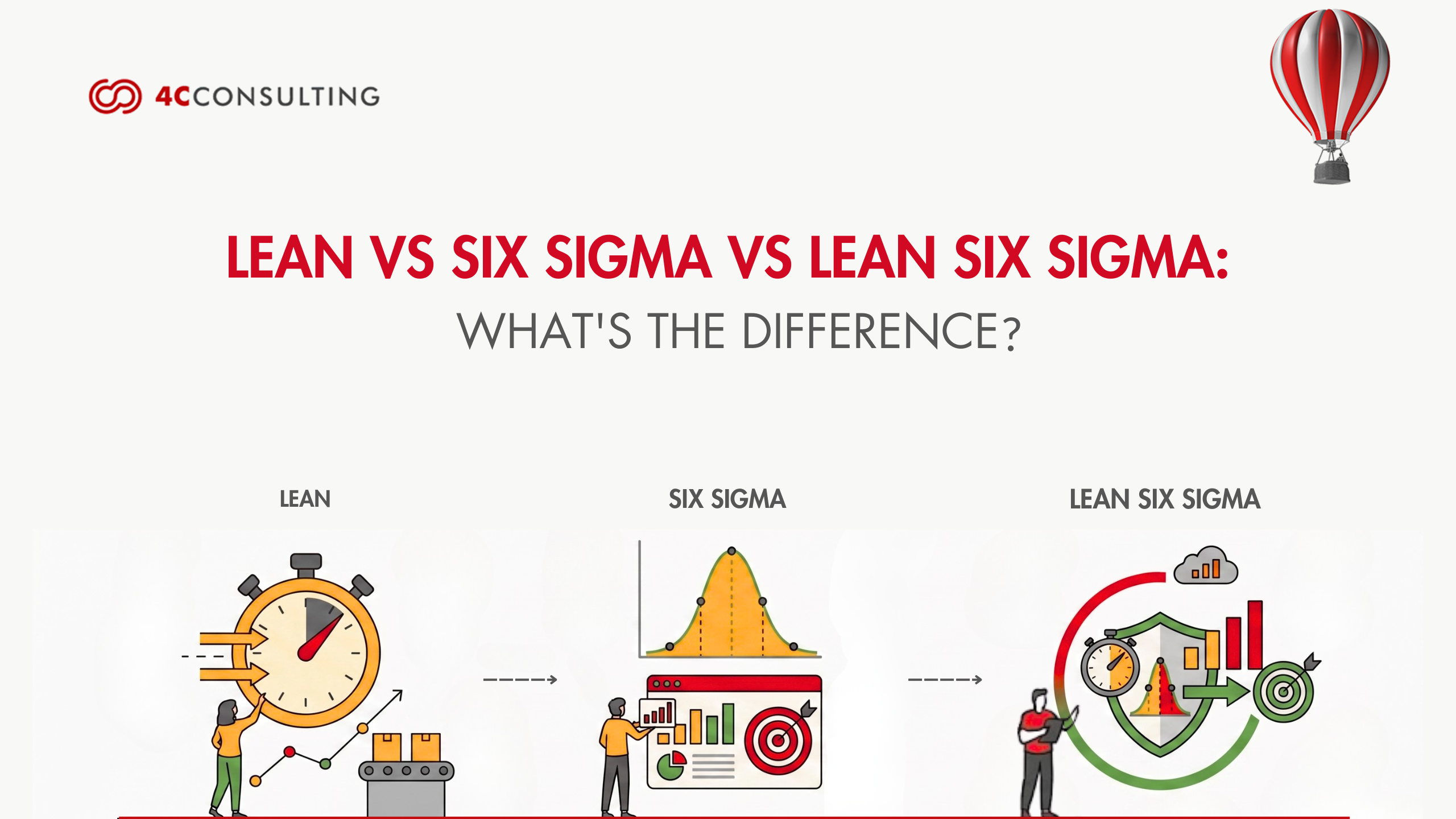
Businesses lose money every day not because of bad products but because of broken processes.
Delays, defects, rework and waste silently eat into your profits and frustrate your customers. Most teams are so busy firefighting that they never stop to fix the root cause.
That’s exactly what Lean, Six Sigma and Lean Six Sigma are built for.
These are proven methods used by thousands of businesses worldwide to fix how work gets done faster, cleaner and with fewer errors. But a common question always comes up:
“What’s the difference between these three and which one is right for us?”
This blog answers exactly that. Simply and clearly.
What is Lean?
Lean is a management approach focused on maximizing value by eliminating waste from processes. It aims to improve efficiency, streamline operations, and deliver better outcomes with fewer resources.
Originally born on Toyota’s factory floors, Lean has since spread across every industry from healthcare and banking to IT and logistics. The core idea stays the same everywhere: if a step in your process doesn’t directly add value for the customer, it’s waste. And waste costs you time, money and trust.
What kind of waste does Lean target?
Think about your daily operations. How much time is spent waiting for approvals? How often is work redone because of errors? How much inventory sits unused? Lean puts a name to all of it:
- Overproduction
- Waiting time
- Excess inventory
- Unnecessary transportation
- Unnecessary movement
- Defects and rework
These aren’t small inefficiencies; they silently drain your resources every day.
How does Lean fix this?
Lean works through five straightforward principles:
- Understand what your customer actually values
- Map your process and spot where value stops flowing
- Remove the blockages so work moves smoothly
- Produce only what’s needed, when it’s needed
- Keep improving always (this is called Kaizen)
Benefits of Lean
- Faster turnaround times
- Reduced operating costs
- Better utilization of team time and energy
- Improved process consistency
- Reduced operational chaos
- Ability to achieve more with fewer resources without overburdening teams
Common Lean Tools & Techniques
To effectively implement Lean principles, organizations use a set of tools and techniques to identify and eliminate waste.
- Value Stream Mapping (VSM)
- 5S Methodology
- Kaizen (Continuous Improvement)
- Kanban
- Just-in-Time (JIT)
What is Six Sigma?
Six Sigma is a data-driven methodology focused on reducing defects and minimizing process variation.
Unlike Lean, which emphasizes speed and efficiency, Six Sigma is centred on improving accuracy and consistency through statistical analysis.
What Does Six Sigma Focus On?
Six Sigma focuses on improving quality by:
- Identifying defects in processes
- Analysing root causes using data
- Reducing variation to ensure consistent outcomes
How Does Six Sigma Work?
Six Sigma follows the structured DMAIC approach:
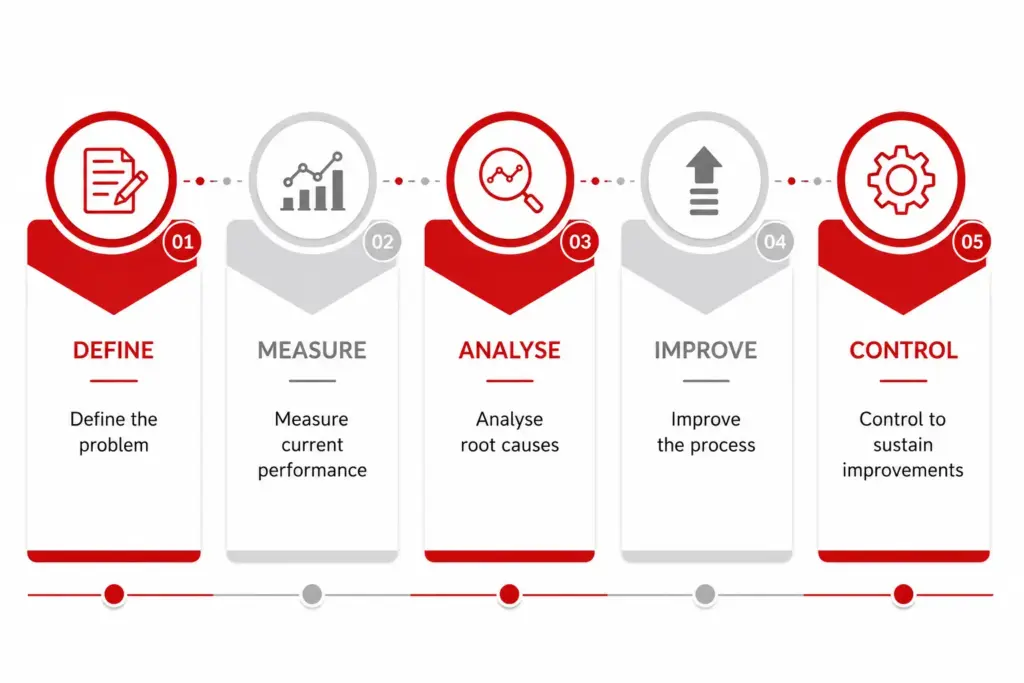
- Define the problem
- Measure current performance
- Analyse root causes
- Improve the process
- Control to sustain improvements
Benefits of Six Sigma
- Improved product and service quality
- Reduction in defects and errors
- Data-driven decision-making
- Strong process control and consistency
Six Sigma ensures that processes deliver reliable and accurate results every time.
Common Six Sigma Tools & Techniques:
- DMAIC Framework
- Root Cause Analysis (Fishbone Diagram)
- Pareto Analysis
- Control Charts
- Statistical Process Control (SPC)
What is Lean Six Sigma?
Lean Six Sigma is an integrated methodology that combines Lean’s efficiency with Six Sigma’s focus on quality. It brings together the strengths of both approaches to deliver faster and more reliable processes.
It focuses on:
- Eliminating waste (Lean)
- Reducing variation and defects (Six Sigma)
What Does Lean Six Sigma Focus On?
Lean Six Sigma focuses on:
- Eliminating waste from processes
- Reducing variation and defects
- Improving overall process performance
How Does Lean Six Sigma Work?
It combines:
- Lean tools for improving flow and eliminating inefficiencies
- Six Sigma’s DMAIC framework for structured problem-solving and quality improvement
This integrated approach ensures both speed and precision.
Benefits of Lean Six Sigma
- End-to-end process optimization
- Improved customer satisfaction
- Faster processes with higher quality
- Sustainable and scalable improvements
Lean Six Sigma enables organizations to achieve operational excellence by balancing efficiency and quality.
Common Lean Six Sigma Tools & Techniques:
- Combination of Lean + Six Sigma tools
- VSM + DMAIC
- 5S + Root Cause Analysis
- Process Mapping & Data Analysis
Continuous Improvement Frameworks
Lean vs Six Sigma vs Lean Six Sigma: A Comparative Overview
Understanding the difference between Lean and Six Sigma becomes clearer when we compare them side by side.
| Aspect | Lean | Six Sigma | Lean Six Sigma |
|---|---|---|---|
| Primary Focus | Eliminates non-value-added activities (waste) to streamline processes | Reduces process variation and defects using data | Combines waste elimination and defect reduction for overall optimization |
| Objective | Improve process flow, reduce delays and increase efficiency | Improve quality by minimizing errors and inconsistencies | Achieve both efficiency and high-quality output |
| Approach | Flow-based and process-oriented, focusing on continuous movement | Data-driven approach using statistical analysis | Integrated approach combining process improvement with data insights |
| Methodology | Continuous improvement through Kaizen and value stream optimization | Structured DMAIC (Define, Measure, Analyze, Improve, Control) framework | Uses Lean tools along with DMAIC for comprehensive improvement |
| Tools Used | 5S, Kaizen, Kanban, Value Stream Mapping | DMAIC, Statistical Process Control, Root Cause Analysis | Combination of Lean and Six Sigma tools |
| Implementation Complexity | Relatively simple and quick to implement across teams | More complex due to statistical analysis and structured phases | Moderate complexity with balanced implementation effort |
| Speed of Results | Faster results by removing inefficiencies quickly | Slower due to in-depth data collection and analysis | Moderate speed with sustainable long-term improvements |
| Best Use Case | Ideal for reducing process delays and improving workflow efficiency | Best suited for solving quality issues and reducing defects | Suitable for end-to-end process transformation and optimization |
| Measurement Metrics | Focuses on cycle time, lead time and throughput | Focuses on defect rates, variation and sigma levels | Uses combined KPIs covering both efficiency and quality |
| Business Impact | Enhances productivity and reduces operational costs | Improves product/service quality and consistency | Drives operational excellence with measurable performance improvement |
Real-World Case Study Examples
Understanding Lean, Six Sigma and Lean Six Sigma becomes easier when we see how global companies use them in practice.
Lean Case Study: Toyota
Toyota used Lean manufacturing to eliminate waste from its production system.
By implementing Just-in-Time (JIT) production and Kaizen, Toyota was able to:
- Reduce excess inventory
- Improve production flow
- Minimize delays
- Increase operational efficiency
This system later became globally known as the Toyota Production System (TPS).
Six Sigma Case Study: Motorola
Motorola introduced Six Sigma to reduce defects and improve product quality.
Using the DMAIC methodology, Motorola identified process variations and improved consistency across operations. The result was:
- Reduced defects and errors
- Improved product reliability
- Better customer satisfaction
- Significant cost savings
Motorola’s success with Six Sigma later inspired organizations worldwide to adopt data-driven quality improvement practices.
Lean Six Sigma Case Study: General Electric (GE)
General Electric adopted Lean Six Sigma to improve both efficiency and quality across its business operations.
By combining Lean waste reduction with Six Sigma’s data-driven approach, GE achieved:
- Faster and more efficient processes
- Improved product and service quality
- Reduced operational costs
- Higher customer satisfaction
GE’s success played a major role in making Lean Six Sigma popular worldwide.
When Should You Choose Lean, Six Sigma or Lean Six Sigma?
Choosing the right process improvement methodology is not about which one is “better” it’s about which one aligns best with your current business challenges.
Each approach solves a different type of problem. Understanding where your organization stands today is the first step toward making the right decision.
1. When to Choose Lean
Lean is the right choice when your processes are slowing you down.
If your operations involve delays, unnecessary steps or underutilized resources, Lean helps streamline workflows and eliminate inefficiencies. For example, if your team spends excessive time waiting for approvals, handling redundant tasks or managing unused inventory, these are clear indicators of process waste.
In such cases, Lean focuses on simplifying processes, improving flow and ensuring that every step adds value. The result is faster turnaround times, improved productivity and better use of available resources.
2. When to Choose Six Sigma
Six Sigma becomes essential when quality issues start affecting your business performance.
If you are dealing with frequent errors, inconsistent outputs or customer complaints, the problem is not speed it is accuracy. Six Sigma helps identify the root causes of these issues using data and structured analysis.
For instance, in manufacturing, recurring defects in products or in service industries, inconsistent service delivery, are strong indicators that variation needs to be controlled. Six Sigma provides a disciplined approach to reduce these inconsistencies and ensure processes deliver reliable outcomes.
3. When to Choose Lean Six Sigma
In most real-world scenarios, businesses face both efficiency and quality challenges at the same time. This is where Lean Six Sigma becomes the most effective approach.
If your processes are complex, involve multiple teams or directly impact compliance and customer satisfaction, you need a solution that improves both speed and accuracy together. Lean Six Sigma addresses this by combining waste reduction with defect prevention.
It is particularly useful for organizations aiming for long-term operational excellence, where improvements need to be sustainable, measurable and aligned with business goals.
4. Real-World Application Across Industries
Different industries apply these methodologies based on their priorities.
In manufacturing, a combination of Lean and Six Sigma is often used to achieve high-speed production while maintaining defect-free output. Service-based industries, such as banking or IT, typically benefit from Lean by improving turnaround times and enhancing customer experience.
In compliance-driven sectors where standards like ISO certifications play a critical role Lean Six Sigma is highly effective. It ensures processes are not only efficient but also controlled, consistent and audit-ready.
How 4C Consulting Helps You Achieve Operational Excellence
4C Consulting helps organizations achieve operational excellence through structured, result-driven implementation of Lean, Six Sigma and Lean Six Sigma methodologies while clearly addressing the difference between Lean and Six Sigma to ensure the right approach for your business.
As trusted process improvement experts, we deliver Lean Six Sigma consulting services tailored to your specific operational needs. Our focus is on end-to-end process optimization, helping you improve efficiency, reduce defects and achieve measurable performance improvement. We also ensure seamless integration with ISO standards such as ISO 9001, ISO 14001 and ISO 45001 to strengthen both compliance and process effectiveness. Through our operational excellence consulting, we emphasize practical execution over documentation. This enables faster audit readiness, stronger process control and sustainable long-term results.
Struggling with inefficiencies or quality issues? Get a structured process improvement roadmap tailored to your business connect with our experts today.
FAQs
1. What is the main difference between Lean and Six Sigma?
Lean focuses on eliminating waste and improving process speed, while Six Sigma focuses on reducing defects and improving quality through data analysis.
2. Is Lean Six Sigma better than Lean or Six Sigma alone?
Lean Six Sigma is often more effective because it combines efficiency and quality improvement, making it suitable for complex business processes.
3. Which industries use Lean Six Sigma?
Lean Six Sigma is widely used in manufacturing, healthcare, IT services, logistics and compliance-driven industries.
4. Can Lean and Six Sigma be implemented together?
Yes, combining Lean and Six Sigma creates a powerful approach that improves both efficiency and accuracy.
5. Do I need certification to implement Lean Six Sigma?
Certification is not mandatory but proper training and expert guidance significantly improve implementation success and results.

Devanshi Viramgami
Vice PresidentDevanshi is a Vice President at 4C Consulting with expertise in 5S, Lean, and Six Sigma. She helps organizations improve workplace organization, streamline processes, reduce operational waste, and build a culture of continual improvement. Her expertise in Lean methodologies and process improvement supports businesses in enhancing efficiency, strengthening operational discipline, and achieving sustainable performance improvements.