
Table of Contents
- Why BRCGS Certification is Essential for Audit Success
- Facing similar BRCGS audit challenges?
- Understanding Non-Conformities in a BRCGS Audit
- Common BRCGS Audit Non-Conformities Explained
- Proven Methods to Close BRCGS Audit Non-Conformities Faster
- Achieve BRCGS Compliance Faster with 4C Consulting Expertise
- FAQs:
Top 12 BRCGS Audit Non-Conformities and How to Close Them Fast
1st May, 2026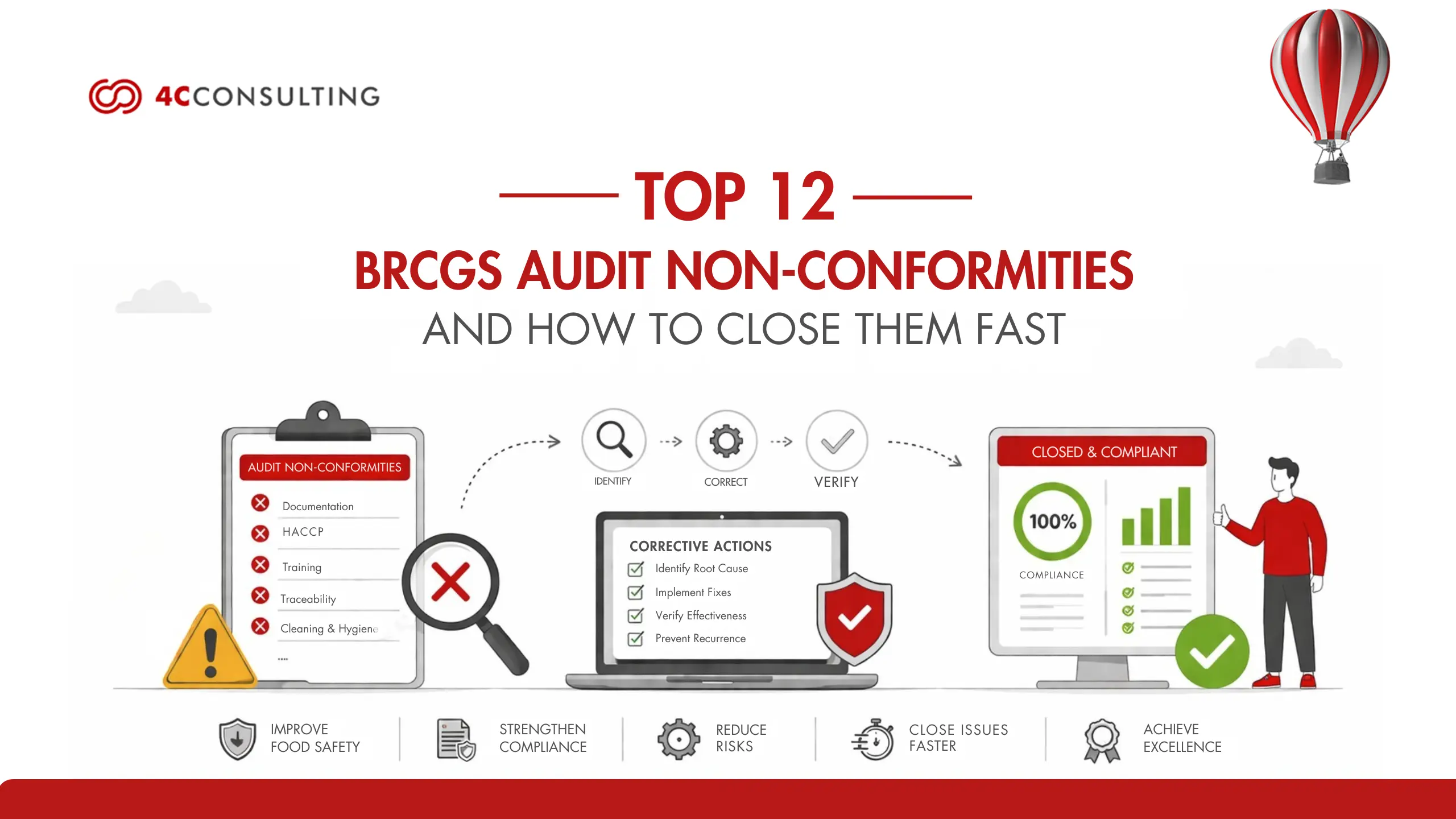
Preparing for a BRCGS audit can feel like ticking off a long checklist, but passing it requires much more than that.
Many organizations enter the audit confident, only to face unexpected non-conformities. Why? Because BRCGS certification is not just about having systems, it’s about proving they work consistently.
Consider this:
- Most non-conformities are linked to gaps in monitoring, records, or verification
- Even small issues can escalate into major findings if repeated
- Weak BRCGS food safety practices can impact both compliance and customer trust
The difference between passing smoothly and struggling through corrective actions often comes down to how well your system is implemented, not just documented.
In this blog, we’ll uncover the top 12 BRCGS audit non-conformities and show you exactly how to fix them quickly so you can achieve food safety certification without unnecessary delays.
Why BRCGS Certification is Essential for Audit Success
Achieving BRCGS certification is more than just passing an audit it reflects your organization’s commitment to BRCGS food safety standards and operational excellence.
Here’s why it matters:
- Global Recognition: Accepted by retailers and buyers worldwide
- Improved Food Safety: Structured approach to risk management
- Regulatory Compliance: Aligns with international food safety requirements
- Enhanced Brand Credibility: Builds trust with stakeholders and customers
However, certification success depends heavily on how well your systems align with the BRCGS audit checklist. Even minor gaps can lead to non-conformities that delay certification.
Facing similar BRCGS audit challenges?
Understanding Non-Conformities in a BRCGS Audit
Non-conformities are deviations from the requirements defined in the BRCGS standard. During a BRCGS audit, auditors assess your processes, documentation, and implementation against a structured framework.
Types of non-conformities:
1. Critical: A critical non-conformity indicates a serious failure in the BRCGS food safety system. It directly impacts product safety, legality, or consumer health. Such issues can lead to immediate audit failure and must be addressed urgently before certification can be granted.
2. Major: A major non-conformity highlights a significant gap in system implementation or control. While it may not pose an immediate safety risk, it can affect the effectiveness of your BRCGS compliance if not corrected. Certification is usually delayed until proper corrective actions are implemented.
3. Minor: A minor non-conformity is a small or isolated lapse in compliance, often related to documentation or minor process deviations. It does not directly impact food safety but indicates areas for improvement. If ignored, these issues can escalate in future BRCGS audits.
Why Do Non-Conformities Occur?
- Incomplete understanding of BRCGS compliance requirements
- Poor implementation despite documented procedures
- Lack of internal audits aligned with the BRCGS audit checklist
- Reactive approach instead of proactive system management
Common BRCGS Audit Non-Conformities Explained
1. Inadequate HACCP Plan Implementation
A poorly implemented HACCP plan is one of the most critical gaps identified during a BRCGS audit. Many organizations prepare HACCP documentation, but it does not reflect actual production practices, leading to ineffective hazard control and audit findings.
Common gaps:
- Missing hazard analysis: Potential biological, chemical, or physical hazards are not fully identified or documented.
- Incorrect identification of Critical Control Points (CCPs): CCPs are wrongly defined or not properly monitored, reducing control over key risks.
How to close it fast:
- Conduct a thorough hazard analysis
- Validate control measures
- Regularly review and update HACCP documentation
2. Poor Documentation and Record Control
Documentation is essential for demonstrating BRCGS compliance, as it provides evidence of consistent implementation. However, many businesses struggle with maintaining accurate and controlled records.
Common gaps:
- Uncontrolled documents: Multiple versions of procedures exist without proper approval, leading to confusion.
- Missing records during audit: Critical records are incomplete, misplaced, or not available when required.
How to close it fast:
- Implement a document control system
- Ensure version control and approvals
- Maintain easily accessible records
3. Lack of Senior Management Commitment
Strong leadership involvement is a key requirement in BRCGS certification. When top management is not actively engaged, it weakens the overall food safety culture and system effectiveness.
Common gaps:
- No evidence of management review: Meetings are either not conducted or not documented properly.
- Lack of food safety objectives: Clear, measurable goals are not defined or communicated.
How to close it fast:
- Conduct regular management review meetings
- Document decisions and action plans
4. Incomplete Internal Audits
Internal audits are a critical tool for identifying gaps before the actual BRCGS audit. However, many organizations treat them as a routine task rather than a strategic process.
Common gaps:
- Limited audit scope: Not all departments or processes are covered during internal audits.
- No follow-up on findings: Identified issues are not tracked or closed effectively.
How to close it fast:
- Align audits with the BRCGS audit checklist
- Ensure complete process coverage
- Track and close all audit findings
5. Weak Corrective and Preventive Action (CAPA)
An ineffective CAPA system often leads to repeated non-conformities because organizations focus on quick fixes rather than identifying and eliminating root causes. Without proper root cause analysis, documentation, and effectiveness checks, the same issues continue to resurface during audits, indicating weak system control and poor continuous improvement practices.
Common gaps:
- Superficial corrective actions: Issues are temporarily resolved without identifying the actual cause.
- Repeated non-conformities: The same problems occur again due to lack of preventive action.
How to close it fast:
- Use root cause analysis tools (5 Why, Fishbone)
- Implement preventive measures
6. Poor Cleaning and Sanitation Practices
Cleaning and sanitation are directly linked to BRCGS food safety performance, and any inconsistency in execution or monitoring can increase contamination risks. When cleaning procedures are not properly validated or verified, it creates gaps between documented processes and actual practices, which auditors quickly identify as a serious compliance concern.
Common gaps:
- Incomplete cleaning records: Cleaning activities are not properly documented or verified.
- Ineffective sanitation procedures: Cleaning methods are not validated for effectiveness.
How to close it fast:
- Define cleaning schedules
- Validate cleaning effectiveness
- Maintain proper logs
7. Pest Control Management Failures
An ineffective pest control system can result in significant food safety risks and major audit findings, especially when monitoring records, trend analysis, or preventive actions are missing. Simply having a pest control program is not enough; organisations must demonstrate active control, regular review, and timely corrective actions.
Common gaps:
- Missing monitoring records: Pest activity is not consistently tracked or documented.
- Ineffective pest control measures: Preventive actions are not properly implemented or reviewed.
How to close it fast:
- Implement a documented pest control program
- Conduct regular inspections
8. Training and Competency Gaps
Employees are critical to maintaining BRCGS compliance, but without proper training and competency evaluation, even well-designed systems fail during execution. Lack of awareness, inconsistent training programs, and absence of skill assessment often led to operational errors that directly impact audit outcomes.
Common gaps:
- Lack of awareness: Employees are not fully aware of procedures or food safety requirements.
- No training records: Training activities are not documented as evidence.
How to close it fast:
- Conduct regular training sessions
- Maintain competency and training records
9. Supplier Approval and Monitoring Issues
Supplier management is essential for achieving food safety Certification, yet weak approval processes or a lack of ongoing monitoring can introduce risks into the supply chain. Organizations must ensure suppliers are evaluated, approved, and periodically reviewed to maintain compliance and product integrity.
Common gaps:
- No supplier evaluation process: Suppliers are approved without proper risk assessment.
- Lack of monitoring: Supplier performance is not regularly reviewed.
How to close it fast:
- Develop a supplier approval system
- Conduct periodic evaluations
10. Traceability and Recall System Weakness
Traceability is a key requirement in BRCGS audits, ensuring organizations can quickly track and recall products when needed. Weak systems, incomplete records, or a lack of testing through mock recalls can delay response times and increase the impact of food safety incidents.
Common gaps:
- Delayed traceability: Difficulty in tracking products within a defined time.
- Ineffective recall procedures: Recall processes are not tested or clearly defined.
How to close it fast:
- Conduct mock recall exercises
- Maintain accurate traceability records
11. Allergen Management Failures
Allergen control is a critical responsibility in food safety, and failures can lead to severe health risks and reputational damage. Inadequate segregation, improper labelling, or lack of employee awareness are common gaps that auditors identify, making allergen management a high-risk area in audits.
Common gaps:
- Cross-contamination: Lack of proper segregation between allergen and non-allergen products.
- Incorrect labelling: Labels do not accurately reflect allergen content.
How to close it fast:
- Implement allergen control programs
- Ensure proper segregation and labelling
12. Facility and Maintenance Issues
Facility conditions directly impact hygiene and compliance, and poor infrastructure or delayed maintenance can create contamination risks. Issues such as damaged surfaces, equipment failures, or inadequate upkeep often result in non-conformities, highlighting the need for a proactive maintenance approach.
Common gaps:
- Poor maintenance: Equipment or infrastructure is not maintained regularly.
- Damaged structures: Cracks, leaks, or structural issues create hygiene risks.
How to close it fast:
- Implement preventive maintenance plans
- Conduct regular inspections
Proven Methods to Close BRCGS Audit Non-Conformities Faster
Closing non-conformities in a BRCGS audit requires a structured and disciplined approach, not just quick fixes. Auditors expect organizations to demonstrate control, consistency, and continuous improvement. This means focusing on identifying the true root cause of issues and implementing corrective actions that prevent recurrence, rather than simply addressing surface-level symptoms.
Best practices to follow:
- Prioritize critical and major non-conformities first: Not all non-conformities carry the same impact. Critical and major findings directly affect your BRCGS certification status and must be addressed immediately to avoid audit delays or certification risks.
- Conduct root cause analysis instead of temporary fixes: Quick fixes may close the issue temporarily, but without identifying the underlying cause, the same non-conformity is likely to repeat. Using structured methods like root cause analysis helps build a more reliable and compliant system.
- Align actions with BRCGS food safety requirements: Corrective actions should not be generic; they must align with specific BRCGS requirements and audit expectations. This ensures that your actions are both relevant and acceptable during verification.
- Maintain proper documentation as evidence: In a BRCGS audit, if it’s not documented, it’s considered not done. Clear, accurate, and timely documentation of corrective actions is essential to demonstrate compliance and support audit closure.
- Verify effectiveness before closure: Simply implementing a solution is not enough. Organizations must validate that the corrective action is working effectively in real operations and has eliminated the root cause.
Organizations that adopt a proactive and structured approach to BRCGS compliance not only close non-conformities faster but also strengthen their overall food safety management system, making future audits smoother and more predictable.
Achieve BRCGS Compliance Faster with 4C Consulting Expertise
Facing repeated non-conformities or delayed certification?
At 4C Consulting, we bring 20+ years of practical audit and implementation experience, helping organizations move from documentation-heavy systems to fully audit-ready operations.
We don’t just prepare you for audits, we help you build systems that actually work.
- Gap assessment aligned with audit expectations
- Practical implementation support
- Root-cause-driven CAPA closure
- End-to-end audit readiness
Get a structured BRCGS audit readiness plan. Connect with our experts today.
FAQs:
1. How long does it take to close BRCGS audit non-conformities?
The timeline depends on the severity of the non-conformity. Minor issues can be resolved within a few days, while major non-conformities may take several weeks, especially if system changes or process improvements are required.
2. What happens if non-conformities are not closed in a BRCGS audit?
If non-conformities are not closed within the specified timeframe, it can lead to delay or failure in BRCGS certification, additional audit costs, and potential loss of business opportunities.
3. What is the difference between major and minor non-conformities in BRCGS?
Major non-conformities indicate significant system failures that can impact BRCGS compliance, while minor ones are small, isolated issues that do not immediately affect food safety.
4. Can small businesses get BRCGS certification?
Yes, small and medium-sized businesses can achieve food safety certification by implementing the required systems and processes, often with expert guidance.
5. How can I prepare for a BRCGS audit effectively?
Preparation should include conducting internal audits based on the BRCGS audit checklist, reviewing HACCP plans, ensuring proper documentation, and training employees on food safety practices.

Sachin Mohan
General ManagerSachin Mohan is a General Manager at 4C Consulting with expertise in Food Standards, ISO 9001, ISO 14001, ISO 45001, SEDEX, and SA 8000. He supports organizations in strengthening management systems, improving compliance, and aligning business processes with recognized quality, environmental, health & safety, and social responsibility standards. His expertise helps businesses build structured systems that support responsible operations and continual improvement.