
Table of Contents
- What is ISO 27001?
- Understanding ISO 27001 Framework
- Why ISO 27001 Drives Strategic Growth for Startups
- Want to build trust with enterprise clients and scale your business faster?
- Step-by-Step ISO 27001 Implementation for Startups
- Common Challenges Startups Face in ISO 27001 Implementation
- How 4C Consulting Can Help Your Startup Achieve ISO 27001 Certification
- FAQ's:
ISO 27001 for Startup Companies: A Practical Guide to Winning Enterprise Clients
6th Apr, 2026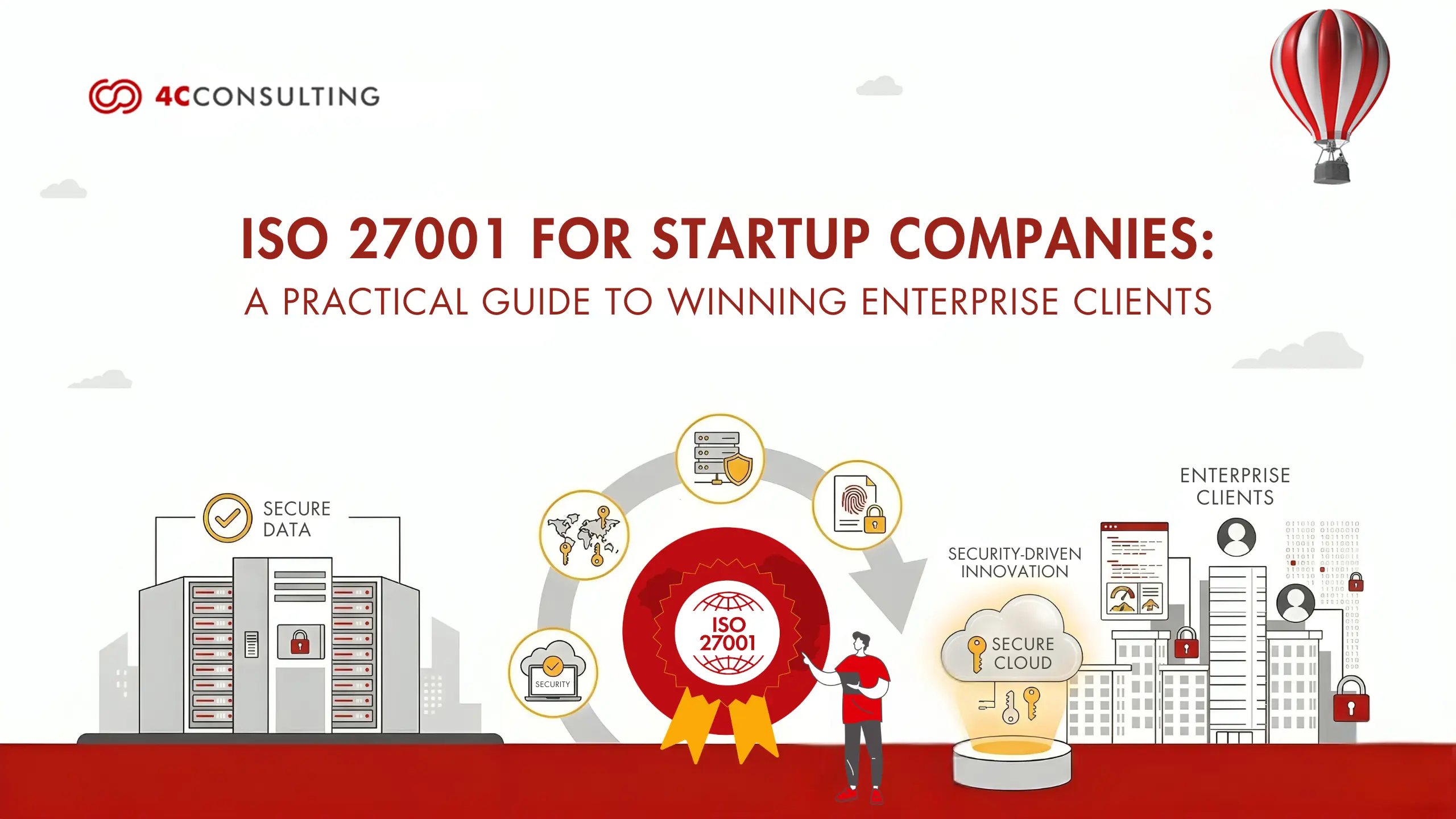
Startups need to take information security very seriously, especially in today’s environment where cyber breaches are becoming increasingly common. The average cost of a data breach has reached around $4.44 million globally, while cybercrime is expected to cost businesses $10.5 trillion annually. Additionally, 88% of breaches are linked to human error and small and mid-sized businesses are frequent targets of ransomware attacks. For startups aiming to secure enterprise clients, these risks can directly affect trust, deal closures and long-term growth.
ISO 27001 helps startups address these challenges by introducing a structured information security management system. It enables businesses to move from unorganized security practices to a more controlled and risk-based approach. This not only improves data protection but also strengthens credibility among clients and stakeholders, making ISO 27001 for startups a key enabler of business growth.
This blog explains how ISO 27001 certification can strengthen security, build trust and help startups secure enterprise clients. It also highlights the framework, its strategic importance, key implementation steps, common challenges and how expert guidance can simplify the process.
What is ISO 27001?
ISO 27001 is an internationally recognized standard for managing and protecting sensitive business information. It provides a structured approach to information security by helping organizations identify risks, apply suitable controls and safeguard data from threats such as breaches, cyberattacks and unauthorized access. The standard is applicable to businesses of all sizes and industries, making it especially valuable for startups that handle customer, financial or operational data.
ISO 27001 promotes the use of Information Security Management System (ISMS). ISO 27001 ensures that information is kept confidential and that it is precise and accessible when it is needed. it allows consumer’s, partners and stakeholders to trust organizations that comply with global security standards.
Understanding ISO 27001 Framework
The ISO 27001 framework helps businesses manage data security in an integrated way through an Information Security Management System (ISMS). A business can comply with the framework’s guidelines to determine and mitigate hazards to their data, and strengthen their controls to protect data and adjust the process to improve data security. This framework integrates ISMS with business operations, replacing unstructured and inconsistent security practices.
A key strength of the framework is its flexibility, allowing organizations to adapt it based on their business model, type of data and level of risk. It includes essential operational areas such as:
- Risk assessment and risk treatment processes
- Information Security policies and procedures
- Access control mechanisms
- Incident management protocols
- Business continuity planning
- Internal audits and continuous monitoring
Continuous improvement is a principle of the framework. It is expected that an organization reviews and revises its practices to mitigate and control newly identified risks and to enhance works of the ISMS to support the organization’s growth and development. For startups, it offers a scalable way to build strong security systems while maintaining efficiency and trust.
Why ISO 27001 Drives Strategic Growth for Startups
In the initial phases of development, startups put a significant amount of effort into constructing their products and acquiring initial customer engagement. However, once they begin working with larger clients, the focus shifts toward developing reliability and the management of project risks. ISO 27001 assists with this transition by implementing practice sets that are indicative of advanced business development, allowing startups to transition away from casual procedures and work in a manner that enterprise customers demand, all the while maintaining their ability to innovate. This is where ISO 27001 for startups becomes especially valuable in supporting this shift.
One of the most significant benefits from ISO 27001 implementation is the positive effect it has on business potential. During vendor reviews, large MNC companies evaluate information security as a business-critical requirement. With ISO 27001 certification, startups can engage in business discussions earlier, move through the qualification process faster and close agreements more efficiently.
Implementing ISO 27001 also enhances the overall efficiency of the Startup organization while improving the speed, quality and clarity of managerial operations. As the startup expands, the overall complexity and managerial difficulty of the organization increase in correlation to the amount and difficulty of data, access and responsibilities that are present. ISO 27001 assists in simplifying complexity by establishing clear responsibilities, reducing information security risk and improving the overall quality of operations to the organization during the effort.
How ISO 27001 Certification Helps You Win Enterprise Clients
Enterprise clients follow strict vendor evaluation processes and information security is always a top priority. Many organizations require vendors to have a recognized certification before even considering them for partnerships. ISO 27001 helps startups meet these expectations and improves their chances of securing enterprise deals.
Here’s how ISO 27001 certification supports startups:
1. Builds Instant Credibility
ISO 27001 certification indicates that an organization is serious about information security. The certification means that information security policies and procedures are documented, organized and aligned with ISO standards. Enterprise clients can have confidence in certified startups and their information security policies. Certification affords startups a professional and trustworthy image to clients.
2. Meets Vendor Compliance Requirements
Large corporations typically have strict supplier selection requirements, and possessing mandatory security certifications is essential. For these requirements, ISO 27001 certification justifies the inclusion of your startup when considering potential partnerships and opportunities. Certification ensures your business is aligned with and meets the governance and compliance standards of larger corporations. Without ISO certification, startups are eliminated from opportunities to work with larger corporations.
3. Reduces Due Diligence Time
Enterprise clients usually conduct detailed security checks before finalizing vendors. With ISO 27001 already implemented, much of this information is readily available and well-documented. This makes it easier to respond to security questionnaires and audit requests quickly. It reduces delays in decision-making and speeds up the overall onboarding process. As a result, deals can move forward more efficiently.
4. Strengthens Data Protection Assurance
With ISO 27001, clients gain confidence that strong controls are in place to safeguard sensitive information at every stage. It ensures that risks are actively managed and reduced through structured security practices. Clear processes also help prevent data breaches and misuse of information. Such a secure and reliable approach plays a key role in building strong and long-term client relationships.
5. Enhances Long-Term Partnerships
ISO 27001 supports continuous improvement by aligning information security practices with evolving risks and business requirements, enabling organizations to maintain consistent, reliable and compliance-driven operations. It also serves as a strong foundation for meeting global frameworks such as GDPR, SOC 2 and HIPAA, enhancing credibility and building trust with enterprise clients for long-term partnerships.
Want to build trust with enterprise clients and scale your business faster?
Step-by-Step ISO 27001 Implementation for Startups
Achieving ISO 27001 certification may seem complex at first, but with the right approach, it can be done smoothly and efficiently. Below is a simple step-by-step path to help you get certified.
Step 1: Define the Scope of ISMS
It is important to clearly define your business scope before finalizing the parts of the Information Security Management System. This may include certain departments, apps, processes and the kinds of data handled. When the scope is defined, there is less chance for confusion during the process and the process is contained to a manageable level and the critical areas are targeted with appropriate resource allocation. Proper scoping provides a solidified base for the entire certification process.
Step 2: Conduct Risk Assessment
Identify the risks that could affect your company’s information assets, such as data breaches, system failures, or unauthorized access. Evaluate how likely these risks are to occur and the impact they could have on your business. Focus on the most critical risks first and take immediate action to address them. Risk assessment forms the foundation of an ISMS, making it essential to have a well-structured approach for implementing the right security controls.
Step 3: Develop Policies and Procedures
It is essential to develop information security policies in compliance and are in accordance with the standards set by the ISO 27001. These include the procedures and practices the organization utilizes in securing and maintaining confidentiality and sensitive information the organization processes and retains. Insufficient structured policies and procedures enhance the likelihood employees will deviate from prescribed behaviours in performing the various activities of the organization. The policies and procedures should be user friendly and applicable in the day-to-day operations of the organization.
Step 4: Implement Security Controls
Based on the risks identified, implement the appropriate security controls as defined in Annex A of ISO 27001. These may include access restrictions, data encryption, backup systems and monitoring mechanisms. The goal is to reduce risks to an acceptable level while protecting sensitive information. Controls should be aligned with business processes to ensure they are practical and effective. The focus should be on achieving real, operational security rather than just maintaining documentation.
Step 5: Conduct Training and Awareness
It is essential for organizations to provide employees with proper security training to protect sensitive information. Employees should be aware of security policies, potential risks and the correct practices to follow in their daily work. They can be both a potential security risk and a valuable asset to an organization’s security. Regular training and awareness programs help reduce human errors and strengthen the overall effectiveness of the ISMS.
Step 6: Perform Internal Audit
Internal audits evaluate how effectively the ISMS is implemented and help identify gaps or non-compliance areas. They should be conducted before the external certification audit to ensure readiness. Addressing these issues in advance increases the chances of successfully achieving ISO 27001 certification.
Step 7: Management Review
Top management or the ISMS administrator, must analyse the audit results, the areas where the organization is at risk and the areas of overall impact of the ISMS. This review ensures that the system aligns with business objectives and compliance requirements. Senior management must be involved in the review because this will help them make decisions and allocate funds to fix the ISMS. It also shows commitment to maintaining strong security practices. Regular reviews support continuous improvement.
Step 8: Certification Audit
A certification body that is accredited will perform an external audit to review the ISMS and all that the organization has documented and the procedures that have been implemented. For an organization to obtain a certification of 27001 ISMS, it must prove that it meets all the requirements. All of the areas that have been reported as gaps need to be fixed before the organization can be approved. If an organization meets all requirements, it will be awarded the 27001 Certification, which validates that the organization has an adequate security framework.
Common Challenges Startups Face in ISO 27001 Implementation
While the benefits are clear, startups often encounter challenges during implementation:
1. Limited Resources
A majority of startups have very small teams; therefore, employees have to cover a multitude of roles, resulting in a smaller focus on security and regulation. This can create delays in implementation and more importantly, a loss of accountability.
How to overcome: In cases where internal teams are limited and unable to effectively manage implementation, outsourcing to a reliable ISO 27001 Consultant is a recommended approach. This ensures a structured process, expert guidance, and efficient execution without placing additional burden on internal resources.
2. Lack of Awareness
Many startups are not fully familiar with ISO 27001 requirements, making the process feel confusing and difficult to navigate. This lack of clarity can lead to delays or incorrect implementation.
How to overcome: Invest in basic training sessions or workshops to build understanding within the team. Seeking expert guidance can simplify the process and ensure correct direction from the start.
3. Documentation Complexity
The preparation of control and procedural documentation associated with the implementation of ISO 27001 is a very time-consuming task and even more so the daily updates and maintenance of these documents.
How to overcome: Use ready-made templates and standardized formats to save time, there are readily available ISO 27001 Documentation Toolkits that can be used for this purpose. Focus on creating only necessary and practical documents instead of overcomplicating the process.
4. Balancing Speed and Compliance
Rapid growth and product development are usually prioritized by startups; therefore, compliance activities may not be prioritized, which can result in delays in implementations.
How to overcome: Integrate security practices into daily operations instead of treating them as separate tasks. Breaking the implementation into smaller steps can help maintain progress without affecting business speed.
5. Cost Concerns
Due to the nature of most startups, there are budgetary constraints whereby spending money on certifications, tools or expert guidance seems financially counterproductive. This also leads to postponing the implementation of ISO 27001.
How to overcome: View ISO 27001 as a long-term investment rather than an expense. Start with essential controls first and scale gradually, which helps manage costs while still moving forward.
Despite these challenges, adopting ISO 27001 early helps startups avoid bigger risks, improve trust and build a strong foundation for future growth.
How 4C Consulting Can Help Your Startup Achieve ISO 27001 Certification
4C Consulting supports startups in achieving ISO 27001 certification through a structured and results-oriented approach. With over 20+ years of consulting experience and a team of experienced information security professionals, we help organizations design, implement and optimize their Information Security Management Systems (ISMS) in line with international standards. Our approach ensures that information security is not just implemented for compliance, but effectively integrated into daily business operations for long-term value and resilience, making it ideal for ISO 27001 for startups.
Having worked with 3000+ clients and collaborated with multiple certification bodies, we bring strong domain expertise and practical insights to every project. In the processes involved in risk assessment, definition of control and guideline and audit readiness, we help startups achieve ISO 27001 as seamlessly as possible, while improving their security and reliability as an enterprise and fostering their trust. This is why we prioritize and work tirelessly to help you achieve that. Contact us today to get started on your ISO 27001 journey and position your startup as a secure and reliable business partner.
FAQ’s:
1. Is ISO 27001 mandatory for startups?
ISO 27001 is not legally mandatory for startups, but it is increasingly becoming a business requirement. Many enterprise clients and investors prefer or require vendors to have ISO 27001 certification before collaboration. It acts as a strong trust signal that your startup follows global information security standards. Without it, you may miss out on high-value opportunities. Adopting ISO 27001 early gives you a competitive advantage in the market.
2. How long does ISO 27001 implementation take for startups?
The implementation timeline for ISO 27001 typically ranges between 3 to 6 months for startups. The exact duration depends on your organization’s size, existing processes and level of preparedness. Startups with basic security practices in place can achieve certification faster. Proper planning and expert guidance can significantly reduce delays. A structured approach ensures smooth and efficient implementation.
3. What is the cost of ISO 27001 certification?
The cost of ISO 27001 certification varies based on factors like company size, scope of ISMS and consultancy support. It includes expenses for implementation, documentation, training and certification audits. While the initial cost may seem high, it is a long-term investment in security and business growth. It helps prevent costly data breaches and builds client trust. Over time, the return on investment becomes significant.
4. Can small startups implement ISO 27001?
Yes, ISO 27001 is designed to be flexible and scalable, making it suitable for startups of any size. Small startups can implement only the necessary controls based on their risk level. It does not require complex infrastructure or large teams to get started. With the right approach, even early-stage startups can achieve certification. This helps them build credibility from the beginning.
5. Does ISO 27001 help in getting international clients?
ISO 27001 is globally recognized, making it highly valuable for startups targeting international markets. It demonstrates that your organization follows internationally accepted security practices. This builds confidence among global clients and reduces concerns related to data protection. Many international companies prefer working with ISO-certified vendors. It helps startups expand beyond local markets more easily.
6. What is the difference between ISO 27001 and other security standards?
ISO 27001 provides a complete framework for managing information security through an ISMS. It focuses on risk management, continuous improvement and organization-wide security practices. Other standards may address specific areas like data privacy or technical controls only. ISO 27001 takes a holistic approach covering people, processes and technology. This makes it more comprehensive and widely applicable.
7. Do startups need a dedicated security team for ISO 27001?
Startups do not necessarily need a dedicated security team to implement ISO 27001. Existing employees can manage responsibilities with proper training and defined roles. Many startups also take support from external consultants for guidance. The standard is flexible and can be adapted based on available resources. This makes it practical even for small teams to implement effectively.

Dr.Jigar Doshi
Vice PresidentJigar Doshi is a Vice President at 4C Consulting with expertise in Operational Excellence, ISO 27001, NABL, SOC 2, IATF 16949, and AS 9100. He helps organizations strengthen operational performance, information security, quality systems, and industry-specific compliance frameworks. With expertise across diverse management standards, Jigar focuses on helping businesses establish robust systems that improve performance, compliance, and organizational excellence.