
ISO 14001:2026 Explained: A Complete Guide to the Updated EMS Standard
24th Apr, 2026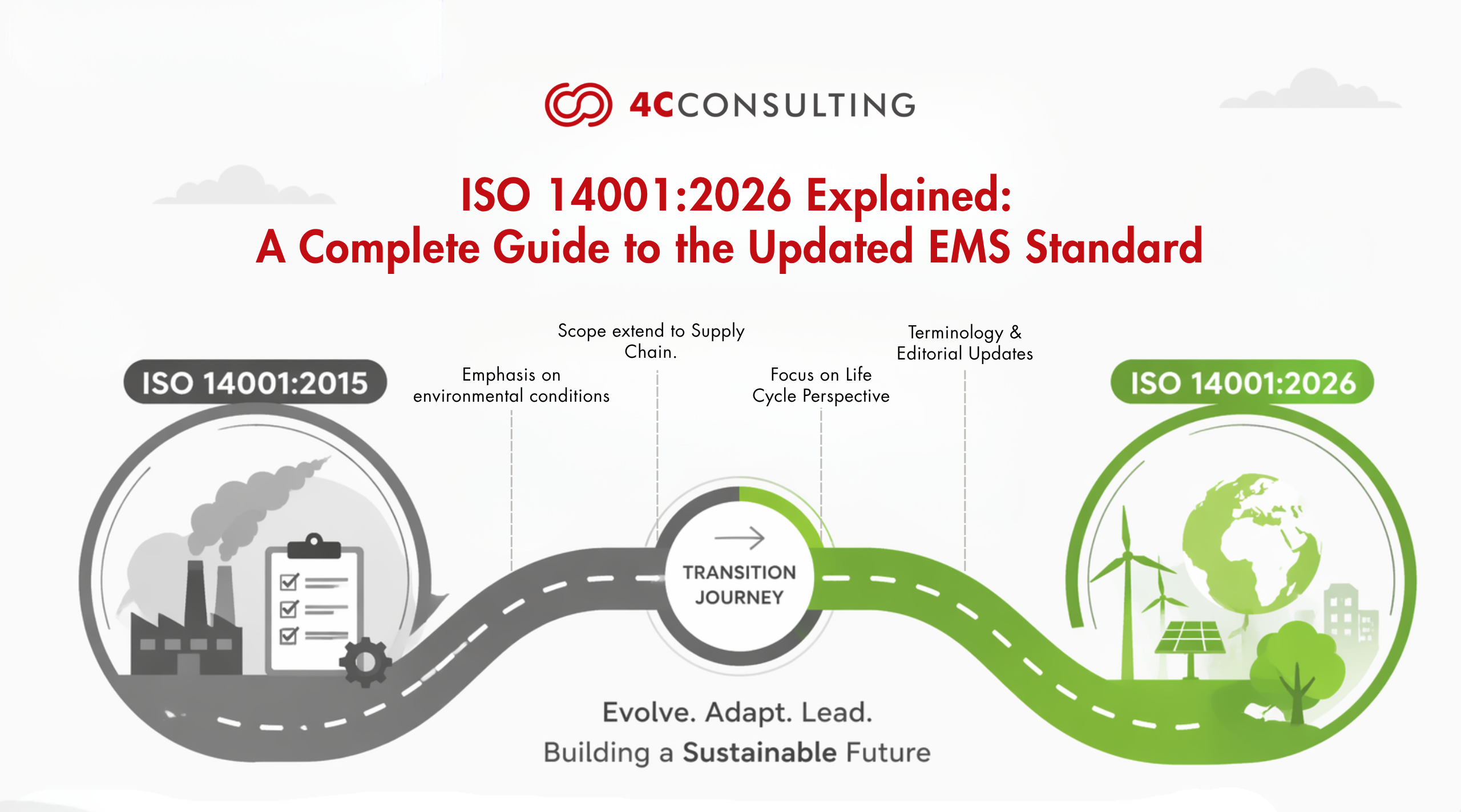
The ISO 14001 environmental management system has been widely adopted by organizations across the globe. With the official publication of ISO 14001:2026, organizations now have a revised framework that places stronger emphasis on climate change adaptation, climate resilience, biodiversity protection and sustainable resource use.
The updated version provides clearer guidance, refined terminology and strengthened requirements to support organizations in addressing evolving environmental expectations.
Now that the standard is published, organizations must begin planning their transition to maintain their ISO 14001 certification and enhance environmental performance. The revision supports business improvement by clarifying risk planning, strengthening clauses such as emergency preparedness and reinforcing proactive environmental management.
What is ISO 14001:2026?
An Environmental Management System (EMS) is a structured framework that helps an organization identify, manage, monitor and improve its environmental impacts in a systematic way. It covers everything from energy consumption, waste generation, emissions, water usage and resource efficiency to legal compliance and sustainability goals. The purpose of an EMS is not only to control environmental risks but also to integrate environmental responsibility into daily business operations. ISO 14001 is the internationally recognized standard for implementing an Environmental Management System (EMS).
ISO 14001:2026 strengthens this framework by refining clause structures, updating terminology and offering clearer EMS implementation guidance while continuing to follow the Annex SL structure used across ISO standards.
More importantly, it emphasizes:
- Measurable environmental performance
- Risk-based thinking
- Lifecycle perspective
- Alignment with global sustainability expectations
Organizations are now expected to demonstrate real, data-driven environmental improvements and integrate sustainability into long-term business strategy.
ISO 14001:2026 Publication & Transition Timeline
| Information | Details |
|---|---|
| Transition Period | Organizations must transition from ISO 14001:2015 to ISO 14001:2026 by year 2029. |
.
Key Focus Areas in ISO 14001:2026:
- Stronger emphasis on measurable environmental performance indicators
- Clearer integration of climate change and sustainability considerations
- Improved risk and opportunity assessment
- Greater alignment with corporate strategy and ESG goals
- Enhanced leadership accountability and stakeholder engagement
In simple terms, ISO 14001:2026 will not just help organizations “manage” environmental issues it will guide them toward building a resilient, performance-driven and sustainability-focused business model.
Simplify Your ISO 14001:2026 Transition with Confidence
Key Changes in ISO 14001:2026
The revised ISO 14001:2026 standard includes improved terminology and minor modifications to make the standard clearer and easier to understand. It will also strengthen important requirements for environmental management. The standard places a higher priority on precise communication, stronger accountability, improved risk management and measurable environmental performance. Below is a simple breakdown of the clauses.
Clause 4: Context of the Organization
The revised standard strengthens the life cycle perspective (LCP) requirement while defining the EMS scope. Organizations will need to more clearly consider upstream and downstream environmental impacts that they can control or influence. This ensures that environmental responsibilities are not limited only to internal operations but also include suppliers, outsourced activities and product use stages.
Documentation impact:
- Update context analysis
- Revise stakeholder register
- Include climate-related risks and expectations
Clause 5: Leadership
Top management involvement is expanded. Leadership will need to support not only managerial roles but all relevant roles within the organization. This increases accountability, personal responsibility and active participation across all levels, making environmental performance a shared responsibility rather than a delegated task.
Documentation impact:
- Update Environmental Policy to reflect sustainability commitments
- Revise roles and responsibilities matrix if required
Clause 6: Planning
A new focus on “planning and managing changes” is introduced. Organizations will need to formally plan and control changes that may affect EMS standard outcomes. Additionally, emergency preparedness will expand from “reasonably foreseeable” emergencies to identifying all potential emergency situations, ensuring stronger risk anticipation and climate resilience planning.
Documentation impact:
- Update environmental aspects register
- Revise risk & opportunity assessment format
- Strengthen measurable environmental objectives
Clause 7: Support
The changes under the Support clause of ISO 14001:2026 are primarily focused on improving clarity and consistency in language. These updates aim to make information easier to understand, more unified and aligned with the latest harmonized structure used across ISO management system standards. Organizations may need to update their documented information, internal procedures and communication materials to reflect the revised terminology and simplified definitions.
Documentation impact:
- Review document control procedures
- Improve version control and traceability
- Update communication and training records
Clause 8: Operation
Control of outsourced processes will now be more clearly defined under the term “externally provided processes, products or services.” These controls will focus only on activities relevant to EMS standard outcomes. Emergency situations will also be linked directly to risks and opportunities, ensuring broader identification of possible environmental incidents.
Documentation impact:
- Update operational procedures
- Strengthen supplier evaluation records
- Review emergency preparedness plans (including climate-related risks)
Clause 9: Performance Evaluation
Greater emphasis is placed on measuring the effectiveness of the EMS. Internal audits now require clearly defined objectives and management review inputs are more specific and mandatory, strengthening transparency and performance monitoring. The information requirements for management review are more explicit, with the use of “shall” language ensuring consistent compliance.
Documentation impact:
- Update monitoring matrices
- Strengthen management review inputs
Clause 10: Improvement
Changes in this clause are minor and mainly related to terminology clarification. However, the overall direction continues to reinforce continual improvement and measurable environmental performance outcomes.
Overall, ISO 14001:2026 strengthens clarity, accountability and performance focus while maintaining the existing Annex SL structure.
Steps to Prepare Your Organization for ISO 14001:2026
Step 1: Conduct a Gap Analysis
Start by comparing your existing Environmental Management System aligned with ISO 14001:2015 against the updated requirements of ISO 14001:2026. Evaluate whether climate-related risks, such as carbon emissions or extreme weather disruptions, are formally identified and managed within your EMS. Review whether your environmental performance metrics are measurable, data-driven and linked to clear sustainability objectives. Also assess how effectively you communicate environmental commitments and results to stakeholders such as customers, regulators and suppliers.
Step 2: Establish Competence and Awareness
ISO 14001:2026 requires strong involvement from both leadership and operational teams. Organizations should conduct structured awareness training to explain the updated requirements, particularly those related to climate risks and sustainability reporting. Roles and responsibilities must be clearly defined and updated for example, assigning a sustainability officer to monitor carbon data or making department heads accountable for environmental KPIs. Cross-functional participation is equally important; procurement, operations, HR and compliance teams should collaborate to ensure environmental objectives are integrated across all business functions, rather than being managed by a single department.
Step 3: Strengthen Environmental Risk Assessment
Organizations must re-evaluate their environmental aspects and impacts to ensure they reflect current operational realities. This includes reviewing how activities such as energy consumption, waste generation, water usage and emissions impact the environment. Compliance obligations should also be reassessed to ensure alignment with updated environmental laws and regulatory requirements. Additionally, businesses should identify emerging environmental risks, such as climate-related disruptions, carbon emission liabilities and increasingly stringent pollution norms.
Step 4: Upgrade Documentation & Monitoring
Organizations must modernize their EMS documentation and monitoring systems. Instead of relying on manual records or scattered spreadsheets, ISO 14001:2026 encourages the use of structured digital systems that ensure real-time access, version control and audit readiness. KPI tracking should be strengthened for example, monitoring monthly energy consumption and improving resource efficiency through lean practices. Additionally, automating compliance alerts helps reduce the risk of missed obligations and non-conformities. A data-driven approach not only supports compliance but also enhances sustainability-focused decision-making.
Step 5: Conduct Internal Audits & Management Review
Organizations should conduct internal audits in line with ISO 14001:2026 to assess whether their Environmental Management System is aligned with the updated requirements. The audit should focus on verifying compliance, reviewing documented information, evaluating environmental objectives and assessing the effectiveness of risk controls and monitoring processes. Following the audit, top management must carry out a formal management review to evaluate audit findings, environmental performance results, compliance status and areas for improvement. Based on this evaluation, corrective actions and strategic decisions should be documented to ensure readiness for the ISO 14001 certification transition.
Key Benefits of Implementing ISO 14001:2026 for Businesses
Implementing ISO 14001:2026 will offer multiple strategic and operational advantages for organizations. Below are the major benefits in clear bullet points:
1. Increased Strategic Responsibility
ISO 14001:2026 elevates environmental management from an operational function to a board-level strategic priority. This means top management not only approves environmental policies but also actively drives sustainability goals and integrates them into long-term business planning. Leadership accountability becomes more visible, with measurable environmental objectives aligned to corporate strategy. For example, a manufacturing company may set a board-approved target to reduce carbon emissions by 30% within five years, influencing major investment decisions, adoption of energy-efficient technologies and supplier selection. Instead of treating environmental compliance as a routine ISO 14001 audit requirement, organizations embed sustainability into core business growth, risk management and brand positioning.
2. Higher Compliance Credibility
Adopting the revised ISO 14001:2026 significantly strengthens an organization’s compliance credibility by ensuring readiness for stricter environmental regulations and evolving audit expectations. A robust ISO 14001 environmental management system helps minimize the risk of legal penalties, regulatory notices and major non-conformities. It also boosts confidence during third-party surveillance and certification audits because documentation, monitoring systems and environmental controls are already structured and transparent. For example, a food processing company that systematically tracks wastewater discharge levels and maintains real-time compliance records can easily demonstrate adherence to pollution control norms during regulatory inspections.
3. Stronger ESG Reporting Alignment
ISO 14001:2026 improves alignment with ESG reporting requirements. It encourages organizations to measure, monitor and clearly disclose their environmental performance. This helps with better sustainability reporting, boosts ESG ratings and builds investor confidence. For example, a manufacturing company that tracks its carbon emissions, water usage and waste reduction through its EMS documents can present verified environmental data in its annual ESG report. This not only increases credibility with global buyers and export partners but also makes the company more appealing to environmentally conscious investors.
4. Competitive Market Advantage
Gaining a competitive market advantage through a strong Environmental Management System goes beyond compliance; it improves how the market sees your brand. When a company achieves ISO 14001 certification, it shows environmental responsibility, enhancing reputation. This builds long-term trust and improves chances for sustainability-driven contracts, especially in sectors like infrastructure, manufacturing and exports. For instance, an automobile parts manufacturer certified under ISO 14001 is more likely to win contracts from global OEMs that favor environmentally responsible suppliers. Ultimately, it positions the company as a forward-thinking leader committed to sustainable growth.
5. Improved Operational Efficiency
Improved operational efficiency under ISO 14001 encourages organizations to make data-driven environmental decisions instead of relying on assumptions. By monitoring energy use, waste generation and resource consumption, businesses can spot inefficiencies and make targeted improvements. For example, a manufacturing company that tracks its electricity use may find energy waste during peak hours and switch to energy-efficient machinery. This change can reduce both power usage and utility costs. Similarly, better waste sorting and recycling practices can lower landfill disposal fees. Over time, these improvements not only help meet environmental goals but also significantly cut long-term operational and compliance costs.
The transition from ISO 14001:2015 to ISO 14001:2026 represents more than a routine standard update it reflects a global shift toward measurable, transparent and performance-driven environmental responsibility. Organizations must now view their environmental management system as a strategic framework that supports long-term sustainability, risk management and operational excellence. Businesses that approach this transition proactively will not only maintain ISO 14001 certification but also strengthen stakeholder confidence and competitive positioning. Treating the revised standard as an opportunity rather than a compliance obligation enables companies to enhance efficiency, improve environmental performance and align with evolving ESG expectations.
How 4C Consulting Supports Your ISO 14001:2026 Transition
At 4C Consulting, we are a partner in helping organizations implement and upgrade to ISO 14001:2026 with confidence and clarity. With over 20+ years of experience, 500 EMS implementations across more than 15 industries and a team of IRCA-certified consultants and auditors, we offer complete support including gap analysis, customized documentation, environmental risk assessments, EMS standard, ISO 14001:2026 internal audits and ISO 14001:2026 awareness training programs. This ensures your Environmental Management System is compliant and focused on performance. Our practical, industry-driven approach helps minimize risks, improve operational efficiency and ensure ISO 14001 certification readiness. Contact us on WhatsApp now to discuss your ISO 14001:2026 transition plan and take the next step toward environmental excellence.
Frequently Asked Questions (FAQs)
1. How to prepare for an ISO 14001:2026 audit in manufacturing industries?
Manufacturing organizations should take a structured approach:
- Conduct a gap analysis against the updated requirements
- Update environmental aspects and risk registers (including climate-related risks)
- Review operational controls, especially for waste, emissions and resource consumption
- Strengthen supplier environmental performance evaluation
- Conduct internal audits before the certification audit
Ensuring strong documentation control, monitoring data accuracy and employee awareness is critical for audit readiness.
2. What are the questions asked in an ISO 14001 audit?
During an ISO 14001 audit, auditors typically ask:
- How have you identified environmental aspects and impacts?
- How do you evaluate compliance obligations?
- What risks and opportunities have been identified?
- How are environmental objectives monitored and measured?
- How does top management demonstrate leadership and commitment?
- How are nonconformities handled and corrected?
- How is continual improvement ensured?
Auditors will review documented information, interview employees and verify operational controls to ensure effective EMS implementation.
3. How to comply with EMS standard requirements for small businesses?
Small businesses can comply with Environmental Management System (EMS) standards by adopting a practical and scalable approach. First, identify environmental aspects such as waste generation, energy use, water consumption and emissions. Next, understand applicable legal and regulatory requirements.
Develop a simple environmental policy, set measurable objectives and assign clear responsibilities. Maintain essential documented information, conduct periodic internal reviews and ensure employee awareness.
An EMS does not have to be complex; what matters is consistency, compliance and continual improvement.
4. What are the steps to establish an effective environmental management system?
Establishing an effective EMS typically involves the following structured steps:
- Understand Organizational Context
- Develop Environmental Policy
- Identify Environmental Aspects & Impacts
- Set Objectives & Targets
- Implement Operational Controls
- Monitor & Measure Performance
- Conduct Internal Audits
- Management Review & Improvement
Following a systematic approach ensures compliance while improving environmental performance and operational efficiency.
5. What are the core principles of an environmental management system?
An Environmental Management System is built on several core principles:
- Environmental Protection
- Compliance Obligations
- Risk-Based Thinking
- Leadership Commitment
- Employee Awareness & Participation
- Continual Improvement
These principles help organizations operate responsibly, reduce environmental risks and strengthen sustainability performance over time.