
Table of Contents
- What is ISO 42001?
- The Hidden Scaling Problems ISO 42001 Helps Startups Avoid
- Do Startups Really Need ISO 42001 Certification?
- Need expert support for ISO/IEC 42001 implementation?
- What Does ISO 42001 Certification Cover?
- Benefits of ISO 42001 Certification for Startups
- Common Challenges Startups Face Without ISO 42001
- How 4C Consulting Helps Startups Achieve ISO 42001 Certification
- FAQ's
ISO/IEC 42001 Certification for Startups: What It Covers and Whether You Need It
22nd May, 2026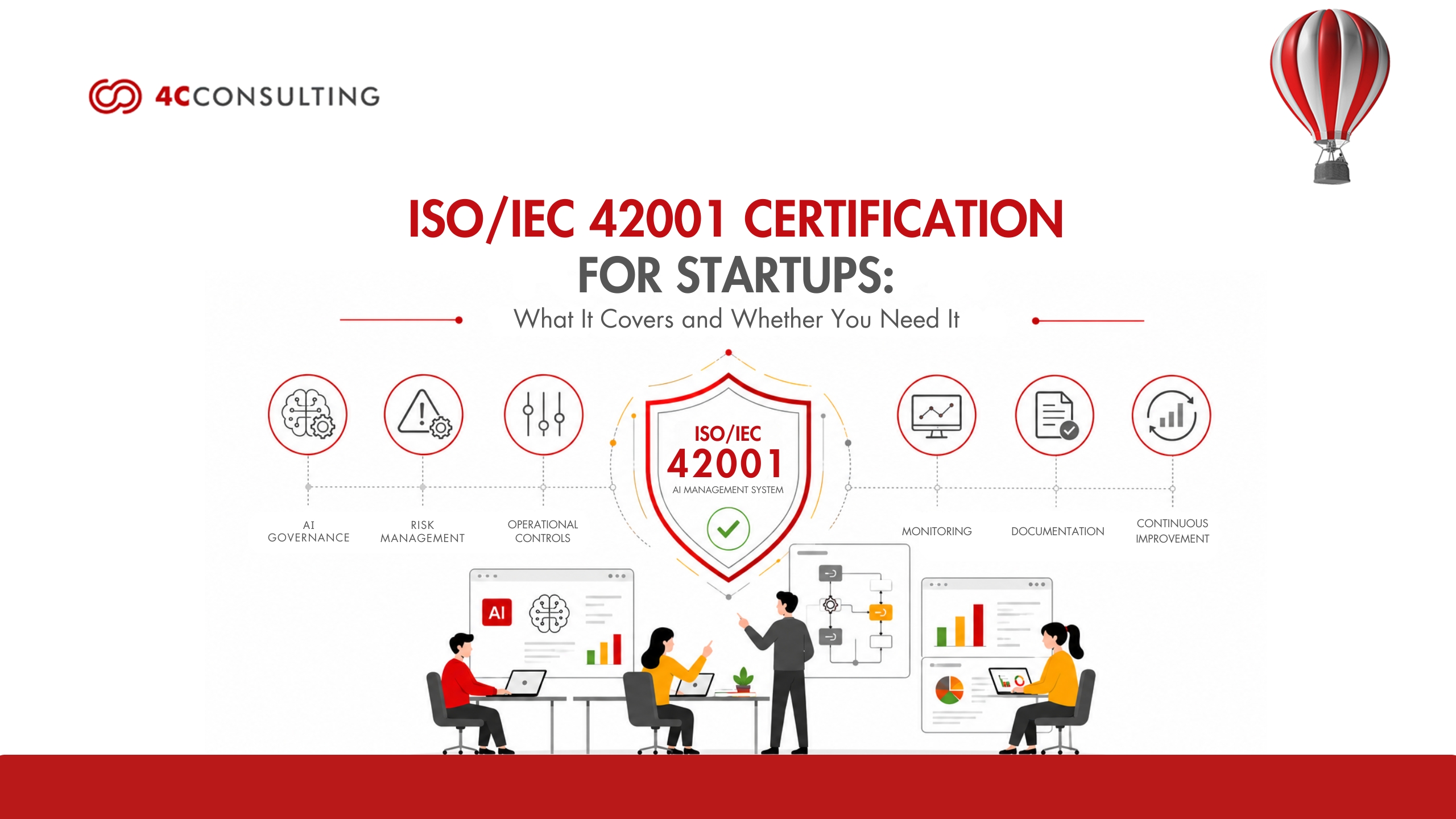
Artificial Intelligence is rapidly becoming a core part of modern startups. From SaaS platforms and AI-powered applications to manufacturing businesses, healthcare startups, logistics companies, retail brands, financial services, education platforms and service-based businesses, organizations across industries are using AI, automation and analytics tools to innovate faster and scale more efficiently.
However, as AI adoption increases, many startups face a challenge they often overlook in the early stages: managing AI systems in a structured and scalable way. In fast-growing startups, the focus is usually on product development, market expansion and speed. But when businesses begin working with enterprise clients, handling sensitive data, entering global markets or preparing for investor due diligence, expectations around operational maturity and AI management increase significantly.
Without standardized processes, startups may struggle with:
- Inconsistent AI operations
- lack of documentation
- Unclear accountability
- Compliance pressure during scaling
To manage AI operations more effectively, many startups are now adopting ISO 42001 Certification as a framework for improving scalability, strengthening business credibility and preparing for future compliance expectations.
What is ISO 42001?
ISO/IEC 42001 is the world’s first international standard for Artificial Intelligence Management Systems (AIMS). Developed to support responsible AI operations, the standard provides a structured framework for organizations that develop, deploy, manage or use AI systems. The objective of Ai Management System standard is to help businesses manage AI systematically instead of handling AI operations in an unorganized or reactive way.
In simple terms, it helps businesses create processes for developing, managing, monitoring and improving AI systems in a controlled way.
The standard is designed for organizations that:
- Develop AI products
- Use AI in business operations
- Provide AI-powered services
- Manage AI-driven automation or analytics
The standard focuses on key areas such as:
- AI governance
- Risk management
- Operational controls
- Monitoring
- Documentation
- Continuous improvement
For startups, ISO 42001 certification helps establish structured AI management processes early, making it easier to scale operations, meet enterprise expectations and improve business credibility.
The Hidden Scaling Problems ISO 42001 Helps Startups Avoid
Startups are built for speed but rapid AI adoption without well-defined management system can create operational challenges as the business grows. Many startups only recognize these gaps when onboarding enterprise clients, expanding operations or preparing for compliance reviews.
It helps startups build standardized AI management processes early and avoid scaling-related issues later.
1. Unstructured AI Operations During Rapid Growth:
Many startups deploy AI systems quickly without standardized processes or clear controls. As teams grow, this often leads to inconsistent operations, limited monitoring and process confusion. ISO/IEC 42001 helps establish standardized and scalable AI management practices.
2. Difficulty Meeting Enterprise Client Expectations:
Enterprise clients increasingly expect startups to demonstrate operational maturity, AI controls and documented processes during vendor evaluations. ISO 42001 certification helps businesses improve credibility and demonstrate a structured AI management framework.
3. Operational Confusion and Undefined Responsibilities:
As startups scale, unclear ownership and accountability can create communication gaps and operational inefficiencies. It encourages businesses to define responsibilities and governance structures early.
4. Inconsistent AI Outputs and Process Reliability:
Without proper monitoring and review mechanisms, AI systems may produce inconsistent or unreliable outputs. It promotes continuous monitoring and improvement of AI systems to improve reliability and operational consistency.
5. Last-Minute Compliance Pressure:
Many startups only focus on compliance when entering regulated markets or onboarding enterprise customers. This often creates rushed implementation challenges. Early adoption of ISO/IEC 42001 helps businesses prepare for future compliance expectations more efficiently.
6. Documentation Gaps That Slow Down Scaling:
Missing policies, procedures and process records can delay audits, enterprise onboarding, partnerships and investment activities. ISO 42001 certification helps startups maintain structured documentation that supports long-term scalability.
Do Startups Really Need ISO 42001 Certification?
Not every startup needs ISO 42001 Ai certification immediately. However, for AI-driven businesses, early implementation can provide strong long-term advantages.
ISO/IEC 42001 certification is especially valuable for:
- AI product companies
- Saas businesses using AI
- Startups serving enterprise clients
- Businesses handling sensitive or regulated data
These organizations often face higher expectations around operational maturity, compliance and AI management.
Early-stage startups with minimal or experimental AI usage may adopt Ai Management System standard later as operations grow. However, implementing AI management early is usually easier than fixing operational gaps during rapid scaling.
Early adoption of Ai Management System helps startups improve scalability, reduce compliance pressure and build stronger operational foundations.
.
Need expert support for ISO/IEC 42001 implementation?
What Does ISO 42001 Certification Cover?
ISO/IEC 42001 focuses on the management system surrounding AI operations, not just the technical side of AI tools. The standard helps organizations create controlled processes for managing AI responsibly, consistently and efficiently while improving operational control and scalability.
1. AI System Management
It requires businesses to establish clear controls for AI-related activities. This includes creating AI policies, operational procedures, governance frameworks, monitoring methods and defined responsibilities. The purpose is to ensure AI systems are properly managed and aligned with overall business objectives.
2. Risk Management
Risk management is a key part of ISO 42001 certification. The standard helps businesses identify, assess, monitor and control AI-related risks through a well-defined approach. This is especially important for SaaS companies, AI product businesses, healthcare startups, fintech organizations, data-driven companies and industries where AI directly impacts operations or customer experiences. Effective risk management helps reduce operational disruptions and improves business stability.
3. AI Lifecycle Management
ISO/IEC 42001 covers the complete lifecycle of AI systems, including development, deployment, maintenance, monitoring, evaluation and improvement. Instead of focusing only on implementation, the standard encourages continuous oversight to maintain long-term reliability and consistency.
4. Data Management and Reliability
Since AI systems heavily rely on data, this AI risk management framework also emphasizes data accuracy, integrity, consistency and controlled usage. Strong data management practices improve the reliability of AI-driven outputs and support better business decision-making.
5. Performance Monitoring and Improvement
The standard promotes regular evaluation and continuous monitoring of AI systems. Organizations are expected to review effectiveness, identify issues, take corrective actions and improve processes when required. This helps maintain consistency and supports long-term operational performance.
6. Documentation and Accountability
ISO 42001 also requires businesses to maintain proper documentation related to AI operations, including policies, procedures, monitoring records, risk assessments, governance controls and defined responsibilities. Proper documentation improves transparency, accountability, operational visibility and audit readiness.
Benefits of ISO 42001 Certification for Startups
For startups, ISO/IEC 42001 certification is not limited to AI product companies alone. Businesses across SaaS, manufacturing, healthcare, logistics, retail, finance, education and service industries are increasingly using AI, automation, analytics and intelligent systems in daily operations. As adoption grows, organizations also face rising expectations around governance, operational control, reliability and compliance.
1. Builds Stronger Credibility with Enterprise Clients
Enterprise customers now evaluate businesses not only on innovation but also on operational maturity, governance and risk management practices.
ISO/IEC 42001 certification helps startups demonstrate that AI-related operations are managed through defined policies, monitoring practices, accountability structures and operational controls. This improves credibility during enterprise onboarding, client evaluations and partnership discussions across industries.
2. Helps Businesses Scale Operations More Effectively
As startups grow, operations become more complex with expanding teams, new technologies and AI systems supporting multiple functions.
Without structured processes, businesses may face:
- Inconsistent workflows
- Communication gaps
- Unclear ownership
- Operational inefficiencies
Iso 42001 encourages:
- Clearly defined responsibilities
- Standardized operational practices
- Governance mechanisms
- Monitoring and review processes
This creates a stronger operational foundation for sustainable growth.
3. Improves Investor and Stakeholder Confidence
Investors and enterprise clients increasingly assess operational maturity alongside innovation.
ISO/IEC 42001 certification helps startups show that AI operations are managed responsibly through structured governance and risk management practices. This can strengthen confidence among investors, strategic partners, procurement teams and regulatory stakeholders.
4. Supports Better Risk and Compliance Management
As AI adoption increases, businesses face growing expectations around transparency, accountability and responsible AI usage.
This AI risk management framework helps organizations establish proactive governance, documentation, monitoring and risk evaluation processes early, reducing future compliance challenges and improving preparedness for evolving industry requirements.
5. Improves Operational Reliability and Consistency
AI systems are increasingly used across customer support, analytics, automation, manufacturing and business operations.
ISO/IEC 42001 encourages organizations to regularly monitor AI-related operations, evaluate system effectiveness, maintain documentation and continuously improve processes.
This helps strengthen:
- Operational reliability
- Process consistency
- Accountability
- Long-term performance management
6. Strengthens Long-Term Market Positioning
Businesses that adopt structured AI governance practices early often position themselves more effectively for long-term growth.
ISO 42001 helps organizations present themselves as:
- Professionally managed
- Operationally mature
- Enterprise-ready
- Future-focused
This strengthens competitiveness in industries where trust, transparency, operational consistency and compliance readiness are becoming increasingly important.
Common Challenges Startups Face Without ISO 42001
Without structured AI management, startups commonly face:
- Unorganized AI operations
- Inconsistent monitoring processes
- Lack of accountability
- Missing documentation
- Difficulty meeting enterprise compliance expectations
- Limited operational visibility
- Higher scaling risks
These challenges may not appear immediately during early growth stages but they often become significant barriers during expansion.
It helps organizations address these operational gaps proactively.
How 4C Consulting Helps Startups Achieve ISO 42001 Certification
At 4C Consulting, we help startups simplify the ISO 42001 implementation journey through end-to-end consulting and hands-on support. Our team works closely with businesses to establish AI management systems that are practical, scalable and certification-ready.
Our support includes:
- Gap Analysis
- Awareness Training
- Documentation
- Implementation & Monitoring
- Internal Audits
- Management Review
- Certification Audit
With over 20 years of consulting experience across management systems and compliance frameworks, 4C Consulting helps startups build stronger operational foundations while preparing for long-term growth, enterprise onboarding and future AI compliance requirements.
Ready to Strengthen Your Startup’s AI Management Framework?
Partner with 4C Consulting to implement ISO/IEC 42001 Certification efficiently and build an AI management system that supports growth, credibility and long-term business success.
FAQ’s
1. How long does it take to achieve ISO/IEC 42001 certification?
The timeline depends on the size of the organization, existing processes, and AI maturity level. For startups, implementation and certification can typically take a few months based on readiness and operational complexity.
2. What is the difference between ISO 42001 and ISO 27001?
ISO 42001 focuses on managing AI systems and AI-related operational risks, while ISO 27001 focuses on information security management. Many organizations implement both standards together for stronger governance and security.
3. Can small startups apply for ISO 42001 certification?
Yes. ISO/IEC 42001 is applicable to organizations of all sizes, including early-stage startups, SaaS companies, and AI product businesses.
4. What are the main documents required for ISO 42001 certification?
Common documentation includes AI policies, risk assessments, operational procedures, monitoring records, defined responsibilities, and management system documentation.
5. Is ISO 42001 relevant for SaaS companies using AI features?
Yes. SaaS businesses using AI for automation, analytics, recommendations or customer-facing functionalities can benefit significantly from ISO 42001 certification.
6. How much does ISO 42001 certification cost for startups?
The cost of ISO 42001 certification depends on factors such as company size, AI complexity, scope of implementation, and certification requirements.

Shardul Patel
Founder & CEOShardul Patel is the Founder and CEO of 4C Consulting, with expertise spanning management systems, ISO standards, emerging standards, and organizational improvement. He brings a broad understanding of evolving compliance and business requirements, helping organizations navigate new standards and strengthen their management frameworks. His leadership focuses on delivering practical consulting solutions that support compliance, continual improvement, and long-term business growth.