
Table of Contents
- What Is Kaizen?
- The Core Objectives of Kaizen
- What Is Kaizen Culture?
- Key Characteristics of a Strong Kaizen Culture
- Why Do Most Kaizen Programs Fail?
- Ready to Build a Kaizen Culture That Lasts?
- What Happens When Kaizen Fails?
- Quick Summary: Why Kaizen Programs Fail and Their Business Impact
- Kaizen Principles That Build a Sustainable Improvement Culture
- Essential Kaizen Tools Every Organization Should Know
- How to Successfully Implement Kaizen in Your Organization
- How 4C Consulting Helps Organizations Build a Sustainable Kaizen Culture
- Ready to Build a Lasting Kaizen Culture?
- Frequently Asked Questions (FAQs)
Kaizen Without Culture: Why Most Improvement Programs Fail
10th Jul, 2026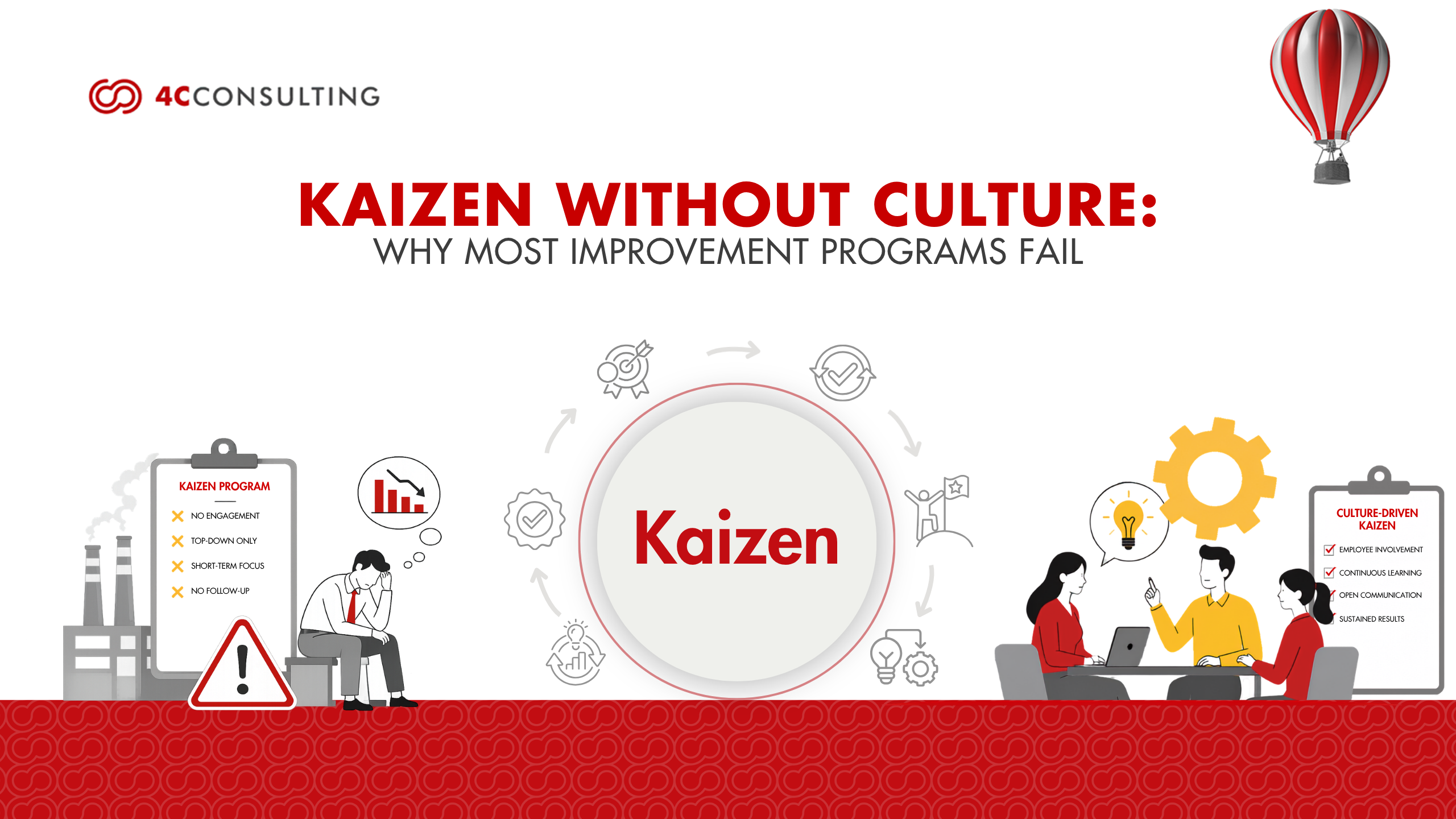
More than 80% of improvement initiatives lose momentum within the first year not because Kaizen doesn’t work, but because organizations implement tools without changing behaviour. Improvement boards disappear, suggestion boxes remain empty and employees gradually return to old habits.
The problem isn’t Kaizen. The problem is culture.
In fact, organizations around the world have successfully used the Japanese Kaizen concept to improve quality, reduce waste and build high-performing operations. The real challenge is that many businesses focus on Kaizen tools and short-term projects while overlooking the one element that determines long-term success: a strong Kaizen culture.
In this guide, you’ll learn what is Kaizen culture, why Kaizen implementation often fails, the core Kaizen principles behind sustainable improvement and practical steps to build a successful Kaizen continuous improvement process. Whether you’re just starting your improvement journey or looking to revive an existing Kaizen program, this article will help you make continuous improvement part of everyday work not just another initiative.
What Is Kaizen?
Kaizen is a Japanese business philosophy that focuses on making small, continuous improvements to processes, products and workplace practices. The word comes from two Japanese terms: “Kai,” meaning change and “Zen,” meaning better, together translating to “change for the better.”
Unlike large transformation projects that require significant investment and disruption, the Kaizen methodology encourages employees at every level to identify small improvement opportunities and implement them consistently. Over time, these incremental improvements create significant gains in productivity, quality, safety and customer satisfaction.
Originally developed and popularized in Japan after World War II, the Japanese Kaizen concept became widely recognized through organizations such as Toyota, where continuous improvement became a fundamental part of daily operations. Today, Kaizen is adopted across manufacturing, healthcare, logistics, construction, IT and service industries as a proven approach to operational excellence.
At its core, the Kaizen process is built on a simple belief:
Small improvements made consistently deliver greater long-term results than occasional large-scale changes. Rather than waiting for major innovations, organizations encourage employees to identify everyday inefficiencies, eliminate waste and continuously improve how work is performed.
The Core Objectives of Kaizen
Kaizen implementation aims to:
- Improve product and service quality.
- Eliminate waste and non-value-added activities.
- Increase operational efficiency.
- Reduce costs and process variation.
- Enhance workplace safety.
- Improve customer satisfaction.
- Encourage employee involvement in problem-solving.
Because Kaizen focuses on improving existing processes instead of replacing them entirely, it helps organizations achieve sustainable improvements with lower risk and greater employee acceptance.
What Is Kaizen Culture?
Many organizations believe implementing Kaizen tools or conducting occasional improvement workshops is enough to become a Kaizen-driven organization. In reality, tools alone do not create lasting change. Sustainable improvement happens only when continuous improvement becomes part of an organization’s culture.
So, what is Kaizen culture?
A Kaizen culture is a workplace environment where every employee from frontline operators to senior leadership is encouraged to identify problems, suggest improvements and contribute to making processes better every day. Continuous improvement is not treated as a one-time project or management initiative but as an ongoing responsibility shared across the organization.
Instead of asking, “Who made the mistake?”, organizations with a strong Kaizen culture ask, “How can we improve the process so this doesn’t happen again?” This shift in mindset creates an environment where employees feel empowered to solve problems rather than fear blame.
Key Characteristics of a Strong Kaizen Culture
Organizations that successfully sustain quality improvement through Kaizen typically share several common characteristics:
- Leadership actively supports continuous improvement initiatives.
- Employees are encouraged to identify and solve process issues.
- Small improvements are valued as much as major innovations.
- Standardized processes are regularly reviewed and improved.
- Cross-functional collaboration is encouraged.
- Learning from mistakes is prioritized over assigning blame.
- Continuous improvement becomes part of daily work rather than a periodic activity.
Kaizen implementation process requires more than technical knowledge it requires leadership commitment, employee engagement and a workplace culture where continuous improvement becomes everyone’s responsibility.
When organizations build this culture first, Kaizen is no longer seen as another improvement program. Instead, it becomes a way of thinking that drives operational excellence, strengthens quality management and creates long-term business success.
Why Do Most Kaizen Programs Fail?
Most Kaizen programs fail because organizations focus on implementing Kaizen tools instead of building a culture of continuous improvement. Without leadership commitment, employee involvement and standardized processes, improvement initiatives lose momentum and fail to deliver sustainable results.
The following are the most common reasons why Kaizen implementation fails.
1. Organizations Focus on Tools Instead of Culture
One of the biggest misconceptions about Kaizen is that implementing tools automatically creates continuous improvement. Many organizations introduce 5S, visual management boards, suggestion systems or improvement workshops believing these activities alone will transform workplace performance.
However, Kaizen tools are only part of the solution.
Without leadership commitment, employee engagement and a culture that encourages continuous learning, even the best improvement tools produce only temporary results. Employees may participate initially because they are instructed to do so, but without ownership and consistent reinforcement, improvement activities gradually decline.
Successful organizations understand that Kaizen culture comes before Kaizen tools. When employees genuinely believe that continuous improvement is everyone’s responsibility, the tools become far more effective.
2. Lack of Leadership Commitment
Every successful Kaizen implementation begins with leadership.
In many organizations, senior management approves a Kaizen program but remains largely disconnected from the implementation process. Improvement initiatives are delegated to quality teams or department managers, while business leaders continue focusing solely on production targets and financial performance.
Employees quickly notice this disconnect. If leaders are not actively participating in improvement activities, attending review meetings or recognizing employee contributions, continuous improvement is often viewed as another temporary management initiative.
Strong leadership commitment means more than approving budgets or launching programs. It requires leaders to:
- Participate in Gemba walks and workplace observations.
- Encourage employee suggestions.
- Remove barriers to improvement.
- Allocate time and resources for continuous improvement activities.
- Celebrate both small and significant improvements.
A well-known example is the NUMMI manufacturing plant in California, a joint venture between Toyota and General Motors. Before Toyota became involved, the plant struggled with poor quality and low employee morale. Toyota introduced not only Kaizen tools but also a culture that empowered employees to stop production, identify problems and suggest improvements without fear of blame. The result was dramatic improvements in quality, productivity and employee engagement demonstrating that leadership commitment and culture are essential for sustainable continuous improvement.
3. Employee Resistance to Change
People naturally become comfortable with familiar ways of working. Even when existing processes are inefficient, employees may hesitate to adopt new methods if they fear additional workload, criticism or uncertainty.
Resistance often occurs when organizations introduce changes to employees rather than with employees.
Common causes of resistance include:
- Lack of communication about improvement objectives.
- Limited employee involvement in decision-making.
- Fear of failure or blame.
- Unclear roles and responsibilities.
- Previous improvement initiatives that failed to deliver results.
A successful Kaizen implementation process encourages employees to become active contributors instead of passive participants. When people are involved in identifying problems and developing solutions, they are more likely to support and sustain the improvements.
4. Treating Kaizen as a One-Time Project
Another common reason Kaizen programs fail is that organizations view them as short-term initiatives rather than an ongoing business philosophy.
Many businesses organize a Kaizen event, complete a workplace improvement campaign or conduct a week-long workshop and assume the transformation is complete. Once the project ends, employees return to their normal routines and improvement efforts gradually disappear.
The Kaizen methodology is built on the principle of continuous improvement not periodic improvement.
Organizations that successfully sustain quality improvement through Kaizen integrate improvement activities into daily operations by:
- Encouraging employees to identify improvement opportunities every day.
- Reviewing improvement ideas during regular team meetings.
- Monitoring improvement metrics continuously.
- Standardizing successful changes.
- Continuously looking for new opportunities to improve.
Example: Kaizen Beyond Manufacturing
Continuous improvement is no longer limited to manufacturing. Many hospitals have adopted Kaizen principles to reduce patient waiting times, improve medication safety and streamline administrative processes. Rather than relying on one-time improvement projects, successful healthcare organizations encourage staff to identify and solve every day operational challenges.
Their experience reinforces a key lesson: sustainable improvement comes from continuous daily effort, not occasional improvement events.
5. Failure to Standardize Improvements
Implementing a successful improvement is only half the job. One of the biggest reasons Kaizen implementations fails is that organizations make improvements but never standardize them. As a result, employees gradually return to old methods and the benefits of the improvement are lost.
Standardization ensures that every successful improvement becomes the new way of working. This includes updating Standard Operating Procedures (SOPs), work instructions, visual controls and employee training materials. Regular audits and performance reviews also help ensure that improved processes are consistently followed.
Without standardization, continuous improvement becomes temporary, making it difficult to sustain long-term operational excellence
6. Inadequate Training and Employee Development
Many organizations assume that conducting a one-time Kaizen training session is enough to build a culture of continuous improvement. In reality, training is only the beginning.
Employees need ongoing coaching, practical problem-solving experience and opportunities to apply Kaizen principles in their daily work. Managers and supervisors also require training to effectively guide improvement initiatives, encourage employee participation and remove implementation barriers.
Organizations that invest in continuous learning are far more likely to sustain improvement efforts than those that rely solely on classroom training.
7. No Measurement or Follow-Up
Continuous improvement cannot succeed without measuring results. Many Kaizen programs begin with enthusiasm but lose momentum because organizations fail to track progress or evaluate the effectiveness of implemented improvements.
Monitoring key performance indicators (KPIs) helps organizations understand whether improvement initiatives are delivering measurable value. Common metrics include:
- Productivity improvements
- Defect and rework reduction
- Lead time improvements
- Cost savings
- Employee participation
- Customer satisfaction
Regular reviews also create accountability and encourage teams to identify new improvement opportunities. Measuring progress transforms Kaizen from a series of isolated activities into a structured business improvement system.
Ready to Build a Kaizen Culture That Lasts?
What Happens When Kaizen Fails?
When Kaizen fails, the impact extends far beyond an unsuccessful improvement initiative. Organizations often experience declining productivity as inefficient processes remain unresolved; while recurring quality issues continue to increase rework, waste and customer complaints.
It can also lead to higher operational costs, as organizations spend time and resources on improvement efforts that fail to deliver sustainable results. Employees may become disengaged and lose confidence in future initiatives, making them less willing to participate in continuous improvement activities. Over time, this resistance creates a culture where innovation slows and operational excellence becomes increasingly difficult to achieve.
Ultimately, inconsistent processes, reduced employee engagement and declining customer satisfaction can weaken an organization’s competitiveness. This is why successful Kaizen implementation requires more than introducing tools it requires strong leadership, employee involvement and a culture that supports continuous improvement every day.
Quick Summary: Why Kaizen Programs Fail and Their Business Impact
| Common Reason | Business Impact |
|---|---|
| Focusing on Tools Instead of Culture | Short-term improvements that are difficult to sustain. |
| Lack of Leadership Commitment | Low employee engagement and weak implementation. |
| Employee Resistance to Change | Slow adoption of improvements and reduced participation. |
| Treating Kaizen as a One-Time Project | Improvement efforts lose momentum over time. |
| Failure to Standardize Improvements | Teams revert to old processes, reducing long-term benefits. |
| Inadequate Training and Coaching | Employees lack the skills to identify and implement improvements effectively. |
| No Measurement or Follow-Up | Limited visibility into results and missed improvement opportunities. |
Identifying these challenges early allows organizations to strengthen their improvement strategy, avoid common implementation mistakes and maximize the long-term benefits of the Kaizen methodology.
Kaizen Principles That Build a Sustainable Improvement Culture
Successful Kaizen implementation is guided by a set of principles that shape how organizations think, solve problems and improve processes. These Kaizen principles create a culture where continuous improvement becomes part of everyday operations rather than an occasional initiative.
1. Continuous Improvement
At the heart of the Kaizen methodology is the belief that every process can be improved. Instead of waiting for major transformation projects, organizations focus on making small, consistent improvements that deliver long-term results.
2. Respect for People
Employees perform processes every day, making them best positioned to identify inefficiencies and improvement opportunities. A strong Kaizen culture values employee ideas, encourages collaboration and creates an environment where everyone contributes to organizational success.
3. Eliminate Waste
One of the primary goals of the Kaizen process is to eliminate activities that do not add value. Reducing unnecessary movement, waiting time, defects, excess inventory and overproduction help improve productivity while lowering operational costs.
4. Standardize Successful Improvements
Every successful improvement should become the new standard. Documenting improved processes and regularly reviewing them ensures that improvements are sustained and continuously refined over time.
5. Make Decisions Using Data
Effective improvements are based on facts rather than assumptions. Organizations should use performance data, root cause analysis and process measurements to identify improvement opportunities and evaluate results.
6. Encourage Employee Participation
Continuous improvement succeeds when everyone is involved. Organizations that actively encourage employee suggestions and recognize improvement efforts develop stronger ownership, higher engagement and more sustainable results.
Essential Kaizen Tools Every Organization Should Know
While culture drives continuous improvement, Kaizen tools provide practical methods for identifying problems, analysing root causes and implementing sustainable solutions. Selecting the right tools helps organizations improve efficiency, strengthen quality management and reduce operational waste.
| Kaizen Tool | Purpose |
|---|---|
| 5S | Organizes the workplace to improve efficiency, safety and productivity. |
| PDCA (Plan-Do-Check-Act) | Provides a structured cycle for testing, implementing and continuously improving processes. |
| 5 Why Analysis | Identifies the root cause of problems by repeatedly asking “Why?” until the underlying issue is discovered. |
| Fishbone (Ishikawa) Diagram | Helps analyse and categorize possible causes of process or quality problems. |
| Value Stream Mapping (VSM) | Visualizes the flow of materials and information to identify waste and process improvement opportunities. |
| Visual Management | Uses visual controls such as boards, labels and performance indicators to improve communication and process visibility. |
| Standard Work | Documents the most efficient way to perform a task, ensuring consistency and reducing process variation. |
It’s important to remember that Kaizen tools alone do not create lasting improvement. Their effectiveness depends on strong leadership, employee involvement and a culture that supports continuous learning and problem-solving. When combined with the right mindset, these tools become powerful enablers of quality improvement through Kaizen and long-term operational excellence.
How to Successfully Implement Kaizen in Your Organization
A successful Kaizen implementation is not achieved through a single improvement event or training session. It requires a structured approach that combines leadership commitment, employee involvement and continuous monitoring. Organizations that follow a systematic Kaizen implementation process are far more likely to sustain improvements and build a long-term culture of operational excellence.
Step 1: Assess Current Processes
Begin by evaluating your existing processes to identify inefficiencies, quality issues and areas of waste. Conduct workplace observations, review performance data and gather employee feedback to establish a clear baseline for improvement.
Step 2: Secure Leadership Commitment
Leadership plays a critical role in the success of any Kaizen program. Senior management should actively support improvement initiatives, allocate resources and demonstrate their commitment by participating in reviews, workplace observations and continuous improvement activities.
Step 3: Build Employee Awareness
Employees should understand not only what Kaizen is but also why continuous improvement matters to the organization. Clear communication helps reduce resistance to change and encourages employees to contribute improvement ideas with confidence.
Step 4: Provide Practical Kaizen Training
Effective Kaizen training should focus on developing problem-solving skills, root cause analysis and the practical application of improvement tools. Regular coaching and hands-on learning reinforce continuous improvement behaviours far more effectively than one-time classroom sessions.
Step 5: Start with a Pilot Project
Rather than attempting organization-wide implementation immediately, begin with a pilot area where improvements can be tested, measured and refined. Early success helps build confidence, demonstrates value and encourages wider adoption across the business.
Step 6: Measure and Review Performance
Monitor key performance indicators such as productivity, quality, lead time, waste reduction and employee participation. Regular reviews help determine whether improvements are delivering the expected results and identify new opportunities for optimization.
Step 7: Standardize Successful Improvements
Once improvements prove effective, update standard operating procedures, work instructions and visual controls to ensure consistency. Standardization prevents organizations from reverting to previous practices and creates a foundation for future improvements.
Step 8: Continue Improving
The Kaizen continuous improvement process never ends. Organizations should regularly review performance, encourage employee suggestions and continuously refine processes to achieve sustainable operational excellence.
How 4C Consulting Helps Organizations Build a Sustainable Kaizen Culture
With over 20 years of consulting experience 4C Consulting help organizations develop practical and sustainable Kaizen implementation strategies that drive measurable business improvement.
Our Kaizen consulting services include:
- Kaizen Readiness Assessment
- Kaizen Implementation Roadmap
- Kaizen Training and Awareness Programs
- 5S Implementation and Workplace Organization
- Process Improvement and Waste Elimination
- Standardization and Visual Management
- Operational Excellence Consulting
- Continuous Improvement Performance Reviews
Ready to Build a Lasting Kaizen Culture?
Whether you’re launching your first Kaizen program or strengthening an existing continuous improvement initiative, our consultants help you create a culture where improvement becomes part of everyday operations.
Get in touch with 4C Consulting today, to discover how our Kaizen consulting and operational excellence solutions can help your organization achieve sustainable business improvement.
Frequently Asked Questions (FAQs)
1. What are the most commonly used Kaizen tools?
Popular Kaizen tools include 5S, PDCA (Plan-Do-Check-Act), 5 Why Analysis, Fishbone Diagram, Value Stream Mapping (VSM), Standard Work and Visual Management.
2. Is Kaizen only applicable to manufacturing?
No. Although Kaizen originated in manufacturing, it is now widely used in healthcare, logistics, construction, education, IT, finance and service industries to improve quality, efficiency and customer satisfaction.
3. What is the difference between Kaizen and Lean?
Kaizen focuses on continuous, incremental improvement through employee involvement, while Lean is a broader management approach that aims to maximize customer value by eliminating waste. In practice, Kaizen is often an essential component of Lean implementation.
4. Is Kaizen certification mandatory?
No. Kaizen certification is not mandatory. However, Kaizen training and certification programs can help individuals and organizations develop the knowledge and skills needed to implement continuous improvement effectively.
5. How much does Kaizen certification cost?
The Kaizen certification cost varies depending on the training provider, certification level, course duration and delivery format. Organizations should choose programs that combine practical implementation guidance with recognized industry expertise.

Devanshi Viramgami
Vice PresidentDevanshi is a Vice President at 4C Consulting with expertise in 5S, Lean, and Six Sigma. She helps organizations improve workplace organization, streamline processes, reduce operational waste, and build a culture of continual improvement. Her expertise in Lean methodologies and process improvement supports businesses in enhancing efficiency, strengthening operational discipline, and achieving sustainable performance improvements.