
Table of Contents
- What Is IATF 16949 and Why Does Implementation Matter More Than Certification?
- What Are the Benefits of IATF 16949 Implementation?
- PREPARE YOUR ORGANIZATION FOR IATF 16949 IMPLEMENTATION
- A Quick Overview: Benefits of IATF 16949 Implementation
- Beyond Certification: Where the Real Value Comes From
- Common Mistakes That Prevent Organizations from Realizing These Benefits
- How 4C Consulting Approaches IATF 16949 Implementation
- FAQs
10 Key Benefits of IATF 16949 Implementation Beyond Certification
20th Jun, 2026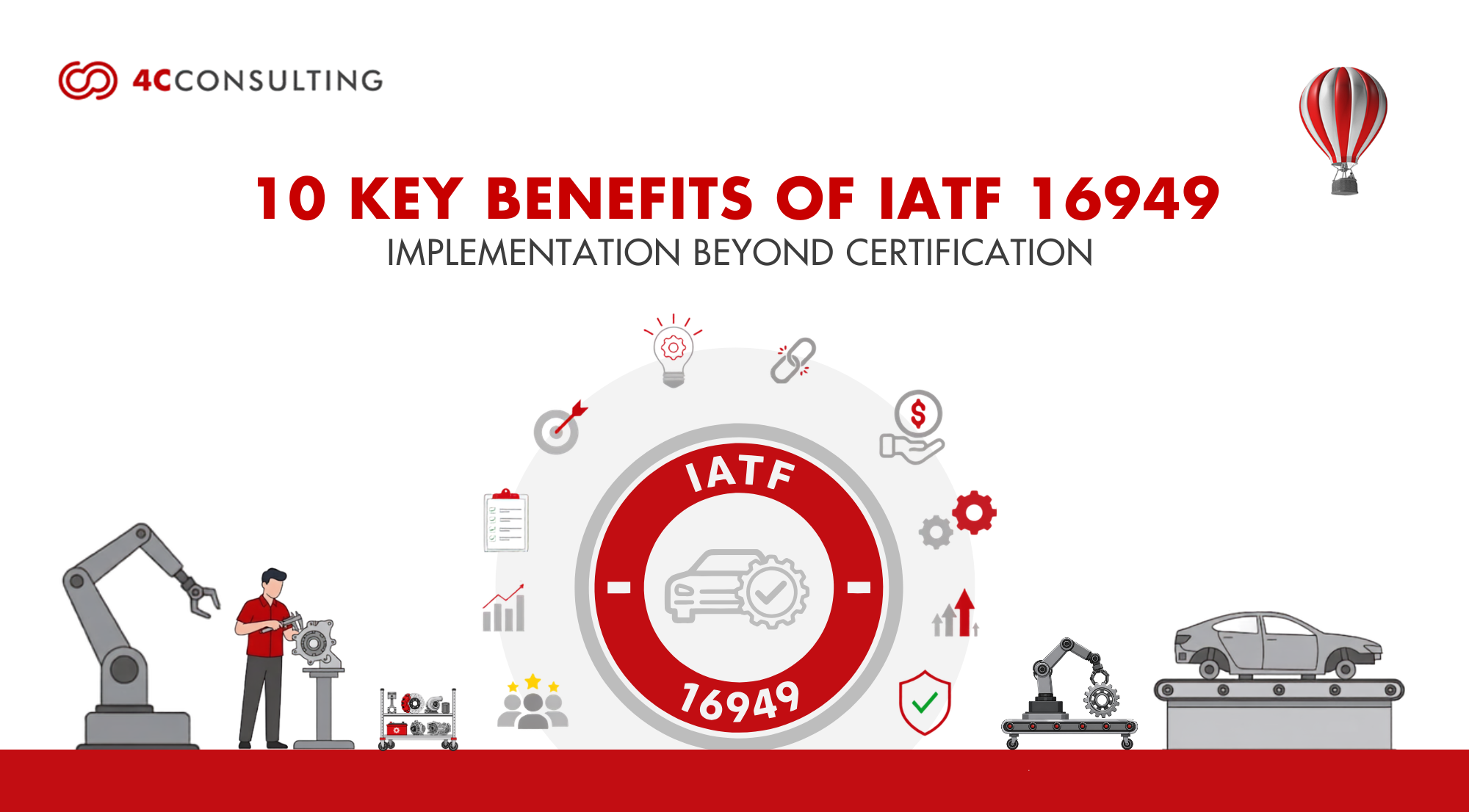
Most manufacturers treat IATF 16949 the same way they treat a fire extinguisher they get one, mount it on the wall and hope they never actually need it. The certificate goes into the company profile, the auditor leaves and life goes on largely unchanged.
That is exactly the wrong way to think about it. And it is exactly why so many companies invest months of effort and significant money into the process only to see negligible improvement in their actual operations.
The certificate is not the outcome. It is the by-product of doing something far more important: building a quality management system that genuinely changes how your organisation plans, produces, monitors, improves and manages risk. When IATF 16949 implementation is done right, it transforms the way a business operates from the inside improving product quality, reducing waste, building stronger teams and creating the kind of data-driven decision-making that drives sustainable growth.
This blog is for quality managers, operations heads, plant directors and business owners who want to understand what IATF 16949 implementations actually delivers not just what the standard says it should.
What Is IATF 16949 and Why Does Implementation Matter More Than Certification?
IATF 16949 is the internationally recognised quality management system standard for the automotive industry, developed by the International Automotive Task Force (IATF). It builds on the foundation of ISO 9001 and adds automotive-specific requirements covering production part approval, defect prevention, supply chain control and continuous improvement.
The distinction between getting certified and genuinely implementing IATF 16949 is critical. Certification means an accredited body has audited your documented system and found it compliant. Implementation means your processes, people and performance metrics have been redesigned around the standard’s requirements in a way that actually prevents defects, reduces waste and delivers value to your OEM customers.
The difference in outcome between these two approaches is enormous. Companies that implement IATF 16949 as a compliance exercise typically see minor, short-term improvements. Companies that implement it as a business transformation tool see sustained reductions in PPM (parts per million defects), cost of poor quality, customer complaints and manufacturing downtime outcomes that directly affect profitability and market position.
What Are the Benefits of IATF 16949 Implementation?
While certification may be the goal for many organizations, the real value comes from the improvements achieved along the way. Let’s take a closer look at the 10 key benefits of IATF 16949 implementation.
1. Improved Product Quality and Consistency
One of the most immediate benefits of IATF 16949 implementation is improved product quality. The standard requires organizations to establish controlled processes, define quality objectives, monitor performance and implement corrective actions when issues occur. As processes become more structured and consistent, variation decreases and product quality improves.
Instead of relying heavily on end-of-line inspection, organizations build quality directly into their processes. This shift helps create more predictable outcomes, better conformity to specifications and greater confidence among customers and stakeholders.
Organizations that effectively implement IATF 16949 often experience:
- More consistent production outcomes
- Reduced process variation
- Improved conformity to specifications
- Greater customer confidence
2. Reduced Defects, Scrap and Rework
Defects are expensive. They consume materials, labour, machine time and management attention while negatively impacting customer satisfaction. One of the primary objectives of IATF 16949 is to move organizations from defect detection to defect prevention.
To achieve this, the standard encourages organizations to implement structured quality practices and leverage IATF Core Tools to identify potential risks, strengthen process controls and prevent quality issues before they occur.
The standard promotes proven quality methodologies such as:
- Failure Mode and Effects Analysis (FMEA)
- Statistical Process Control (SPC)
- Root Cause Analysis
- Corrective Action Systems
- Advanced Product Quality Planning (APQP)
These approaches help organizations identify and address potential issues before they result in product failures.
As a result, organizations often achieve lower defect rates, reduced scrap generation, fewer rework activities and fewer customer complaints. The financial impact of these improvements can be substantial, particularly for organizations managing high production volumes.
3. Better Process Control and Standardization
Inconsistent processes create inconsistent results.
IATF 16949 encourages organizations to define, document, monitor and continuously improve key processes across the business. This structured approach creates greater visibility into how work is performed and helps ensure activities are carried out consistently regardless of department, shift, or location.
When processes are standardized and regularly monitored, organizations gain stronger operational control, clearer accountability and improved process stability. This leads to more predictable outcomes, fewer process-related issues and greater confidence in overall performance.
4. Lower Cost of Poor Quality (COPQ)
Many organizations underestimate the true financial impact of quality failures. The Cost of Poor Quality (COPQ) extends far beyond obvious expenses such as scrap and rework. It also includes warranty claims, product returns, investigation activities, additional inspections, production delays and the resources required to manage recurring quality issues. These costs often remain hidden within day-to-day operations, making them difficult to identify and control.
IATF 16949 implementation helps organizations reduce these losses by focusing on prevention rather than correction. Through stronger process controls, risk-based thinking, root cause analysis and continual improvement practices, organizations can identify the underlying causes of quality problems and eliminate them before they escalate. As defects decrease and processes become more stable, quality-related costs naturally decline. Over time, this not only improves profitability but also allows organizations to redirect resources toward innovation, process improvement and business growth rather than repeatedly addressing the same quality issues.
5. Stronger Risk Management and Preventive Thinking
Modern quality management is increasingly focused on prevention rather than reaction.
IATF 16949 integrates risk-based thinking throughout the organization by encouraging teams to identify potential risks, assess their impact and implement appropriate controls before issues occur. This proactive approach helps organizations anticipate challenges rather than simply respond to them.
By embedding risk management into everyday decision-making, organizations can improve product reliability, reduce operational disruptions and strengthen overall business resilience. This creates a more stable operating environment and improves the organization’s ability to adapt to changing business conditions.
6. Improved Operational Efficiency
Quality and efficiency are closely connected. Poorly controlled processes often result in delays, waste, unnecessary inspections and inefficient use of resources.
Through structured process management and continual improvement, IATF 16949 helps organizations streamline operations and improve overall effectiveness. As quality issues decrease, teams spend less time firefighting and more time focusing on productive activities that add value.
Organizations frequently experience improvements in:
- Productivity
- Resource utilization
- Workflow efficiency
- Process effectiveness
- Waste reduction
These improvements support both quality objectives and broader business goals.
7. Enhanced Supplier Quality Management
The quality of a final product is heavily influenced by the quality of incoming materials, components and services.
A common challenge faced by many organizations is that supplier-related issues often become internal quality problems. Delayed deliveries, inconsistent material quality, incomplete documentation, or process variations at the supplier’s facility can directly affect production performance.
IATF 16949 implementation strengthens supplier management by introducing a more structured approach to supplier selection, evaluation, monitoring and development.
This helps organizations:
- Define supplier performance criteria
- Monitor supplier quality performance
- Reduce supplier-related nonconformities
- Improve incoming material quality
- Build stronger supplier relationships
Rather than reacting to supplier issues after they occur, organizations can proactively identify risks and work collaboratively with suppliers to improve performance. Over time, this leads to a more reliable and stable supply chain.
During an IATF 16949 implementation for an automotive component manufacturer in Gujarat, supplier defect rates were reduced by 38% within nine months after introducing supplier performance scorecards and structured supplier risk reviews. The result was improved incoming material quality, fewer supplier-related nonconformities, and a more reliable supply chain.
8. Greater Employee Accountability and Quality Awareness
A quality management system is only as effective as the people who operate it.
One of the most overlooked benefits of IATF 16949 implementation is its impact on employee engagement and accountability. The standard requires organizations to clearly define roles, responsibilities, competencies and training requirements. Employees must understand how their work contributes to quality objectives and organizational performance. This creates a stronger culture of ownership throughout the organization.
Benefits often include:
- Better role clarity
- Increased accountability
- Improved communication
- Higher employee involvement
- Greater awareness of quality objectives
When employees understand not only what they need to do but also why it matters, quality becomes a shared responsibility rather than the sole responsibility of the quality department.
9. Better Decision-Making Through Data and Performance Monitoring
Many organizations make decisions based on assumptions, past experiences, or isolated incidents. IATF 16949 encourages a more objective and data-driven approach. The standard requires organizations to monitor key performance indicators, analyse trends, evaluate process effectiveness and use data to support decision-making.
Examples of monitored data may include:
- Defect rates
- Customer complaints
- Process capability
- Supplier performance
- Corrective action effectiveness
- Delivery performance
This enables leadership teams to identify issues earlier, prioritize improvement efforts and allocate resources more effectively.
Instead of asking:
“What do we think is happening?”
Organizations begin asking:
“What does the data tell us?”
This shift often leads to faster problem resolution and more informed business decisions.
10. Creates a Sustainable Culture of Continuous Improvement
Many improvement initiatives start with enthusiasm but lose momentum over time. IATF 16949 helps prevent this by embedding continual improvement into the management system itself.
The standard requires organizations to:
- Monitor performance
- Conduct internal audits
- Analyse trends
- Review objectives
- Implement corrective actions
- Identify improvement opportunities
As these activities become part of normal business operations, improvement becomes continuous rather than occasional.
Organizations develop the ability to:
- Identify inefficiencies
- Eliminate recurring problems
- Improve process performance
- Enhance customer satisfaction
- Adapt to changing business requirements
Over time, this culture of continuous improvement becomes one of the most valuable outcomes of implementation. Unlike equipment, technology or infrastructure, a culture of improvement creates long-term organizational capability that competitors cannot easily replicate.
PREPARE YOUR ORGANIZATION FOR IATF 16949 IMPLEMENTATION
A Quick Overview: Benefits of IATF 16949 Implementation
| Benefit | Business Impact |
|---|---|
| Improved Product Quality | Better product consistency and customer satisfaction. |
| Reduced Defects and Rework | Lower scrap, rework, and complaint costs. |
| Better Process Control | More stable and predictable operations. |
| Lower Quality-Related Costs | Reduced waste and quality-related expenses. |
| Stronger Risk Management | Fewer quality and operational disruptions. |
| Improved Supplier Performance | Better supplier reliability and material quality. |
| Increased Operational Efficiency | Higher productivity and reduced waste. |
| Greater Employee Accountability | Improved ownership and responsibility. |
| Better Decision-Making Through Data | Faster and more informed decisions. |
| Continuous Improvement Culture | Sustained performance and business growth. |
Beyond Certification: Where the Real Value Comes From
Many organizations initially pursue IATF 16949 certification because of customer expectations or industry requirements. However, organizations that focus only on obtaining a certificate often miss the larger opportunity. The real value of IATF 16949 implementation comes from the improvements achieved during the implementation journey itself.
These improvements include:
- Better quality performance
- Stronger process control
- Reduced operational waste
- Improved employee engagement
- Better risk management
- Increased efficiency
- More effective decision-making
In fact, many automotive suppliers report 15–40% reductions in internal defects after achieving a mature and well-maintained IATF 16949 implementation. These measurable improvements demonstrate that the standard delivers far more than compliance when it is embedded into day-to-day operations.
Certification simply validates that a management system exists. The business benefits come from how effectively that system is implemented and maintained. Organizations that embrace IATF 16949 as a business improvement framework often realize significantly greater value than those that treat it solely as a compliance exercise.
Common Mistakes That Prevent Organizations from Realizing These Benefits
While the benefits of IATF 16949 implementation can be significant, not every organization achieves the same results. Let’s look at some of the most common mistakes that prevent organizations from realizing the full value of their implementation efforts.
1. Treating Documentation as the Goal
One of the most common mistakes is believing that implementation is complete once procedures, forms and manuals have been created. Documentation is important, but it does not improve quality on its own. The real objective is to ensure that documented processes are followed consistently and contribute to better operational performance.
2. Focusing on Audits Instead of Improvement
Some organizations become overly focused on passing audits. While audits are important, they should not become the primary purpose of the management system. Organizations that focus on performance improvement generally achieve better audit outcomes as a natural result of effective implementation.
3. Limited Cross-Functional Involvement
Quality management is not the responsibility of a single department. Successful implementation requires involvement from leadership, operations, maintenance, purchasing, engineering, human resources and other key functions. Without cross-functional participation, organizations often struggle to sustain improvements.
4. Ignoring Performance Data
Collecting data without analysing it creates little value. Organizations that regularly review performance trends and act on findings are far more likely to achieve measurable improvements.
How 4C Consulting Approaches IATF 16949 Implementation
4C Consulting has been a trusted IATF 16949 certification consultant and implementation partner for automotive manufacturing companies across India for over two decades. Our approach is fundamentally different from the documentation-focused consulting model that is still unfortunately common in the market.
We begin every IATF 16949 engagement with a comprehensive gap analysis not just against the clauses of the standard, but against the actual operating reality of your manufacturing processes, your OEM customer requirements and the specific quality challenges your organisation faces. This baseline gives us a clear picture of where implementation effort will deliver the greatest return.
From gap analysis, we move into a structured implementation roadmap that addresses:
- Documentation development and control
- Automotive core tool deployment
- Internal audit programme development
- Management review frameworks
- Team competency building
We do not hand you a set of procedure templates and call it consulting. Our team works alongside yours on the shop floor, in meetings and in the audit room to ensure the system delivers real operational value.
Our automotive quality management system expertise extends beyond IATF 16949 to the full range of automotive core tools like APQP, PPAP, FMEA, SPC and MSA as well as operational excellence disciplines including Lean Manufacturing, Kaizen and supplier development. This integrated capability means we can address not just your compliance requirements but the underlying operational gaps that compliance alone will not fix.
4C Consulting has successfully supported IATF 16949 implementations for clients including Mitsui Kinzoku Components India and numerous automotive component manufacturers in Gujarat and across India.
Our track record includes:
- 3,000+ Organizations Served Across Industries
- 20,000+ hours of training delivered
- 500+ Long-Term Client Partnerships
Need support with IATF 16949 implementation? Contact 4C Consulting today to improve product quality, reduce defects and strengthen process performance across your organization.
FAQs
1. Does IATF 16949 implementation improve operational efficiency?
Yes. By standardizing processes, reducing waste, improving process control and encouraging continual improvement, organizations often achieve measurable improvements in productivity and efficiency.
2. How does IATF 16949 help reduce defects?
The standard promotes preventive quality methodologies such as risk assessment, process monitoring, root cause analysis and corrective action management, helping organizations identify and eliminate potential issues before they result in defects.
3. Can small and medium-sized organizations benefit from IATF 16949 implementation?
Absolutely. Organizations of all sizes can benefit from stronger process control, improved quality management practices, reduced waste and a structured approach to continual improvement.
4. What is the ROI of IATF 16949 implementation?
The return on investment from IATF 16949 implementation typically comes from reduced defects, lower scrap and rework costs, fewer customer complaints, improved operational efficiency, reduced warranty claims and increased opportunities to win business from automotive OEMs and Tier suppliers.
5. Why do automotive OEMs prefer IATF 16949 certified suppliers?
Automotive OEMs prefer IATF 16949 certified suppliers because certification demonstrates a structured approach to quality management, defect prevention, risk reduction, process control and continuous improvement. It provides confidence that suppliers can consistently meet automotive quality and performance requirements.
6. How long does it take to implement IATF 16949?
The implementation timeline depends on the organization’s size, complexity, existing quality management system maturity and resource availability. Most organizations complete implementation within 6 to 12 months, although larger automotive manufacturers may require additional time.

Dr.Jigar Doshi
Vice PresidentJigar Doshi is a Vice President at 4C Consulting with expertise in Operational Excellence, ISO 27001, NABL, SOC 2, IATF 16949, and AS 9100. He helps organizations strengthen operational performance, information security, quality systems, and industry-specific compliance frameworks. With expertise across diverse management standards, Jigar focuses on helping businesses establish robust systems that improve performance, compliance, and organizational excellence.