
Table of Contents
- What Is the SBTi Corporate Net-Zero Standard?
- The Purpose of the Corporate Net-Zero Standard
- Why Was the SBTi Corporate Net-Zero Standard Version 2.0 Introduced?
- The Key Reasons Behind Version 2.0
- SBTi Version 1 vs Version 2.0: What's Changed?
- The following comparison highlights the major differences
- Understanding the New Company Categories in SBTi 2.0
- What Does This Mean for Organizations?
- Major Changes Introduced in SBTi Corporate Net-Zero Standard Version 2.0
- Practical Checklist to Prepare for SBTi Version 2.0
- Benefits of Early Adoption of SBTi Corporate Net-Zero Standard Version 2.0
- How 4C Consulting Supports Your SBTi Journey
- Build a Credible Roadmap to Net Zero with 4C Consulting
- Frequently Asked Questions (FAQs)
SBTi Corporate Net-Zero Standard Version 2.0: Key Changes Organizations Need to Know
4th Jul, 2026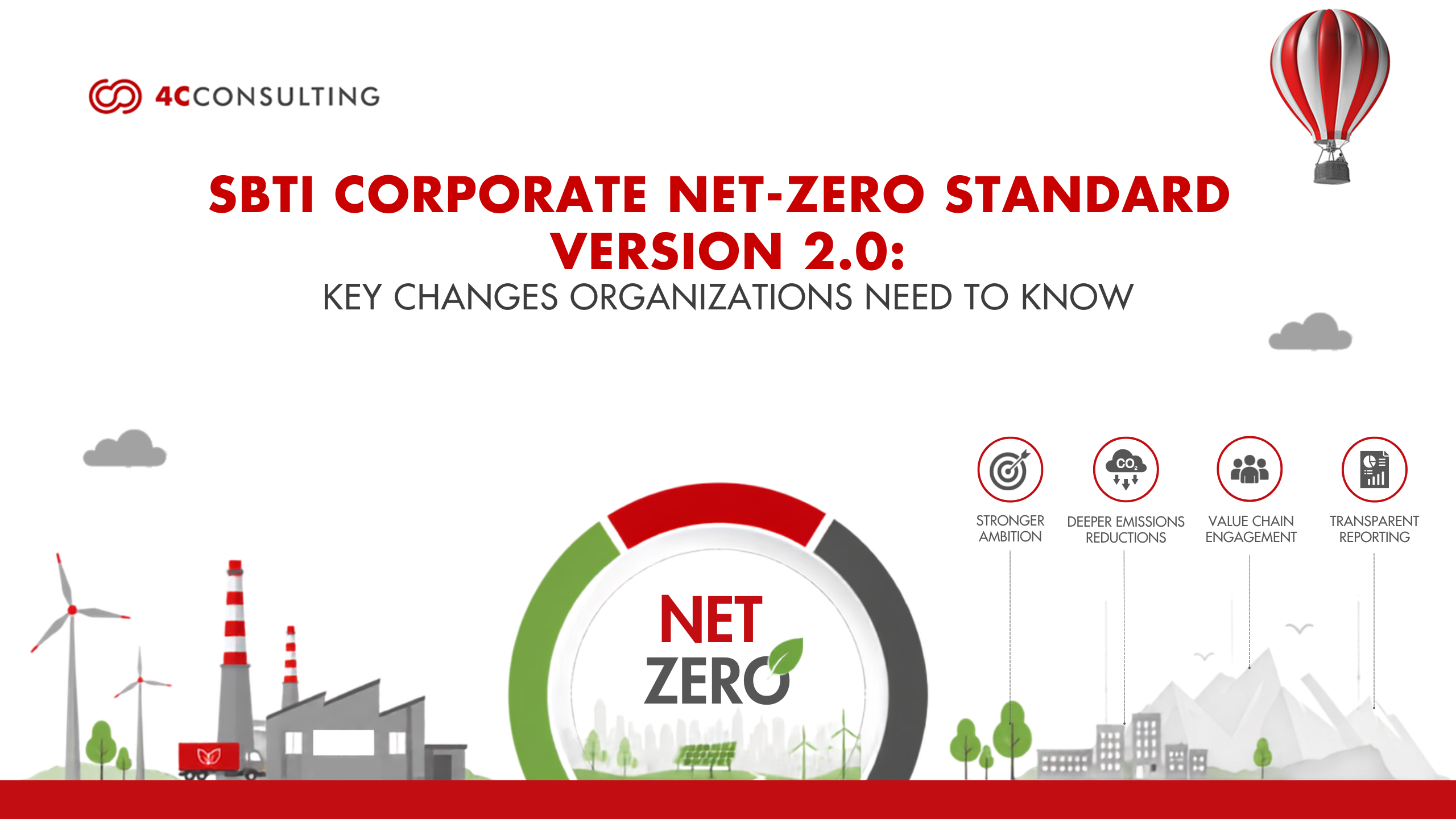
Climate action is no longer just a sustainability initiative it’s a business priority. Investors, customers and regulators increasingly expect organizations to demonstrate credible progress toward net-zero emissions. Today, more than 11,000 companies worldwide have committed to or set science-based emissions reduction targets, making the Science Based Targets initiative (SBTi) the leading global framework for corporate climate action.
To help organizations align with the latest climate science and evolving business expectations, SBTi has introduced the Corporate Net-Zero Standard Version 2.0. The updated standard shifts the focus from simply setting net-zero targets to demonstrating measurable progress through stronger governance, enhanced Scope 1, Scope 2 and Scope 3 emissions management, climate transition planning and greater accountability.
In this guide, you’ll learn what the SBTi Net-Zero V2.0 is, why it was introduced, the key changes from Version 1, how the new requirements affect organizations and the practical steps businesses can take to prepare for a successful transition.
What Is the SBTi Corporate Net-Zero Standard?
The SBTi Corporate Net-Zero Standard is the world’s first science-based framework that provides organizations with a clear methodology for setting, validating and achieving net-zero greenhouse gas emissions.
Introduced in 2021, the standard establishes internationally recognized requirements for developing both near-term emissions reduction targets and long-term net-zero commitments that align with climate science.
Rather than simply encouraging organizations to offset emissions, the standard prioritizes substantial emissions reductions across business operations and value chains before addressing any remaining residual emissions through permanent carbon removals.
The Corporate Net-Zero Standard Version 2.0 builds on this foundation by introducing stronger accountability measures, enhanced Scope 3 requirements, improved governance expectations and more structured implementation guidance.
The Purpose of the Corporate Net-Zero Standard
The standard is designed to help organizations:
- Establish credible net-zero commitments.
- Align business strategies with global climate goals.
- Reduce greenhouse gas emissions using science-based methodologies.
- Improve transparency and stakeholder confidence.
- Create consistent approaches for target validation and progress reporting.
By following a standardized framework, organizations can ensure that their climate commitments are measurable, comparable and aligned with international best practices.
Why Was the SBTi Corporate Net-Zero Standard Version 2.0 Introduced?
When the SBTi Corporate Net-Zero Standard Version 1 was launched in 2021, it established the world’s first science-based framework for corporate net-zero target setting. It quickly became the benchmark for organizations seeking to align their climate strategies with the goals of the Paris Agreement.
However, the climate landscape has changed significantly over the past few years. Thousands of companies have submitted science-based targets, governments have introduced stricter climate regulations, investors have increased scrutiny of corporate climate claims and advances in climate science have provided a clearer understanding of the actions needed to limit global warming.
These developments highlighted opportunities to strengthen the original framework.
The Corporate Net-Zero Standard Version 2.0 has therefore been developed to improve clarity, increase accountability and ensure that corporate climate commitments continue to reflect the latest scientific evidence and implementation experience.
Rather than replacing the core principles of Version 1, Version 2.0 builds upon them by introducing more practical guidance, stronger governance requirements and improved approaches to managing emissions across the value chain.
The Key Reasons Behind Version 2.0
1. Incorporating the Latest Climate Science
It aligns corporate net-zero targets with the latest climate science, ensuring organizations adopt emissions reduction pathways that support global climate goals.
2. Learning from Version 1 Implementation
Feedback from thousands of organizations highlighted challenges in target setting, Scope 3 accounting and implementation. It addresses these gaps with clearer and more practical guidance.
3. Strengthening Scope 3 Emissions Management
As Scope 3 emissions often represent the largest share of an organization’s carbon footprint, the updated standard places greater emphasis on supplier engagement, data quality and value chain decarbonization.
4. Responding to Evolving Regulations
Growing climate disclosure requirements and ESG regulations have increased the need for a more transparent and accountable framework that supports global compliance.
5. Increasing Accountability
It shifts the focus from simply setting targets to demonstrating measurable progress through stronger governance, climate transition planning and continuous performance monitoring.
SBTi Version 1 vs Version 2.0: What’s Changed?
Although the fundamental objective of helping organizations achieve science-based net zero remains unchanged, Version 2 introduces several important structural and technical improvements.
The updated framework strengthens corporate accountability, introduces greater flexibility for different organization types and provides clearer implementation guidance.
The following comparison highlights the major differences
| Area | Version 1 | Version 2.0 |
|---|---|---|
| Company Categories | Single framework for most organizations | Introduces Category A and Category B based on company size and country classification |
| Scope 1 & Scope 2 | Combined focus on operational and purchased energy emissions | Clearer, separate requirements for Scope 1 and Scope 2 emissions |
| Scope 3 Emissions | Broad reduction targets | Greater focus on material emission sources, supplier engagement and improved data quality |
| Climate Transition Plans | Recommended | Expected for Category A organizations to demonstrate implementation |
| Ongoing Emissions Responsibility (OER) | Beyond Value Chain Mitigation (BVCM) encouraged | Introduces OER to strengthen climate action beyond direct emissions reductions |
| Carbon Removals | Limited guidance | Clearer expectations for durable carbon removals and residual emissions management |
| Implementation & Accountability | Focus on target validation | Greater emphasis on governance, implementation, monitoring and measurable progress |
While many of the principles introduced in Version 1 remain valid, Version 2.0 places much greater emphasis on demonstrating credible climate action throughout the target lifecycle.
Understanding the New Company Categories in SBTi 2.0
V2.0 Company Categories
| Organization Type | Category A | Category B |
|---|---|---|
| Large (>1,000 employees or >€450M turnover) | ✓ All countries | — |
| Medium (meeting 2 of: 250–1,000 employees, €50–450M turnover, €25–250M balance sheet) | ✓ High-income countries | ✓ Low-, lower-middle- and upper-middle-income countries |
| Small & Micro (below medium thresholds) | — | ✓ All countries |
New Version introduces two company categories Category A and Category B to apply requirements based on an organization’s size and the World Bank income classification of the country where it operates. This proportionate approach ensures that larger organizations meet more comprehensive requirements, while smaller businesses have a more practical implementation pathway.
Note: Country classification follows the World Bank income categories.
What Does This Mean for Organizations?
- Category A organizations are subject to more comprehensive requirements, including mandatory climate transition plans, ongoing emissions responsibility and, for certain methods, long-term net-zero targets.
- Category B organizations follow a more proportionate approach, with greater implementation flexibility. Some requirements, such as net-zero ambitions and transition plans, may be optional depending on the applicable methodology.
Transition Timeline
Organizations that have already established science-based targets often ask the same question:
“Do we need to switch to Version 2.0 immediately?”
The answer is no.
SBTi has introduced a phased transition period to give organizations sufficient time to understand the updated requirements, adjust their climate strategies and prepare new submissions.
| Timeline | Key Milestone |
|---|---|
| 11 June 2026 | Publication of the Corporate Net-Zero Standard Version 2.0 |
| Early 2027 (expected) | Organizations can begin submitting targets using Version 2.0 requirements |
| 31 December 2027 | Final deadline for submitting targets under Version 1 (subject to SBTi transition guidance) |
| From 1 January 2028 | Version 2.0 expected to become the primary framework for new target submissions |
Organizations should monitor official SBTi announcements, as implementation dates and transition arrangements may be updated during the rollout period.
Major Changes Introduced in SBTi Corporate Net-Zero Standard Version 2.0
The SBTi Corporate Net-Zero Standard Version 2.0 introduces several significant updates that strengthen how organizations set, implement and monitor science-based climate targets. Developed by the Science Based Targets Initiative (SBTi), the revised Corporate Net-Zero Standard moves beyond target setting to place greater emphasis on implementation, accountability and measurable progress. The following are the key changes organizations should understand to prepare for new version and strengthen their net zero compliance strategy.
1. Scope 1 Targets Are Now More Clearly Defined
Under the SBTi Corporate Net-Zero V2.0, Scope 1 emissions direct emissions from owned or controlled operations receive greater attention through dedicated reduction pathways and clearer reporting expectations.
Key updates include:
- Dedicated Scope 1 emissions reduction pathways.
- Greater focus on measurable operational emissions reductions.
- Improved monitoring and reporting of direct emissions.
Organizations should prioritize initiatives such as energy efficiency improvements, fuel switching, process optimization and fleet electrification to reduce operational emissions and align with the Science Based Targets Initiative net zero framework.
2. Scope 2 Requirements Emphasize Greater Transparency
The Net-Zero Standard Version 2.0 introduces stronger expectations for managing Scope 2 emissions from purchased electricity, heating, steam and cooling. While renewable electricity remains a key decarbonization strategy, organizations are expected to improve transparency and the quality of emissions reporting.
Key updates include:
- Improved reporting of electricity-related emissions.
- Greater transparency in market-based and location-based accounting.
- Stronger documentation supporting renewable electricity claims.
Organizations should strengthen electricity data management, review renewable energy procurement strategies and maintain accurate documentation to support SBTi science-based targets.
3. Scope 3 Emissions Receive the Biggest Overhaul
One of the most significant changes in SBTi 2.0 is the enhanced approach to Scope 3 emissions. For many organizations, these value chain emissions account for the largest share of their carbon footprint, making them critical to achieving science-based targets and long-term net-zero goals.
Rather than focusing only on broad reduction targets, the updated SBTi Corporate Net-Zero Standard encourages organizations to adopt a more practical and risk-based approach.
Key updates include:
- Prioritizing the most emissions-intensive activities across the value chain.
- Strengthening supplier engagement and collaboration.
- Continuously improving Scope 3 emissions data quality.
- Increasing transparency in reporting methodologies.
To prepare for SBTi Corporate Net Zero implementation, organizations should identify material emission sources, improve supplier data collection, enhance value chain collaboration and establish long-term plans for improving Scope 3 data accuracy. For many businesses, Scope 3 management will remain the most resource-intensive aspect of implementing the Corporate Net-Zero Standard.
4. Climate Transition Plans Become a Core Expectation
The SBTi Net-Zero V2.0 places greater emphasis on climate transition planning, particularly for larger organizations. Instead of simply setting emissions reduction targets, businesses are expected to demonstrate how those targets will be achieved through a structured implementation roadmap.
A comprehensive transition plan should include the organization’s emissions baseline, reduction milestones, governance framework, investment priorities, supplier engagement strategy and mechanisms for monitoring progress. Integrating climate transition planning into overall business strategy helps organizations meet SBTi 2.0 expectations while supporting long-term business resilience.
5. Introduction of Ongoing Emissions Responsibility (OER)
A major addition to the Science Based Targets Initiative (SBTi) framework is Ongoing Emissions Responsibility (OER), which replaces the previous concept of Beyond Value Chain Mitigation (BVCM).
OER encourages organizations to continue reducing operational emissions while also supporting credible climate mitigation activities beyond their value chain. Although businesses are encouraged to contribute to wider climate action, the SBTi Corporate Net-Zero Standard makes it clear that direct emissions reductions remain the highest priority for achieving science-based target commitments.
6. Stronger Guidance on Carbon Removals
To strengthen the credibility of net zero compliance, the SBTi Net-Zero Standard V2.0 provides clearer guidance on the use of carbon removals. Organizations are expected to prioritize direct emissions reductions and use carbon removals only to address unavoidable residual emissions.
The updated Science Based Targets Standard emphasizes:
- Prioritizing direct emissions reductions before carbon removals.
- Using durable and scientifically credible carbon removal solutions.
- Developing long-term strategies to neutralize residual emissions.
By reinforcing these principles, new version of SBTi helps organizations build credible net-zero strategies while maintaining alignment with evolving climate science and stakeholder expectations.
Practical Checklist to Prepare for SBTi Version 2.0
To prepare for the SBTi Corporate Net-Zero V2.0, organizations should:
- Review existing climate commitments
- Update greenhouse gas (GHG) inventories
- Strengthen Scope 3 emissions data
- Develop a climate transition plan
- Enhance governance and accountability
- Improve emissions data quality
- Engage suppliers and internal stakeholders
- Monitor evolving regulatory requirements
- Conduct an SBTi gap assessment
- Seek expert implementation support
Taking these proactive steps will help organizations transition smoothly to SBTi 2.0, strengthen the credibility of their climate commitments and improve readiness for target validation.
Benefits of Early Adoption of SBTi Corporate Net-Zero Standard Version 2.0
Preparing for the SBTi Corporate Net-Zero Standard Version 2.0 before it becomes the primary framework helps organizations stay ahead of evolving sustainability expectations while building a more resilient business. Early adoption offers several strategic advantages, including:
1. Improved ESG Performance
Science-based targets strengthen ESG performance by establishing measurable climate goals, improving sustainability reporting and demonstrating a credible commitment to net-zero emissions.
2. Stronger Investor and Stakeholder Confidence
Validated climate targets and transparent reporting build trust with investors, customers, regulators and business partners, reinforcing your organization’s long-term sustainability strategy.
3. Better Supply Chain and Regulatory Readiness
As more organizations require suppliers to disclose emissions and adopt science-based targets, early alignment with SBTi improves supply chain competitiveness while preparing businesses for evolving climate regulations.
4. Better Risk Management
A structured decarbonization strategy helps organizations identify climate-related risks, improve resource efficiency and make informed business decisions that support long-term resilience.
5. Enhanced Business Reputation and Operational Efficiency
Implementing science-based targets strengthens brand credibility while driving operational improvements through energy efficiency, process optimization and resource conservation, helping reduce costs and improve overall business performance.
How 4C Consulting Supports Your SBTi Journey
Successfully implementing the SBTi Corporate Net-Zero Standard Version 2.0 requires a structured approach to carbon management, target setting and climate governance. At 4C Consulting, we help organizations navigate every stage of their net-zero journey with practical, science-based solutions.
Our end-to-end support includes:
- Carbon Footprint Assessment
- SBTi Gap Assessment
- Science-Based Target Development
- Climate Transition Planning
- Documentation & Validation Support
- Scope 3 Strategy & Supplier Engagement
- ESG and Sustainability Integration
Build a Credible Roadmap to Net Zero with 4C Consulting
The transition to SBTi Corporate Net-Zero Standard Version 2.0 presents an opportunity to strengthen your organization’s climate strategy, improve stakeholder confidence and prepare for evolving sustainability expectations.
Whether you’re calculating your first carbon footprint, developing science-based targets or preparing existing commitments for Version 2.0, 4C Consulting provides the expertise and practical guidance needed to support every stage of your net-zero journey.
Connect with our sustainability experts today to assess your readiness for SBTi 2.0 and develop a science-based roadmap toward long-term climate resilience.
Frequently Asked Questions (FAQs)
1. How often should organizations review their science-based targets?
Organizations should regularly monitor emissions performance and review their targets whenever significant operational, organizational or regulatory changes occur to ensure continued alignment with SBTi requirements.
2. Which companies should adopt SBTi Version 2.0?
SBTi Version 2.0 is suitable for large enterprises, multinational corporations, manufacturers, exporters, financial institutions and SMEs that want to align their climate strategy with internationally recognized science-based standards.
3. Does Version 2.0 replace Version 1 immediately?
No. SBTi has introduced a phased transition period that allows organizations to continue using Version 1 for a limited time before Version 2.0 becomes the primary framework for new target submissions.
4. What are the biggest changes in Version 2.0?
Key updates include new company categories, clearer Scope 1, Scope 2 and Scope 3 requirements, stronger supplier engagement, mandatory transition planning for larger organizations, the introduction of Ongoing Emissions Responsibility (OER) and enhanced governance and reporting expectations.
5. What is Ongoing Emissions Responsibility (OER)?
OER is a new concept introduced in Version 2.0 that encourages organizations to contribute to climate mitigation beyond their direct emissions reductions while continuing to prioritize operational decarbonization.
6. What is the difference between Version 1 and Version 2.0?
While Version 1 focused primarily on establishing science-based targets, Version 2.0 places greater emphasis on implementation, accountability, transition planning, improved Scope 3 management and continuous performance monitoring
7. Does Version 2.0 replace Version 1 immediately?
No. SBTi has introduced a phased transition period that allows organizations to continue using Version 1 for a limited time before Version 2.0 becomes the primary framework for new target submissions.

Shardul Patel
Founder & CEOShardul Patel is the Founder and CEO of 4C Consulting, with expertise spanning management systems, ISO standards, emerging standards, and organizational improvement. He brings a broad understanding of evolving compliance and business requirements, helping organizations navigate new standards and strengthen their management frameworks. His leadership focuses on delivering practical consulting solutions that support compliance, continual improvement, and long-term business growth.