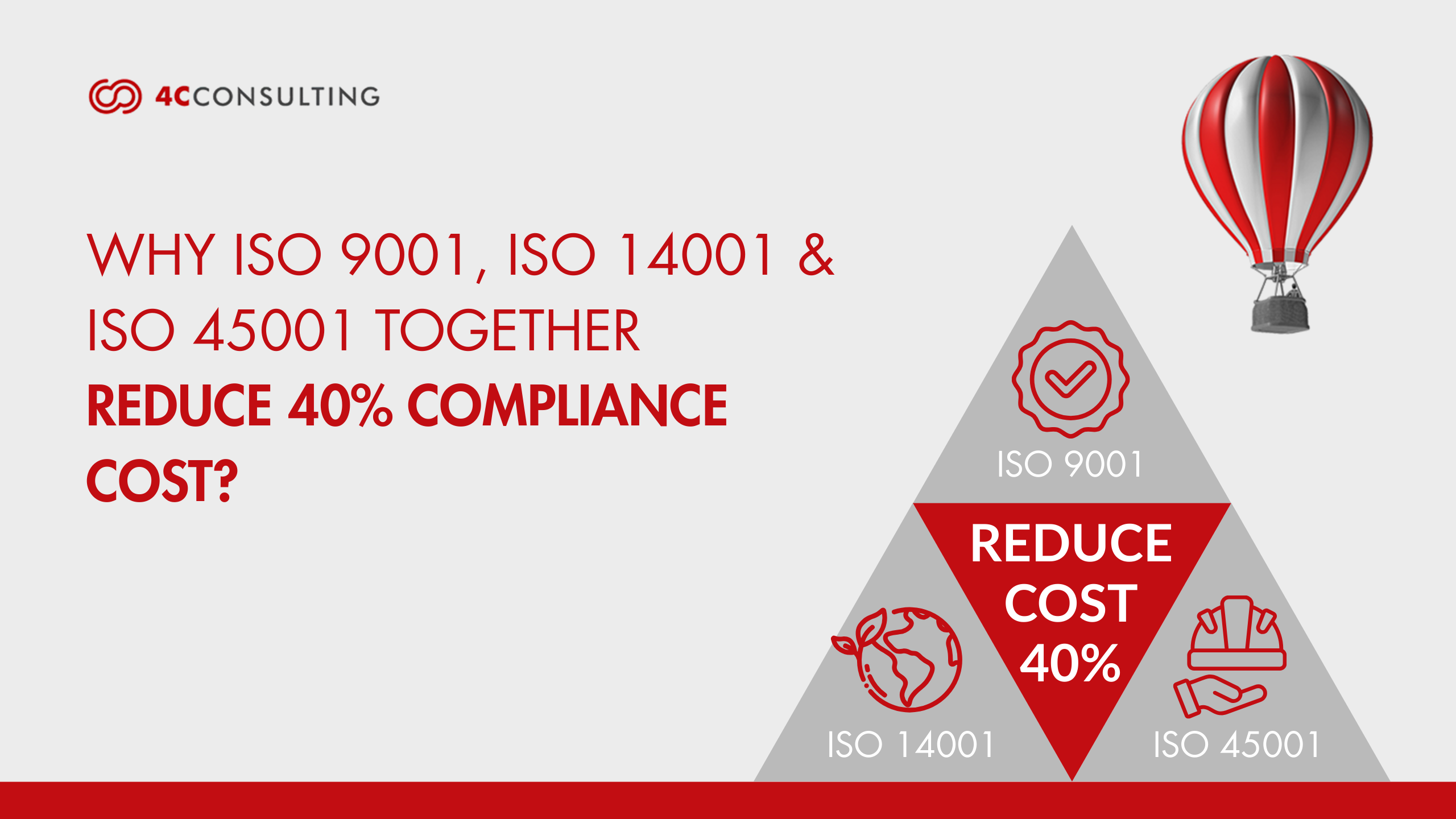
Why ISO 9001, ISO 14001 & ISO 45001 Together Reduce 40% Compliance Cost?
5th Dec, 2025
Global compliance spending has increased by nearly 25% over the last five years, according to industry reports from manufacturing, engineering, pharma and energy sectors. At the same time, organizations operating with separate Quality (ISO 9001), Environmental (ISO 14001) and Occupational Health & Safety (ISO 45001) systems report 30 to 40% higher operational and audit costs due to overlapping requirements, duplicated processes and multiple certification cycles. This rising cost pressure is pushing companies to rethink how they structure their management systems.
Despite dealing with three different compliance domains quality, environment and safety, the reality is that over 60% of the requirements across ISO 9001, ISO 14001 and ISO 45001 are identical. All three standards follow the High-Level Structure (HLS), emphasize risk-based thinking, require documented processes and depend on leadership involvement, operational control and continual improvement. When companies treat these standards as separate systems, they end up repeating the same activities three times: three sets of manuals, three audits, three management reviews and three risk registers.
To address this inefficiency, many organizations are now adopting an Integrated Management System (IMS) approach, where ISO 9001, ISO 14001 and ISO 45001 are implemented together as one cohesive framework. This integration eliminates redundancy, streamlines processes and reduces certification and maintenance efforts. The blog explains why integrating these three standards can reduce compliance cost by up to 40% and how organizations can implement an IMS that improves performance across quality, environment and safety simultaneously.
What Is an Integrated Management System (IMS)?
An Integrated Management System (IMS) is a structured framework that combines the requirements of ISO 9001, ISO 14001 and ISO 45001 into a single, streamlined management system. Instead of maintaining separate quality, environmental and occupational health and safety processes, an IMS brings all three together under one coordinated structure. Each of these three standards focuses on a different area of organizational performance.
ISO 9001: 2015(QMS): ISO 9001 establishes the requirements for a Quality Management System aimed at improving product and service consistency, meeting customer expectations and strengthening process efficiency. It supports organizations in building disciplined workflows, reducing process variations and enhancing customer satisfaction.
ISO 14001: 2015(EMS): ISO 14001 provides a systematic method for managing environmental responsibilities. It helps identify environmental aspects, control impacts, meet environmental regulations and improve resource efficiency. This is particularly important for sectors dealing with waste, emissions, utilities or environmentally sensitive operations.
ISO 45001: 2018(OH&S): ISO 45001 focuses on occupational health and safety by identifying hazards, assessing risks and establishing controls to prevent incidents. It ensures that workplace safety becomes part of day-to-day operations through risk-based thinking, worker participation and compliance with statutory requirements.
Why Organizations Are Moving Toward IMS Integration
- Common Requirements: Nearly 60% of the clauses across QMS, EMS and OHSMS standards follow the same High-Level Structure (HLS) from leadership commitment and documentation control to risk assessment and internal audits. When companies maintain three separate systems, they end up repeating the same compliance activities multiple times. This results in duplicated paperwork, inconsistent controls and unnecessary audit cycles. A chemical plant maintained three risk registers for the same processes simply because the systems were not integrated.
- Audit Intensity: Organizations handling three standalone ISO systems typically undergo three certification audits, three surveillance audits and three sets of ISO internal audits every year. This multiplies not just audit fees but also the time, manpower and preparation effort required from departments. For industries with extensive operations, this becomes a significant financial and productivity loss. An engineering firm spent nearly double the audit hours because QMS, EMS and OHSMS were reviewed separately.
- Duplicate Documentation: Separate management systems often lead to three sets of manuals, SOPs, formats and process descriptions even when the underlying workflows are identical. This creates confusion on the shop floor, makes revision control difficult and increases the chance of nonconformities. When documentation is duplicated, version mismatches become common during audits. A packaging unit maintained separate SOPs for non-conformance control, although the process was identical across all departments.
- Disjointed Risk Assessment: Without integration, organizations conduct risk assessments independently for quality, environment and safety even though many operational risks overlap. This leads to inconsistent scoring, missing controls and weak mitigation strategies. A unified IMS ensures a single risk register that captures Q-E-HS risks together, improving decision-making and resource allocation. A manufacturing company struggled with recurring incidents because their process risks were split into three separate assessments.
- Lack of Clear Ownership: Separate systems often result in fragmented roles quality teams manage QMS, EHS teams handle EMS and safety teams oversee OHSMS. This leads to unclear accountability, misaligned KPIs and inconsistent process monitoring across departments. Without integrated responsibilities, key compliance tasks fall between functions, increasing the risk of audit findings. A pharma plant failed an audit because updated safety procedures were not communicated to the quality team.
- Operational Pressures: Industries are facing increasing demands higher customer expectations, sustainability requirements, cost efficiency goals and regulatory changes. Maintaining three standalone systems slows down decision-making and increases administrative workload. IMS enables faster implementation of improvements, reduces repetitive tasks and aligns Q-E-HS processes under a single operational direction. A large manufacturing unit shifted to IMS to reduce documentation load and speed up compliance updates.
Paying high compliance costs due to separate ISO management systems?
How IMS Reduces Up to 40% Compliance Cost?
- Combined Certification & Surveillance Audits: Integrating ISO 9001, ISO 14001 and ISO 45001 allow companies to undergo a single certification audit and a single surveillance cycle instead of three separate ones. This eliminates auditor charges, travel expenses and multi-day audit disruptions. A unified audit also minimises repeated document reviews and eliminates overlapping audit schedules. A manufacturing company cut its audit expense by 35% after shifting to an integrated audit approach.
- Unified Internal Audit Programme: Instead of conducting three separate internal audits for QMS, EMS and OHSMS, organizations can run one integrated audit covering all system requirements together. This reduces internal audit workload, saves departmental time and strengthens cross-functional evaluation. Integrated audits also improve process visibility and reduce the risk of repeated NCs across systems. An engineering firm reduced internal audit preparation time by half after adopting an IMS.
- Shared Documentation & Records: IMS allows organizations to maintain one manual, one set of procedures and one standardized system of formats instead of three parallel documentation structures. This removes drafting, reviewing, updating and version control efforts. With a unified document set, organizations avoid duplication and minimize errors during audits. A packaging unit eliminated nearly 40% of redundant SOPs when it merged Q-E-HS documentation into a single system.
- Single Risk Register for Q-E-HS: One of the biggest cost efficiencies comes from using a unified risk register that integrates quality risks, environmental aspects and OH&S hazards. Instead of conducting separate risk assessments, teams collaborate on a single structured HIRA/FMEA approach. This eliminates assessment time, repeated scoring and ensures controls are applied consistently. A chemical plant reduced its annual risk assessment workload by almost 30% through integrated risk evaluation.
- Consolidated Training & Competency Hours: Separate systems often require separate training sessions QMS awareness, EMS awareness, OH&S training, internal audit training and system updates. An IMS enables combined training sessions that address requirements of all three standards together. This cuts down the trainer fees, departmental downtime and preparation efforts. A large automotive supplier reduced its yearly training hours by 25% after shifting to integrated Q-E-HS competency programmes.
- Integrated Management Review (MRM): Instead of conducting three management reviews annually, an IMS allows organizations to perform one comprehensive review covering QMS, EMS and OHSMS performance. This reduces meeting preparation, data collection time and cross-department coordination effort. Integrated MRM also enables cohesive decision-making and aligns improvement actions across Q-E-HS. A pharma company reduced its review cycle effort by 40% using a single integrated MRM.
- Faster Implementation: IMS reduces the number of documents, forms, meetings, reviews and audits required for system upkeep. This saves operational teams from repetitive compliance tasks and accelerates implementation timelines. With fewer administrative loops, organizations can focus more on performance improvement rather than paperwork. A mid-sized pharma unit reduced documentation workload by nearly 45% after integrating QMS, EMS and OHSMS.
Key Benefits of Integrating ISO 9001, ISO 14001 & ISO 45001 (IMS)
- Integrated Management System: IMS eliminates the need to maintain three separate QMS, EMS and OHSMS frameworks by merging them into one unified structure. This reduces system complexity, streamlines documentation and ensures consistent process control across all operations. A single framework strengthens alignment between departments and removes confusion caused by parallel procedures. It also enhances system visibility, enabling leadership to monitor quality, environmental and safety performance from one consolidated interface.
- Reduced Audit & Certification Cost: A combined IMS audit framework allows organizations to undergo one certification audit and one surveillance cycle instead of three independent assessments. This reduces auditor’s external audit fees, travel expenses and operational disruptions. With a unified audit trail, evidence collection becomes easier and faster, improving audit readiness and reducing preparation time. Teams no longer spend repeated effort preparing for three separate audits, resulting in substantial cost and time savings.
- Elimination of Duplicate Processes: IMS removes the repetitive tasks associated with maintaining separate procedures, formats, training programmes and reporting structures for QMS, EMS and OHSMS. By standardizing common processes such as nonconformance management, internal audits, corrective action and document control, organizations reduce administrative workload and improve process efficiency. Harmonised workflows also ensure faster updates when regulatory, operational or compliance requirements change.
- Stronger Risk-Based Thinking: A unified risk register integrates process risks, environmental aspects and OH&S hazards into one comprehensive evaluation system. This supports more accurate prioritisation of risks, better resource allocation and clearer identification of cross-functional vulnerabilities. Integrated risk methodology ensures consistency in scoring, monitoring and control implementation. It also strengthens preventive actions by aligning risk controls across quality, environmental and safety domains.
- Higher Documentation Control & Consistency: IMS brings all documents under a single revision system, one approval workflow and an integrated master list. This ensures consistent versioning, eliminates conflicting documents and reduces errors that commonly occur when multiple systems operate independently. Centralised control also accelerates updates during audits or regulatory changes. Unified documentation improves audit performance and ensures that all employees refer to the same approved procedures and records.
- Improved Cross-Functional Collaboration: IMS aligns quality, production, maintenance, supply chain, EHS and top management under shared objectives and unified KPIs. This breaks functional silos, enhances communication and ensures consistent understanding of responsibilities. Integrated roles and responsibilities strengthen process ownership and reduce compliance gaps. Unified reviews and internal audits further improve collaboration by bringing multiple departments together under one coordinated performance monitoring system.
- Enhanced Compliance Maturity & Performance: With integrated KPIs, harmonised monitoring systems and unified corrective actions, IMS elevates overall compliance maturity and operational control. Management can review Q-E-HS performance more holistically, enabling faster decisions and better alignment with strategic business goals. Integrated performance reviews help identify trends, address systemic issues and maintain stronger audit readiness. This leads to sustained improvement across quality, environment and occupational health & safety.
Integrating ISO 9001, ISO 14001 and ISO 45001 into a single IMS is one of the most effective ways for organizations to reduce compliance cost, eliminate duplication and build stronger Q-E-H&S performance. By unifying audits, documentation, risk registers and reviews, companies strengthen operational control, improve decision-making and respond faster to regulatory and customer requirements. As industries face rising pressure for efficiency and sustainability, an integrated approach helps businesses stay compliant, competitive and future-ready.
How 4C Consulting Helps You Implement ISO & ESG Effectively?
4C Consulting enables organizations to implement ISO standards and ESG requirements through a structured, performance-driven approach that strengthens compliance, governance, and sustainability. With 20+ years of expertise in 18,000+ hours of specialized ISO training, we help businesses streamline Q-E-HS systems, integrate ISO frameworks, and build long-term operational maturity. Our collaboration with 50+ certification bodies and our experience supporting 300+ IMS focused clients globally ensure seamless implementation, smoother audits, stronger documentation control and measurable improvements in quality, environmental performance and workplace safety.

Frequently Asked Questions:
The most common challenges include unclear role realignment, resistance from departments used to silo-based functioning, legacy documentation conflicts and lack of cross-functional visibility. These issues are manageable with proper change management and top-management involvement.
Yes. IMS enables unified supplier evaluation criteria covering product quality, environmental impact, worker safety and statutory compliance. This strengthens vendor selection, monitoring and audit preparation.
No. ESG and ISO share many common indicators such as compliance, risk, waste, emissions, safety and stakeholder requirements. Mapping ESG with IMS actually reduces duplication and simplifies data collection.
IMS centralizes procedures, risk controls and KPIs so all sites follow the same governance model. This reduces variation between plants, improves audit readiness and creates standardised reporting across locations.
Yes. IMS provides unified evidence, consolidated SOPs, integrated risk assessments and harmonised records, making customer and regulatory audits smoother, faster and more predictable, with fewer last-minute corrections.
IMS works seamlessly with digital MIS, document control systems, automation dashboards and EHS-QMS platforms. A unified system reduces software complexity by avoiding multiple tools for quality, environment and safety.
Integration clarifies responsibilities instead of increasing workload. Employees follow one system, one set of SOPs and one monitoring structure, which enhances accountability and reduces confusion.
Teams need capability in cross-functional auditing, integrated risk analysis, documentation control, root cause analysis and monitoring of unified KPIs. These skills are developed through targeted IMS training programs.
Sachin Mohan is a General Manager at 4C Consulting with expertise in Food Standards, ISO 9001, ISO 14001, ISO 45001, SEDEX, and SA 8000. He supports organizations in strengthening management systems, improving compliance, and aligning business processes with recognized quality, environmental, health & safety, and social responsibility standards. His expertise helps businesses build structured systems that support responsible operations and continual improvement.