
Table of Contents
- What Is SOC 2 Compliance?
- Why SOC 2 Compliance Matters for SaaS Companies
- How to Achieve SOC 2 Compliance: 7-Step Process
- Ready to Prepare Your SaaS Company for SOC 2 Compliance?
- Common SOC 2 Compliance Challenges for SaaS Companies
- How 4C Consulting Can Help with SOC 2 Compliance
- Frequently Asked Questions About SOC 2 Compliance
How to Achieve SOC 2 Compliance: A Step-by-Step Guide for SaaS Companies
27th Aug, 2026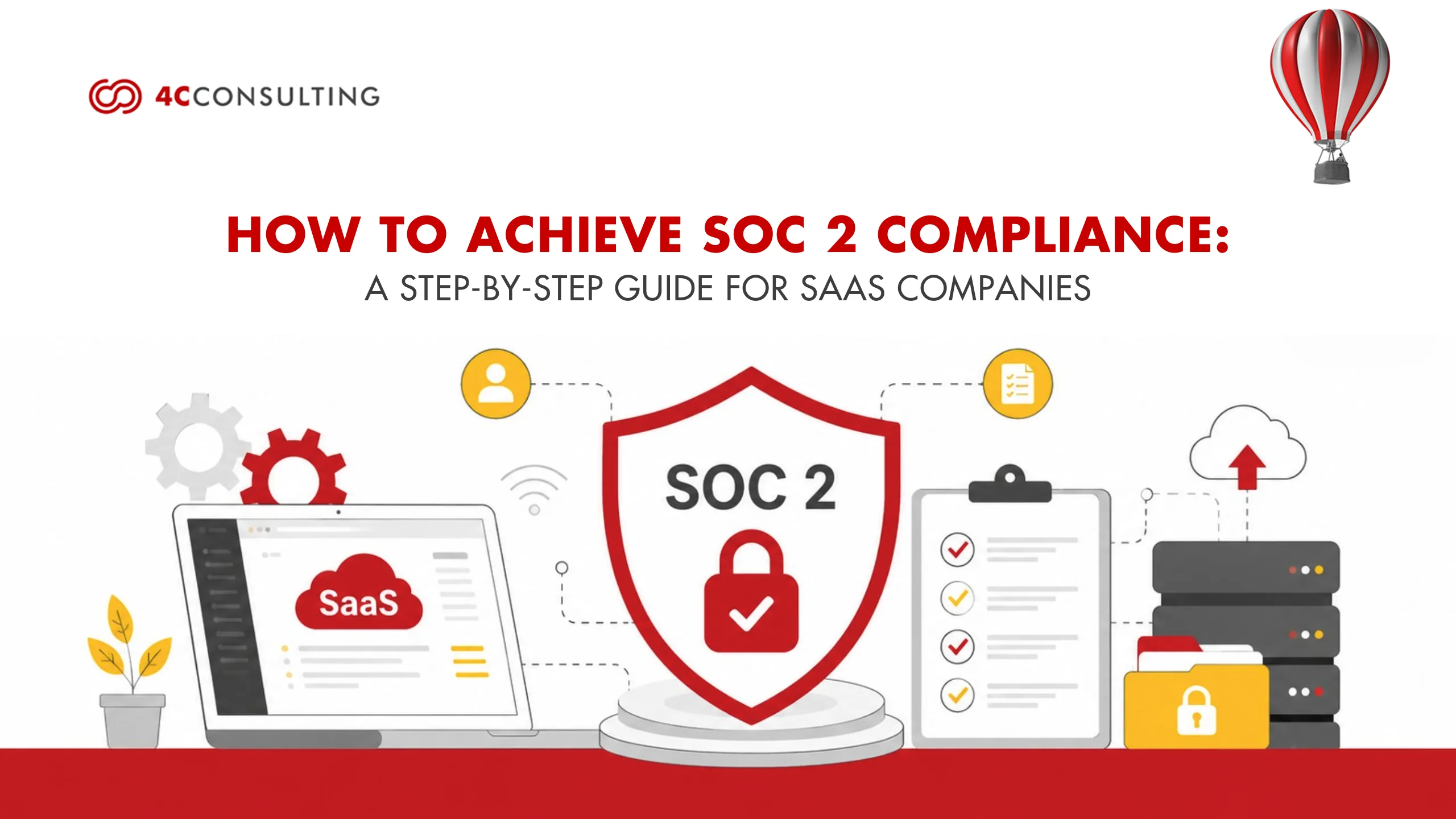
For many SaaS companies, winning enterprise customers comes with a critical question: How do you protect our data and prove that your security controls actually work? As SaaS platforms handle sensitive customer information, cloud infrastructure, applications, and business-critical systems, customers increasingly expect clear evidence of how these environments are protected.
This is where SOC 2 compliance becomes valuable. It provides a structured approach for establishing and demonstrating controls related to security and, where applicable, availability, processing integrity, confidentiality, and privacy. However, achieving compliance involves more than preparing documents before an audit. Companies need to define the right scope, identify gaps, implement effective controls, assign responsibilities, maintain reliable evidence, and ensure those controls work in practice.
So, how to achieve SOC 2 certification without turning it into a last-minute audit exercise? This blog breaks down the SOC 2 compliance process step by step, covering readiness assessment, control implementation, employee responsibilities, evidence collection, audit preparation, common challenges, costs, and timelines specifically for SaaS companies.
What Is SOC 2 Compliance?
SOC 2 compliance is the process of establishing and maintaining controls that address the applicable Trust Services Criteria for a service organization.
The five Trust Services Criteria are:
- Security
- Availability
- Processing Integrity
- Confidentiality
- Privacy
The criteria included in an engagement depend on the organization’s services, commitments, systems and business requirements. For a SaaS company, this can involve controls related to user access, system changes, security monitoring, incident management, data protection, employee responsibilities, vendor management and business continuity.
SOC 2 is generally associated with an independent examination and report rather than a certification in the same format as an ISO certification. In practical terms, businesses use the term SOC 2 compliance to describe the state of having appropriate controls designed, implemented, operated and supported by evidence. For SaaS organizations, the objective is not simply to pass an examination. The goal is to establish controls that become part of normal business operations.
Why SOC 2 Compliance Matters for SaaS Companies
For SaaS companies, security and compliance can directly affect customer acquisition and business growth. Enterprise customers often want evidence that their software provider can protect data, manage access, respond to incidents and maintain reliable technology operations.
A strong SOC 2 programme can help SaaS companies in several practical ways:
1. Build Customer Trust
A SOC 2 report can give customers greater confidence that relevant security and operational controls are formally established and consistently managed.
2. Support Enterprise Sales
SOC 2 can help SaaS companies respond to customer security questionnaires, procurement reviews, vendor assessments and enterprise onboarding requirements. Having documented and tested controls can make these evaluations more structured and easier to handle.
3. Strengthen Security Controls
The SOC 2 process can highlight weaknesses in areas such as user access, employee offboarding, change management, incident response, monitoring and data protection, giving the organization clear areas for improvement.
4. Improve Internal Accountability
SOC 2 requires organizations to establish clear ownership for important controls. This helps teams understand who is responsible for performing, reviewing and maintaining specific compliance activities.
5. Support Business Growth
As SaaS companies move into larger customer segments, stronger compliance practices can help them meet more demanding security expectations and build confidence with enterprise customers and strategic partners.
For a SaaS company, SOC 2 is therefore not just an audit requirement, it can become a practical foundation for stronger security, smoother customer evaluations and sustainable business growth.
How to Achieve SOC 2 Compliance: 7-Step Process
1. Define Your SOC 2 Scope
Before implementing controls, determine what the SOC 2 engagement will actually cover.
A SaaS company may have several products, applications, cloud environments, offices, teams and supporting systems. Bringing everything into scope without evaluating its relevance can unnecessarily increase implementation and audit effort.
Start by identifying:
- The product or service being assessed
- Systems supporting that service
- Customer information handled
- Relevant applications and infrastructure
- Key business functions
- Cloud platforms and technology dependencies
- Third-party services that support the scoped service
- Locations and teams involved in delivering the service
The scope should clearly describe the boundaries of the system being assessed.
For example, if a company operates three SaaS products but only one handles the enterprise customer data covered by the engagement, it may not make sense to automatically include every system and process across the organization. A clearly defined scope creates a practical foundation for the entire SOC 2 compliance process.
2. Select the Applicable Trust Services Criteria
Once the scope is clear, determine which Trust Services Criteria are relevant to the organization. Security is central to SOC 2 engagements, while Availability, Processing Integrity, Confidentiality and Privacy may be included depending on the nature of the service and customer expectations. The selection should be based on what the company actually provides and the commitments it makes to customers.
For example:
- A SaaS platform with strong uptime commitments may need to address Availability.
- A platform handling sensitive business information may consider Confidentiality.
- A system responsible for processing transactions or other critical information may need to address Processing Integrity.
- A service handling personal information may need to consider Privacy.
The objective is to establish a scope and criteria combination that accurately reflects the organization’s service and risk environment.
3. Conduct a SOC 2 Readiness Assessment
Once the scope and applicable criteria are established, the organization needs to understand where it currently stands. A SOC 2 readiness assessment identifies gaps between existing practices and the controls needed for the planned engagement.
For a SaaS company, the assessment may examine areas such as:
- User access and authentication
- Employee onboarding and offboarding
- Privileged access
- Security awareness
- Risk management
- Incident response
- Change management
- Vulnerability management
- System monitoring
- Backup and recovery
- Vendor management
- Data protection
- Policy management
The assessment should look beyond documentation.
For every important control, ask:
Does the control exist? Who owns it? How often is it performed? What evidence is generated? How is it reviewed?
This distinction is important because having a policy that says access should be reviewed does not demonstrate that access reviews are actually performed. A good readiness assessment gives management a prioritized list of gaps rather than a long collection of theoretical requirements.
4. Implement and Document Required Controls
After identifying gaps, the next step is to implement the required controls.
For SaaS companies, these may include controls around:
- Access Management: Establish appropriate user access, authentication, privileged-access controls and periodic access reviews.
- Change Management: Define how changes to applications, infrastructure and critical systems are requested, reviewed, approved, tested and deployed.
- Security Monitoring: Establish appropriate methods for identifying unusual activity, security events, vulnerabilities and other relevant threats.
- Incident Management: Define how security incidents are reported, assessed, escalated, investigated, resolved and reviewed.
- Data Protection: Establish controls for protecting sensitive information throughout its relevant lifecycle.
- Backup and Recovery: Define how critical information and systems are backed up and how recovery capabilities are tested.
- Vendor Management: Evaluate relevant third parties and establish processes for monitoring vendors that have access to systems or information within the defined scope.
Documentation should support these controls but it should not become the objective itself. A common mistake is creating extensive policies without changing the underlying process. SOC 2 examination requires controls to work in practice, not simply appear in documentation.
5. Train Employees and Assign Control Owners
Technology alone cannot maintain SOC 2 controls. Employees across security, engineering, HR, IT, operations, finance and management may have responsibilities that affect compliance. This makes clear control ownership essential.
Every important control should have a defined owner who understands:
- What needs to be done
- How frequently it needs to be performed
- What evidence needs to be retained
- Who reviews the activity
- What happens when an exception occurs
For example, HR may be responsible for ensuring employee onboarding and termination information reaches the appropriate teams, while IT or security may be responsible for granting or removing system access.
SOC 2 training should therefore be role-based wherever practical. Employees do not need to memorize the entire framework. They need to understand the controls relevant to their responsibilities and why those controls matter. Training should also be refreshed when there are significant changes to systems, policies, responsibilities or security risks.
6. Collect Evidence and Test Controls
One of the biggest differences between having a control and demonstrating a control is evidence. Suppose a company requires quarterly access reviews. During an examination, it may need to demonstrate that those reviews were actually completed, who performed them, what was reviewed and how inappropriate access was addressed.
Depending on the control, evidence may include:
- Access review records
- Security training records
- Change approvals
- Incident reports
- Vulnerability assessment results
- Backup testing records
- Vendor assessments
- Risk assessments
- Monitoring records
- Meeting or review records
Evidence should be consistent, traceable and retained in a way that makes it easy to retrieve. The organization should also test controls before the formal SOC 2 audit. Internal testing can reveal missing evidence, inconsistent execution, unclear ownership or controls that are not operating as intended. This is much better than discovering the same issue when an external auditor asks for evidence.
7. Prepare for the SOC 2 Compliance Audit
After controls have been implemented and tested, the organization can prepare for the formal examination. Audit readiness should include more than collecting policies in one folder. The organization should verify that:
- Controls are being performed consistently
- Evidence is available for the required activities
- Control owners understand their responsibilities
- Exceptions have been documented
- Corrective actions have been addressed
- Policies are current
- Relevant employees can explain their processes
- Supporting records can be retrieved efficiently
A final readiness review can simulate the type of questions and evidence requests that may arise during the examination. This gives control owners an opportunity to identify weaknesses before the formal review begins.
For organizations that lack internal experience, SOC 2 certification services or readiness support can help structure this stage and coordinate the different teams involved.
Ready to Prepare Your SaaS Company for SOC 2 Compliance?
Common SOC 2 Compliance Challenges for SaaS Companies
Even technically mature SaaS companies can face practical challenges when turning existing security practices into a structured SOC 2 control environment. These challenges often become more visible as the organization prepares to collect evidence and demonstrate that controls are working consistently.
1. Missing Audit Evidence
Teams may perform important security and compliance activities but fail to maintain consistent evidence of what was done, when it was done and who reviewed it. This can become a problem during the SOC 2 examination when auditors need to verify that controls operated as expected. Using defined evidence requirements for each control can help teams avoid relying on emails, informal approvals or incomplete records.
2. Weak Access Management
Rapid employee growth, multiple applications, privileged accounts and third-party access can make it difficult to maintain appropriate access throughout the user lifecycle. Without periodic access reviews and a defined joiner-mover-leaver process, unnecessary permissions can remain active longer than intended.
3. Unclear Control Ownership
A control involving multiple departments can easily fall through the cracks when no single person is responsible for ensuring that it is performed and reviewed. This is common when responsibilities are shared between security, IT, HR, engineering and operations. Assigning a clear owner, review frequency and evidence requirement to each key control makes accountability easier to maintain.
4. Cloud and Third-Party Dependencies
SaaS companies often depend on cloud infrastructure, hosting providers, payment platforms, communication tools and other external services. These dependencies can make it difficult to determine which controls are managed internally and which rely on third-party providers. Organizations should clearly identify these dependencies and consider how they affect the controls within their SOC 2 scope.
5. Inconsistent Change Management
SaaS development teams may release application and infrastructure changes frequently. Without a defined process for reviewing, approving, testing and documenting significant changes, organizations may struggle to demonstrate that changes are properly controlled. A consistent change-management workflow helps connect development activity with the evidence required for SOC 2.
6. Last-Minute Audit Preparation
Waiting until the audit is close before reviewing controls and collecting evidence can leave little time to address recurring gaps. Organizations that monitor controls, review evidence and address exceptions throughout the compliance period are better positioned for a smoother SOC 2 examination.
How 4C Consulting Can Help with SOC 2 Compliance
Achieving SOC 2 compliance often requires coordination between technology, security, HR, operations, management and other business functions. 4C Consulting can help organizations structure this process and prepare their control environment for examination.
Our SOC 2 consulting services can include:
- SOC 2 readiness assessment
- Gap analysis and requirement mapping
- Policy and documentation support
- Risk assessment
- Control implementation guidance
- SOC 2 training and awareness
- Evidence-readiness support
- Internal audit and readiness review
- Corrective-action support
- SOC 2 examination preparation
Our approach focuses on building practical controls that fit the organization’s existing processes instead of creating unnecessary documentation or complicated compliance layers.
Ready to assess your SOC 2 readiness? Connect with our SOC 2 consultants to identify gaps, strengthen your controls and prepare for the examination.
Frequently Asked Questions About SOC 2 Compliance
1. What is SOC 2 compliance?
SOC 2 compliance means establishing and maintaining controls that address the applicable Trust Services Criteria and preparing the organization to demonstrate that those controls are appropriately designed and operating as intended.
2. Is SOC 2 mandatory for SaaS companies?
SOC 2 is not universally mandatory for SaaS companies. However, enterprise customers and business partners may request a SOC 2 report as part of their vendor evaluation and security assessment process.
3. What are the SOC 2 certification requirements?
The applicable SOC 2 certification requirements depend on the organization’s scope and selected Trust Services Criteria. Companies generally need defined policies, appropriate controls, assigned responsibilities, evidence of implementation and processes for monitoring and reviewing those controls.
4. How much does SOC 2 certification cost?
The cost depends on factors such as the organization’s scope, control maturity, examination type, systems, remediation requirements, technology investments and external consulting or examination fees.
5. How long does SOC 2 compliance take?
There is no universal timeline. The duration depends on the organization’s current control environment, scope, resources, remediation requirements and whether it is preparing for a Type 1 or Type 2 engagement.
6. What does a SOC 2 compliance audit check?
A SOC 2 examination evaluates the organization’s system and relevant controls against the applicable Trust Services Criteria. The review considers whether controls are appropriately designed and, where applicable, whether they operate effectively over the defined period.
7. Do SaaS companies need a SOC 2 consultant?
A consultant is not mandatory but a SOC 2 certification consultant can help SaaS companies assess readiness, identify gaps, establish controls, organize evidence, train employees and prepare for the examination.
8. What documents are required for SOC 2 compliance?
The exact documentation depends on the organization’s scope and applicable controls but commonly required evidence may include:
- Information security policies
- Access-control procedures
- Incident-response documentation
- Risk assessments
- Change-management records
- Vendor-management records
- Training records
- Monitoring and review evidence

Dr.Jigar Doshi
Vice PresidentJigar Doshi is a Vice President at 4C Consulting with expertise in Operational Excellence, ISO 27001, NABL, SOC 2, IATF 16949, and AS 9100. He helps organizations strengthen operational performance, information security, quality systems, and industry-specific compliance frameworks. With expertise across diverse management standards, Jigar focuses on helping businesses establish robust systems that improve performance, compliance, and organizational excellence.