
Table of Contents
- What is FSSC 22000 Certification?
- Why Was FSSC 22000 Version 7 Introduced?
- FSSC 22000 V6 vs FSSC 22000 V7
- What Are the Key Changes in FSSC 22000 Version 7?
- Prepare for FSSC 22000 Version 7 Transition
- FSSC 22000 Version 7 Transition Timeline
- How to Prepare for FSSC 22000 Version 7 Transition
- What Are the Benefits of FSSC 22000 Version 7?
- How 4C Consulting Can Help with FSSC 22000 Version 7
- Frequently Asked Questions (FAQs)
FSSC 22000 Version 7: Key changes, transition timeline and preparation guide
14th Aug, 2026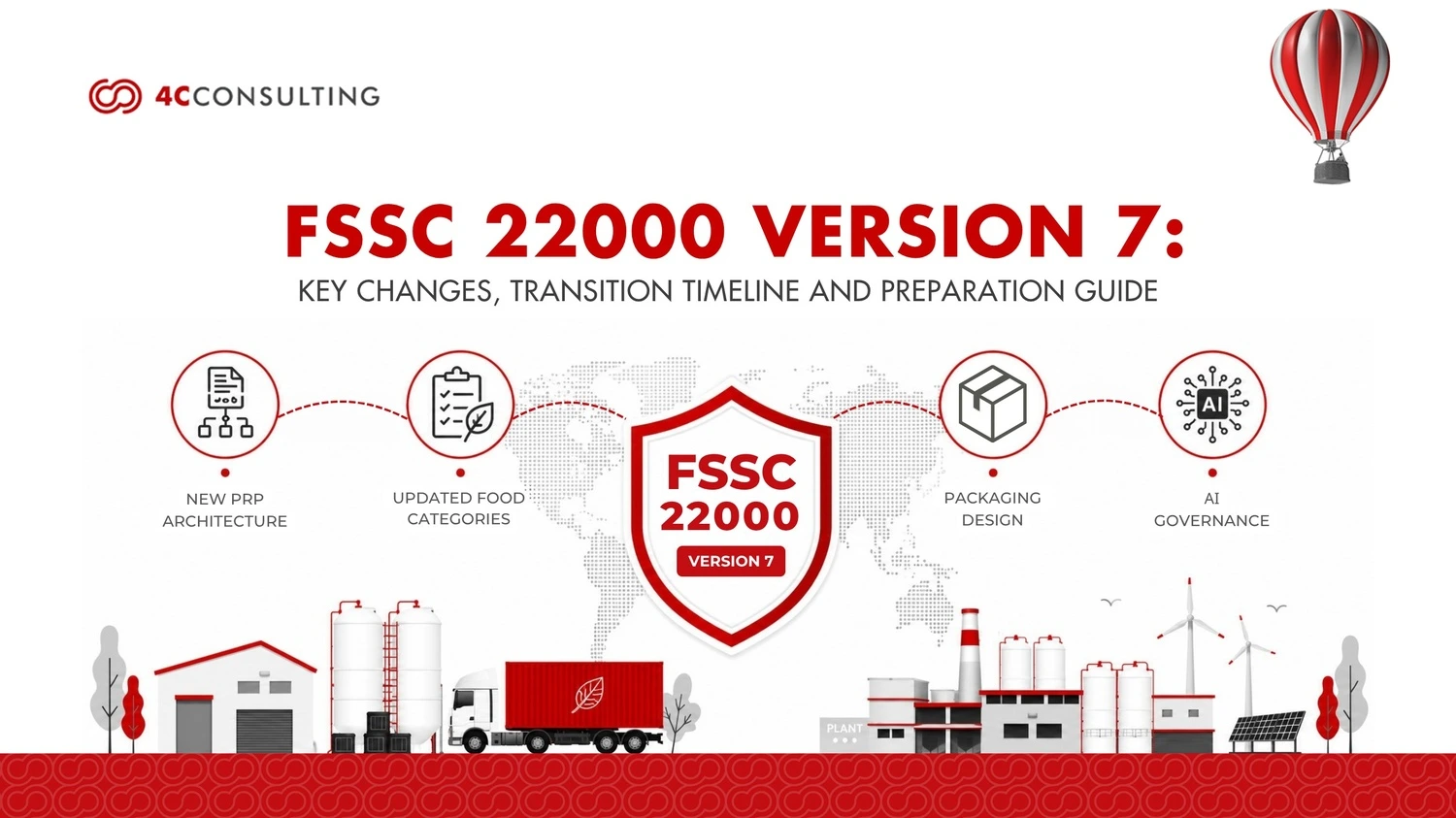
FSSC 22000 Version 7 is here and organizations certified to Version 6 now need to start preparing for the transition. Officially published on 1 May 2026, the new version introduces important updates to the FSSC 22000 certification scheme, including changes to ISO 22002-x:2025 prerequisite programme standards, food chain categories, auditor competence, packaging design, sustainability, and Artificial Intelligence.
For organizations currently certified to FSSC 22000 Version 6, understanding these changes early can make the transition smoother and help avoid compliance gaps during the FSSC 22000 Version 7 upgrade audit. Organizations planning to implement FSSC 22000 can also use these updates to build their Food Safety Management System in line with the latest scheme requirements.
In this blog, we’ll break down the key changes in FSSC 22000 Version 7, the transition timeline, the requirements organizations need to review, and the practical steps to prepare for the upgrade audit.
What is FSSC 22000 Certification?
FSSC 22000 is a globally recognized Food Safety Management System (FSMS) certification scheme for organizations across the food supply chain. It combines the requirements of ISO 22000, relevant Prerequisite Programmes (PRPs) based on the ISO 22002-x series, and additional FSSC requirements.
The scheme provides organizations with a structured approach to managing food safety risks, controlling food safety hazards, meeting applicable requirements, and continually improving their food safety management processes.
FSSC 22000 certification is applicable across different sectors of the food chain, including food manufacturing, packaging, storage and distribution, catering, feed, and other relevant categories.
Because FSSC 22000 is GFSI-recognized, certification is widely valued by food manufacturers, retailers, brands, and supply chain partners operating in international markets.
Why Was FSSC 22000 Version 7 Introduced?
Version 7 was developed to keep the FSSC 22000 scheme aligned with developments in international food safety requirements and the changing needs of the food industry.
According to the Foundation FSSC, the main drivers behind the Version 7 revision include:
- Adoption of the new ISO 22002-x:2025 series for Prerequisite Programmes
- Alignment with the GFSI Benchmarking Requirements 2024
- Stronger support for organizations contributing to the UN Sustainable Development Goals (SDGs)
- A clearer structure for food chain categories and subcategories
- Editorial updates and improvements to make the scheme easier to understand and apply
This means Version 7 is not simply a document update. Organizations need to review how the revised requirements affect their existing Food Safety Management System and determine where changes are necessary.
FSSC 22000 V6 vs FSSC 22000 V7
The most important V7 changes can be summarized as follows:
| Area | FSSC 22000 V6 | FSSC 22000 V7 |
|---|---|---|
| Prerequisite Programmes (PRPs) | Existing ISO/TS 22002-x and related PRP references | New ISO 22002-x:2025 series |
| PRP Structure | Sector-specific standards | ISO 22002-100:2025 common baseline plus applicable sector-specific parts |
| Food-Chain Categories | Existing category structure | More defined food-chain categories and subcategories |
| Auditor Competence | V6 competency requirements | Updated requirements aligned with revised categories and GFSI benchmarking |
| Product Design & Development | Existing requirements | Updated requirements, including sustainable packaging considerations where applicable |
| Food Loss & Waste | Existing Additional Requirement | Continued requirement with added packaging-design considerations |
| Packaging Design | No specific V7 packaging-design requirement | New packaging-design principles for applicable organizations |
| AI | Existing scheme framework | Specific AI governance requirements for AI used in certification |
| Additional Requirements | Existing V6 requirements | Requirements strengthened, revised, or relocated where applicable |
| Transition | Version 6 | 12-month transition period |
FSSC confirms that the principal drivers for V7 include the new ISO 22002-x:2025 series, alignment with GFSI Benchmarking Requirements 2024, stronger support for the UN Sustainable Development Goals, a more defined food-chain category structure and continuous-improvement amendments.
What Are the Key Changes in FSSC 22000 Version 7?
1. New ISO 22002-x:2025 Prerequisite Programme Standards
One of the most important changes in FSSC 22000 Version 7 is the move to the new ISO 22002-x:2025 series for Prerequisite Programmes. The new structure introduces ISO 22002-100:2025 as a common baseline for PRP requirements across the food chain, supported by sector-specific parts depending on the organization’s activities.
For example, an organization involved in food manufacturing will need to consider the relevant sector-specific requirements together with the common baseline.
This updated structure is intended to create greater consistency, reduce duplication, and provide clearer PRP requirements for organizations operating across different food sectors.
What should organizations review?
Organizations transitioning to Version 7 should assess:
- Existing PRP procedures
- Cleaning and sanitation controls
- Hygiene requirements
- Facility and infrastructure controls
- Equipment-related controls
- Relevant sector-specific PRP requirements
- Existing documentation and records
The transition therefore requires more than simply changing references from the old PRP standards to the new ISO 22002-x:2025 requirements.
2. Updated Food Chain Categories and Subcategories
Version 7 introduces a more clearly defined structure for food chain categories and subcategories. This is important because the applicable requirements, PRPs, and audit arrangements depend on the organization’s scope and food chain activities.
Organizations should therefore review their existing FSSC 22000 scope, category, and subcategory classification to ensure that they remain correctly defined under Version 7.
For businesses operating across multiple activities or sites, this review becomes particularly important because an incorrect scope classification can affect the applicable requirements and certification process.
3. Updated Auditor Qualification Requirements
FSSC 22000 Version 7 also updates requirements related to auditor competence and qualification.
The changes are linked to the latest GFSI benchmarking requirements and the clearer division of food chain categories. Auditors are expected to have appropriate knowledge and competence relating to products, processes, practices, legislation, and regulations relevant to the sectors they audit.
For certified organizations, this means audits under the new version will continue to place importance on competent assessment of the organization’s actual food safety processes not simply documentation.
4. Greater Focus on Sustainable Food Packaging
Sustainability receives greater attention in Version 7, including the introduction of Save Food Packaging design principles for organizations involved in the design of packaging materials.
The requirement connects packaging design with the reduction of Food Loss and Waste (FLW). Organizations involved in designing primary packaging and packaging materials need to consider how packaging can protect and preserve food throughout the supply chain while supporting waste reduction.
This can include considerations related to:
- Product protection
- Preservation
- Shelf-life extension
- Packaging functionality
- Ease of opening and resealing
- Portion-related considerations
- Reducing food loss and waste
For organizations within the applicable scope, packaging design should therefore be reviewed as part of the Version 7 transition.
5. AI Governance in the FSSC 22000 Certification Process
FSSC 22000 Version 7 introduces specific requirements for the use of Artificial Intelligence (AI) within the certification process. These requirements are primarily directed at Certification Bodies (CBs) to ensure that AI is used in a controlled, reliable, and transparent manner.
Under Version 7, Certification Bodies using AI in certification activities are expected to establish an appropriate AI governance framework that includes:
- Conducting risk assessments for AI use
- Testing and validating AI systems before and during use
- Monitoring AI performance and effectiveness
- Clearly defining roles and responsibilities for AI-related activities
- Maintaining appropriate human oversight and judgement
- Ensuring AI does not replace key certification decisions or professional judgement
- Maintaining transparency about relevant AI use and communicating it to applicable stakeholders
The objective is to ensure that AI supports the FSSC 22000 certification process without compromising the reliability, impartiality, or integrity of certification activities.
6. Stronger Alignment with GFSI Benchmarking Requirements
FSSC 22000 Version 7 has been aligned with the GFSI Benchmarking Requirements 2024. This alignment supports greater consistency between FSSC 22000 and the broader expectations used within globally recognized food safety certification schemes.
For certified organizations, the practical implication is that the Food Safety Management System should be reviewed not only against individual FSSC requirements but also in terms of how effectively the overall system controls food safety risks and supports continual improvement.
7. Greater Support for Sustainability Objectives
Version 7 also strengthens the connection between food safety management and sustainability objectives. The inclusion of packaging design principles related to food loss and waste is one example of how the updated scheme supports broader sustainability goals.
This creates an opportunity for organizations to look beyond basic compliance and connect food safety activities with resource efficiency, waste reduction, and responsible production practices.
Prepare for FSSC 22000 Version 7 Transition
FSSC 22000 Version 7 Transition Timeline
Understanding the transition dates is critical for organizations currently certified to Version 6. FSSC 22000 Version 7 was published on 1 May 2026, and the Foundation FSSC has established a 12-month transition period for organizations and Certification Bodies to prepare for the new requirements.
Key transition dates
| Timeline | Requirement |
|---|---|
| 1 May 2026 | FSSC 22000 Version 7 published |
| Until 30 April 2027 | Audits against Version 6 are permitted |
| 1 May 2027 | Version 7 upgrade audits begin |
| 1 May 2027 – 30 April 2028 | Version 7 upgrade audit period |
Organizations certified to Version 6 should use the transition period to evaluate their current system, identify gaps, update applicable processes and prepare for the Version 7 upgrade audit.
How to Prepare for FSSC 22000 Version 7 Transition
Preparing early can make the transition significantly easier. Organizations should avoid treating Version 7 as a documentation exercise and instead evaluate how the new requirements affect their actual operations.
1. Conduct a Version 7 Gap Assessment
Compare your existing FSSC 22000 Version 6 system against the Version 7 requirements.
The assessment should identify gaps related to:
- New ISO 22002-x:2025 PRPs
- Food chain category and scope
- Packaging design, where applicable
- AI governance, where applicable
- Auditor and certification requirements
- Sustainability-related requirements
2. Review Your PRP System
Review existing prerequisite programmes against the applicable ISO 22002-x:2025 requirements.
Identify which procedures need revision and determine whether additional controls, records, or monitoring activities are required.
3. Review Food Chain Category and Scope
Confirm that your organization’s certification scope and food chain category/subcategory remain appropriate under Version 7.
This is particularly important for organizations with complex or multi-sector operations.
4. Review Packaging Design Controls
If your organization designs primary packaging or packaging materials, review existing product and packaging development processes against the new requirements related to food loss and waste reduction.
5. Assess AI Use
Identify where Artificial Intelligence is being used within relevant processes and determine whether appropriate governance, risk assessment, validation, monitoring, responsibilities, and training are in place.
6. Train Relevant Employees
Employees responsible for food safety, quality, production, procurement, packaging, internal auditing, and management should understand the changes relevant to their roles.
FSSC 22000 Version 7 training can help teams understand what has changed and how those changes affect day-to-day operations.
7. Conduct an Internal Audit Before the Upgrade Audit
After implementing the necessary changes, conduct a comprehensive FSSC 22000 internal audit against Version 7.
This provides an opportunity to identify and correct gaps before the Certification Body conducts the upgrade audit.
8. Review the System Through Management Review
Top management should evaluate the readiness of the Food Safety Management System, including audit results, identified gaps, corrective actions, objectives, risks, and improvement opportunities.
This helps ensure that Version 7 transition activities are properly supported at the management level.
What Are the Benefits of FSSC 22000 Version 7?
The Version 7 changes are intended to create a clearer and more consistent certification framework while strengthening food safety and supporting sustainability objectives.
For organizations, the transition can help:
- Improve the consistency of Prerequisite Programme implementation
- Strengthen food safety risk management
- Improve clarity around food chain categories
- Support reduction of food loss and waste
- Strengthen packaging design considerations where applicable
- Improve auditor competency and sector-specific assessment
- Establish better governance around the use of AI
- Support continual improvement of the Food Safety Management System
- Maintain access to customers and supply chains that recognize FSSC 22000 certification
The transition from Version 6 to Version 7 should not be left until the last moment. Even though organizations have a defined transition period, the changes to PRPs, food chain categorization, packaging design, AI governance and other requirements may require time for assessment and implementation.
How 4C Consulting Can Help with FSSC 22000 Version 7
Transitioning to FSSC 22000 Version 7 requires a clear understanding of the revised requirements and how they apply to your organization’s operations.
With 20+ years of consulting experience, 10,000+ successful consulting projects, 30,000+ consulting man-days, and 3,000+ long-term clients, 4C Consulting provides practical support for organizations preparing for FSSC 22000 implementation and transition.
Our support can include:
- FSSC 22000 Version 7 gap assessment
- Transition planning and implementation support
- ISO 22002-x:2025 PRP review
- Documentation and process updates
- Employee awareness and Version 7 training
- Internal audit support
- Management review support
- Certification audit readiness
Whether you are transitioning from FSSC 22000 Version 6 to Version 7 or starting your FSSC 22000 certification journey, our consultants can help you understand the applicable requirements, prioritize gaps, and prepare your Food Safety Management System for certification.
Ready for FSSC 22000 Version 7?
Prepare your organization for the Version 7 transition with practical, expert-led FSSC 22000 consulting support from 4C Consulting.
Frequently Asked Questions (FAQs)
1. What is FSSC 22000 Version 7?
FSSC 22000 Version 7 is the latest version of the FSSC 22000 Food Safety Management System Certification Scheme. It was officially published on 1 May 2026 and introduces updates including the new ISO 22002-x:2025 PRP series, updated auditor competence requirements, clearer food chain categories, sustainability-related requirements, and AI governance.
2. What are the key changes in FSSC 22000 Version 7?
The major changes include the adoption of the ISO 22002-x:2025 PRP series, updated food chain categories, revised auditor qualification requirements, packaging design principles supporting food loss and waste reduction, stronger sustainability alignment, and requirements related to AI governance.
3. When does FSSC 22000 Version 7 become mandatory?
Audits against FSSC 22000 Version 6 are permitted until 30 April 2027. Upgrade audits against Version 7 will take place from 1 May 2027 to 30 April 2028. Organizations should plan their transition within this period according to their Certification Body’s arrangements.
4. What is the difference between FSSC 22000 Version 6 and Version 7?
Version 7 updates the prerequisite programme framework to the new ISO 22002-x:2025 series and introduces changes related to food chain categories, auditor competence, sustainability, packaging design, and AI governance. It is designed to provide a more consistent and updated framework for food safety management.
5. Do FSSC 22000 Version 6 certified organizations need to transition to Version 7?
Yes. Organizations currently certified to Version 6 need to complete the transition to Version 7 within the transition framework established by Foundation FSSC. Version 6 audits are permitted until 30 April 2027, followed by the Version 7 upgrade audit period.
6. What is the new ISO 22002-x:2025 requirement in FSSC 22000 Version 7?
Version 7 adopts the new ISO 22002-x:2025 series for Prerequisite Programmes. ISO 22002-100:2025 provides a common baseline, supported by sector-specific parts applicable to different food chain activities.
7. Does FSSC 22000 Version 7 include AI requirements?
Yes. Version 7 addresses governance for the use of AI in certification-related activities. The approach includes appropriate risk assessment, validation, monitoring, defined responsibilities, training, transparency, and communication, with human judgement remaining important.
8. Does FSSC 22000 Version 7 include food loss and waste requirements?
Version 7 strengthens the connection between food loss and waste reduction and packaging design. Organizations involved in designing primary packaging and packaging materials are required to consider relevant packaging design principles that support product protection and help reduce food loss and waste.
9. How can I prepare for FSSC 22000 Version 7?
Start with a FSSC 22000 Version 7 gap assessment, then review your applicable PRPs, certification scope, food chain category, packaging design controls, AI governance where relevant, documentation, training, and internal audit programme. Address identified gaps before the Version 7 upgrade audit.
10. Do I need FSSC 22000 Version 7 training?
Training is recommended for personnel responsible for implementing and maintaining the Food Safety Management System. Version 7 training can help relevant employees understand the revised requirements and apply them effectively within their areas of responsibility.

Sachin Mohan
General ManagerSachin Mohan is a General Manager at 4C Consulting with expertise in Food Standards, ISO 9001, ISO 14001, ISO 45001, SEDEX, and SA 8000. He supports organizations in strengthening management systems, improving compliance, and aligning business processes with recognized quality, environmental, health & safety, and social responsibility standards. His expertise helps businesses build structured systems that support responsible operations and continual improvement.