
Table of Contents
- What Is Flash Point?
- Flash Point Examples of Common Fuels and Solvents
- What do these values tell us?
- Flash Point vs Fire Point vs Autoignition Temperature
- Why Flash Point Matters for Industrial Fire Safety
- How to Find and Interpret Flash Point Information in an SDS
- Flash Point Testing Methods: How Is It Measured?
- Why Can Flash Point Values Differ Between Test Methods?
- Why Is Accurate Flash Point Testing Important?
- Best Practices for Handling and Storing Flammable Liquids
- Common Misconceptions About Flash Point
- How 4C Consulting Can Support Workplace Safety and Compliance
- FAQ’s
Understanding Flash Point: How It Guides Industrial Fire Safety and Chemical Handling
16th Oct, 2026
Flammable liquids are used across manufacturing plants, chemical processing facilities, warehouses and maintenance operations. However, the fire risk they present is not always obvious. A liquid can release ignitable vapours even when it is nowhere near its boiling point, making safe storage and handling an important concern for industrial facilities.
This is where flash point becomes an important safety parameter. Understanding the flash point of flammable liquids helps organizations assess ignition hazards, evaluate chemical handling procedures and select appropriate fire-prevention controls.
In this blog, we’ll explain what flash point means, how it differs from other ignition-related temperatures, and how businesses can use this information to improve fire safety and hazardous materials handling.
What Is Flash Point?
Flash point is the lowest temperature at which a liquid produces enough vapour to ignite momentarily when exposed to an ignition source under specified test conditions. It is an important physical property used to assess the fire hazards associated with flammable liquids and determine appropriate precautions for their storage, handling and use. A liquid with a lower flash point can produce ignitable vapours at relatively lower temperatures, making flash point an important consideration in industrial fire safety and chemical handling.
Flash Point Examples of Common Fuels and Solvents
Flash point values help illustrate why different liquids require different safety precautions. The following examples are representative reported values, not universal specifications for every product.
| Liquid | Representative flash point | Testing information |
|---|---|---|
| Petrol (gasoline) | Approximately −38°C | Reported by NOAA CAMEO; test method not specified in the cited entry |
| Diesel fuel No. 2 | Approximately 52°C | Closed-cup value reported by the International Chemical Safety Card |
| Acetone | Approximately −20°C | Closed-cup value reported in Merck/Sigma-Aldrich product information |
| Ethanol | Approximately 13°C | Reported in manufacturer product information; method not specified on the cited page |
What do these values tell us?
Petrol and acetone have low flash points, meaning they can produce ignitable vapours at temperatures well below typical workplace temperatures. Diesel fuel No. 2 generally has a higher flash point, but it still requires appropriate storage and handling controls. Ethanol can also present a fire hazard at ordinary workplace temperatures.
Values can vary with fuel composition, solvent purity, additives and test method. For a specific product, always consult its current Safety Data Sheet (SDS) or a reliable test report before making safety or compliance decisions.
Flash Point vs Fire Point vs Autoignition Temperature
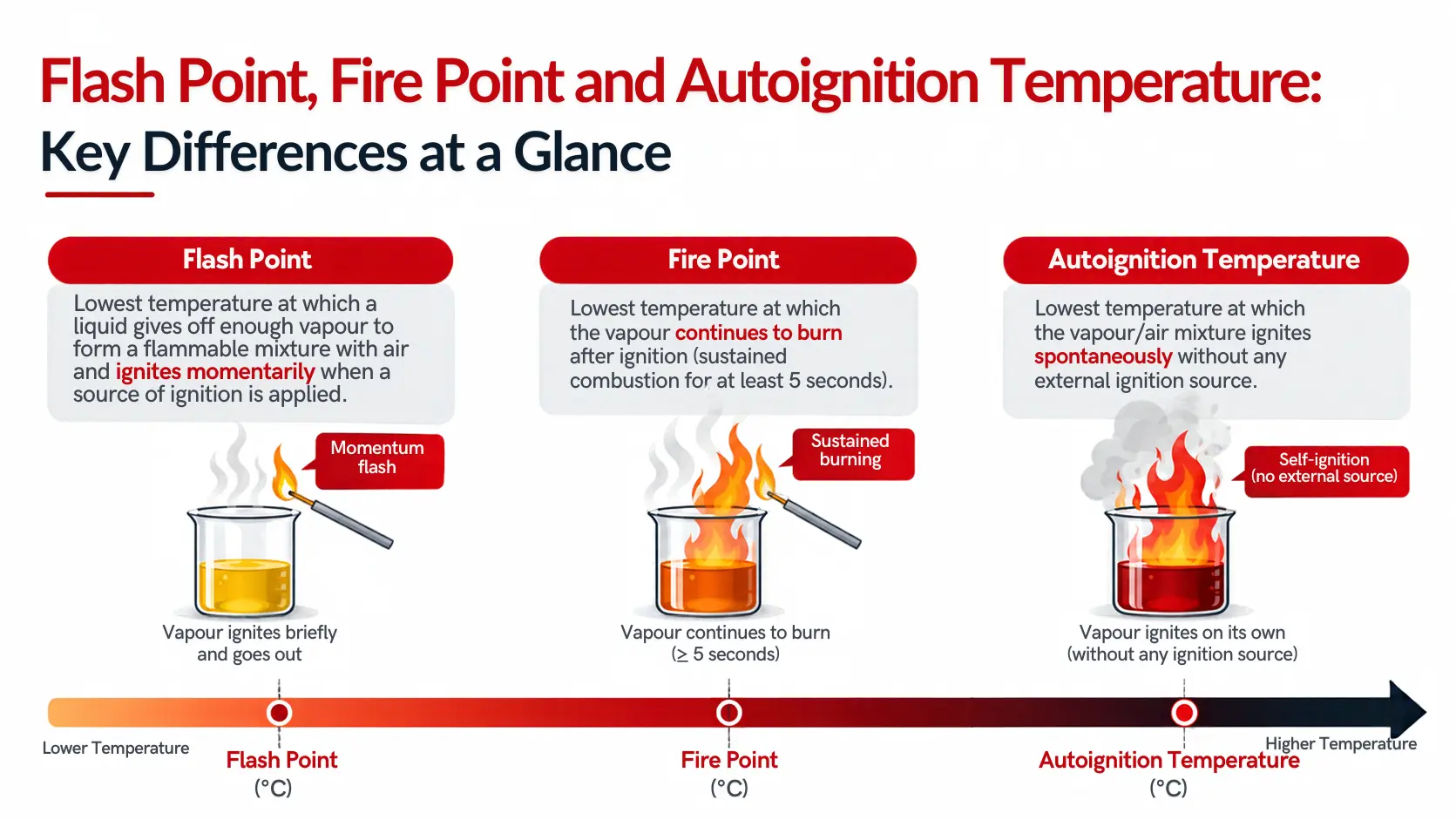
Flash point, fire point and autoignition temperature are related to fire hazards, but they describe different conditions. Understanding the difference helps safety professionals assess flammable liquids and select appropriate handling controls.
| Property | What it means | Why it matters |
|---|---|---|
| Flash Point | The lowest temperature at which a liquid produces enough vapour to ignite momentarily under specified test conditions. | Helps assess the ignition hazard associated with flammable liquids. |
| Fire Point | The temperature at which vapour continues to burn for a specified period under the applicable test method. | Indicates when sustained burning can occur under test conditions. |
| Autoignition Temperature | The temperature at which a substance can ignite without an external ignition source under specified conditions. | Helps assess ignition hazards associated with hot surfaces and elevated temperatures. |
What Is the Practical Difference?
- Flash point: An external ignition source, such as a spark or flame, is introduced.
- Fire point: Burning continues rather than stopping after the initial flash.
- Autoignition temperature: The substance ignites without an external spark or flame.
Why Does This Difference Matter in Industrial Safety?
Consider a facility that stores cleaning solvents and operates equipment that generates heat or sparks.
- Flash point data helps assess the conditions under which the solvents may release ignitable vapours.
- Fire point provides additional information about sustained burning behaviour.
- Autoignition temperature helps safety teams consider hazards involving hot surfaces and elevated operating temperatures.
These properties support different parts of a fire risk assessment. They should not be treated as interchangeable values or used individually to determine whether a chemical is safe to handle. Temperature, ventilation, quantity, ignition sources and applicable storage requirements must also be considered.
Why Flash Point Matters for Industrial Fire Safety
Knowing the flash point of a liquid is useful only when that information guides practical safety decisions. In industrial facilities, it helps safety teams understand potential ignition hazards and determine which controls are needed during storage, handling and routine operations.
1. Identifying Ignition Hazards
Flash point data helps organizations assess the fire hazards associated with solvents, fuels, paints and other flammable liquids. For example, using a low-flash-point solvent near welding or grinding operations requires careful assessment because sparks can ignite flammable vapours. Identifying these hazards early helps teams establish appropriate controls before work begins.
2. Planning Safe Storage and Handling
Storage and handling procedures should reflect the properties of the materials being used.
Depending on the chemical and applicable requirements, controls may include:
- Storing flammable liquids in suitable, designated areas.
- Keeping containers closed when materials are not in use.
- Providing appropriate ventilation to prevent hazardous vapour accumulation.
- Separating incompatible materials and controlling ignition sources.
- Following applicable requirements for flammable-liquid storage and transfer.
Flash point is one factor in selecting these controls; the chemical’s classification, quantity, storage conditions and other hazard information also matter.
3. Controlling Risks During Operations
Fire hazards can arise during activities such as dispensing, mixing, equipment cleaning and maintenance. Consider a worker transferring solvent from a storage drum into a smaller container. Vapours may escape during the transfer, creating an ignition hazard if suitable controls are not in place. A safer procedure should consider the material’s hazards, ventilation, suitable transfer equipment, ignition-source control and any necessary bonding and grounding measures to manage static electricity.
4. Supporting Workplace Risk Assessments
Flash point information can help safety professionals evaluate whether existing controls are suitable for the actual working conditions.
A useful assessment should consider:
- The flash point and other relevant chemical properties.
- The temperature at which the material is stored or used.
- Potential ignition sources and vapour accumulation.
- The quantity handled and the likelihood of spills.
- Existing engineering controls, procedures and emergency arrangements.
Flash point data helps safety teams evaluate potential ignition hazards and determine whether existing workplace controls are appropriate.
How to Find and Interpret Flash Point Information in an SDS
Before handling a chemical, workers should know where to find its fire-related hazards and how to interpret the information correctly. A Safety Data Sheet (SDS) provides essential details about a substance, including its physical properties, hazards and recommended precautions.
Where Is Flash Point Listed in an SDS?
Flash point is generally reported in Section 9: Physical and Chemical Properties.
When reviewing this section, check:
- Flash point value: The reported temperature at which the liquid can produce ignitable vapours under the specified test conditions.
- Test method: Whether the result was obtained using a closed-cup or open-cup method.
- Other physical properties: Such as boiling point, vapour pressure and flammability information, where available.
How Should You Use This Information?
The reported flash point should be considered alongside the conditions in which the chemical will be handled. For example, if a cleaning solvent has a flash point below the temperature of the work area, safety personnel should assess whether ignitable vapours could form and whether existing ventilation and ignition-source controls are adequate.
Use the SDS to help determine appropriate precautions, but do not rely on the flash point alone. Review the manufacturer’s handling recommendations, workplace risk assessment and applicable safety requirements.
Why Does the Test Method Matter?
Flash point results can vary depending on the test method and testing conditions.
- Closed-cup methods measure flash point in a covered test vessel.
- Open-cup methods measure it in an open test vessel.
The results may differ because the test arrangements affect vapour retention. Therefore, when comparing chemicals or interpreting reported values, check the test method and use data suitable for the intended assessment.
Practical tip: Keep current SDSs accessible to employees, ensure chemical containers are correctly identified, and train workers to locate and understand the relevant hazard information before handling unfamiliar substances.
Flash Point Testing Methods: How Is It Measured?
Flash point testing measures the temperature at which a liquid produces enough vapour to ignite momentarily under specified test conditions. Standardized methods are used to obtain reliable results, and the appropriate method depends on the sample’s properties and the applicable testing standard.
Some examples of ASTM International test methods include:
- ASTM D93 – Pensky-Martens Closed-Cup Tester: Used to determine the flash point of specified petroleum products, including diesel and other suitable petroleum liquids, within the method’s scope.
- ASTM D56 – Tag Closed-Cup Tester: Applies to certain lower-viscosity liquids with flash points below 93°C, subject to the standard’s specified conditions.
- ASTM D92 – Cleveland Open-Cup Tester: Used to determine the flash point and fire point of specified petroleum products. Its scope generally covers products with flash points above 79°C and below 400°C, with fuel oils excluded from the standard’s general application.
Each method has a defined scope based on factors such as sample type, viscosity and expected flash point. They should not be treated as interchangeable. Select the appropriate method according to the material and applicable testing requirements.
Flash point test results support the assessment of chemical properties, but they do not independently establish real-world fire risk or determine every legal classification and storage requirement. These decisions must be checked against the applicable regulations and standards.
Why Can Flash Point Values Differ Between Test Methods?
The reported flash point can vary depending on the test apparatus, procedure and sample composition. Closed-cup and open-cup methods differ in how vapours are retained or released during testing, which can affect the measured result.
When comparing flash point values, check the test method and the conditions under which the measurement was obtained. Use reliable product-specific data rather than assuming that a published value applies to every formulation of the same chemical.
Why Is Accurate Flash Point Testing Important?
Reliable results help organizations evaluate chemical properties and support fire risk assessments. However, a laboratory flash point is not a complete measure of real-world fire risk.
Chemical classification, storage and handling requirements must be verified against the applicable regulations and standards. The flash point should be used alongside other relevant hazard information when determining suitable safety controls.
Best Practices for Handling and Storing Flammable Liquids
Knowing the flash point is only useful when it informs how chemicals are stored, transferred and used. Industrial facilities should combine chemical-specific information with appropriate engineering controls, safe work procedures and employee training.
- Review the SDS Before Handling Chemicals: Check the Safety Data Sheet for flash point, flammability hazards, storage conditions and recommended precautions. Ensure employees can access the latest SDS for the chemicals they use.
- Store Flammable Liquids Appropriately:
- Use suitable, designated storage areas and approved containers where required.
- Keep containers closed when not in use.
- Segregate incompatible chemicals.
- Follow applicable requirements for storage quantities and fire protection.
Storage arrangements should reflect the chemical’s hazards and the relevant local regulations.
- Control Ignition Sources: Sparks, open flames, hot surfaces and static electricity can create ignition hazards when flammable vapours are present. Assess activities such as welding, grinding and solvent transfer. Apply appropriate ignition-source controls and follow established procedures for work in hazardous areas.
- Maintain Suitable Ventilation: Adequate ventilation helps prevent hazardous vapour accumulation. Assess ventilation requirements based on the chemical, quantity handled, work environment and potential for vapour release.
- Prepare for Spills and Emergencies: Establish procedures for chemical spills, fire emergencies and safe evacuation. Provide suitable spill-control materials and ensure employees know when to respond and when to withdraw and raise the alarm.
- Train Employees and Review Procedures: Employees should understand chemical hazards, safe handling procedures, PPE requirements and emergency actions. Review safety procedures whenever chemicals, equipment or operating conditions change.
Common Misconceptions About Flash Point
Misunderstanding flash point can lead to incorrect decisions about chemical handling, storage and fire safety. The following misconceptions clarify what this property can and cannot tell you.
1. A Higher Flash Point Means a Liquid Is Completely Safe
A higher flash point generally indicates that a liquid must reach a higher temperature before producing ignitable vapours under the specified test conditions. However, it does not mean the liquid is non-flammable or safe under every condition.
Other factors, including operating temperature, vapour generation and ignition sources, must also be considered.
2. Flash Point and Boiling Point Are the Same
They describe different properties.
- Flash point relates to the temperature at which a liquid produces enough vapour for momentary ignition.
- Boiling point is the temperature at which a liquid’s vapour pressure equals the surrounding pressure.
A liquid can release ignitable vapours well below its boiling point.
3. A Liquid Must Be Hot to Create a Fire Hazard
Not necessarily. Some liquids have low flash points and can release ignitable vapours at ordinary workplace temperatures. This is why solvents and other volatile liquids require appropriate handling precautions even when they are not being heated.
4. Flash Point Alone Determines Storage Requirements
Flash point is important, but storage requirements may also depend on the substance’s hazard classification, quantity, container type, storage location and applicable regulations. Organizations should review the SDS and relevant legal requirements before deciding how a chemical should be stored.
Always verify the chemical’s properties and applicable safety requirements before finalising storage or handling procedures.
How 4C Consulting Can Support Workplace Safety and Compliance
Managing flammable-liquid hazards requires organizations to identify risks, establish appropriate procedures and review whether safety controls are working effectively.
4C Consulting helps organizations strengthen their occupational health and safety management systems through ISO 45001 implementation, internal audits and professional training. These services can help businesses identify gaps in their existing systems and improve how workplace hazards and risks are managed.
Looking to strengthen your occupational health and safety management system? Contact 4C Consulting to discuss your ISO 45001 implementation or internal audit requirements.
FAQ’s
1. What Is the Flash Point of Petrol and Diesel?
Petrol and diesel behave differently because of their fuel properties. Petrol has a very low flash point, so it can release ignitable vapours even in relatively cool conditions. Diesel generally has a higher flash point and is less likely to produce ignitable vapours at ordinary ambient temperatures. However, both fuels require appropriate storage, careful handling and protection from ignition sources.
2. What Is the Difference Between Flammable and Combustible Liquids?
Flammable and combustible liquids are classified according to the applicable safety regulations. For example, under OSHA’s general-industry standard, 29 CFR 1910.106, a flammable liquid generally has a flash point at or below 93°C (199.4°F), with further categories determined by flash point and boiling point. These thresholds are specific to OSHA’s regulatory framework and should not be treated as universal rules. Organizations must follow the requirements applicable to their location and operations.
3. What Is Considered a High Flash Point?
There is no single flash point value that universally defines a high-flash-point liquid. The interpretation depends on the material, the applicable classification system and the purpose of the assessment. A higher flash point generally means a liquid must reach a higher temperature before producing ignitable vapours under the specified test conditions, but it does not automatically make the liquid safe to handle or store.
4. Can Flash Point Change When a Chemical Is Mixed with Another Substance?
Yes. Mixing liquids can change the properties of the resulting mixture, including its flash point. The extent of the change depends on the substances, their proportions and the characteristics of the mixture. Do not assume that a mixture has the same flash point as its individual ingredients. Use reliable data for the actual formulation or obtain appropriate testing where necessary.
5. Is Flash Point the Same as Flammability?
No. Flash point is a specific measured property that indicates when a liquid can produce enough vapour for momentary ignition under defined test conditions. Flammability is a broader characteristic involving how a substance ignites and burns. Flash point is useful for assessing certain fire hazards, but it does not describe every aspect of a material’s flammability.

Sachin Mohan
General ManagerSachin Mohan is a General Manager at 4C Consulting with expertise in Food Standards, ISO 9001, ISO 14001, ISO 45001, SEDEX, and SA 8000. He supports organizations in strengthening management systems, improving compliance, and aligning business processes with recognized quality, environmental, health & safety, and social responsibility standards. His expertise helps businesses build structured systems that support responsible operations and continual improvement.