
Table of Contents
- What Are the 4 Methods of Extinguishing Fire?
- 4 Fire Extinguishing Methods: Quick Comparison
- How Fire Classes Affect the Choice of Extinguishing Method
- How to Choose the Right Fire Extinguisher for a Workplace
- How to Use a Fire Extinguisher – PASS Technique
- How ISO 45001 Addresses Workplace Fire Emergencies
- Fire Emergency Preparedness Under ISO 45001
- Common Workplace Fire Safety Mistakes to Avoid
- How to Build a Fire Emergency Response Plan Under ISO 45001
- How 4C Consulting Can Support ISO 45001 Implementation
- FAQ’s
4 Fire Extinguishing Methods for Workplace Fire Emergencies
3rd Oct, 2026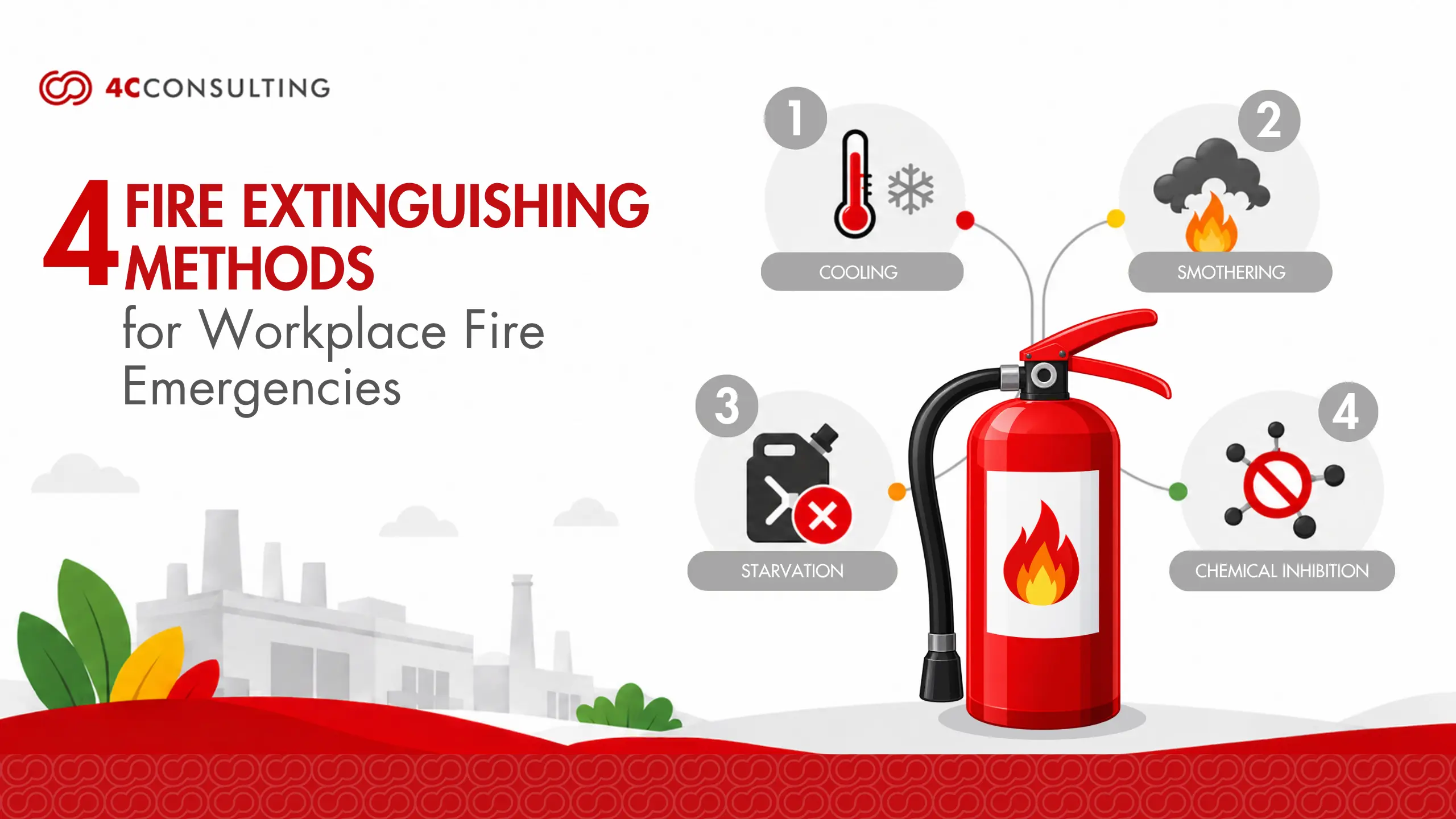
A workplace fire can escalate within minutes, but not every fire should be tackled in the same way. The right response depends on what is burning, what is sustaining the fire and which extinguishing method is suitable for the hazard.
Understanding the four fire extinguishing methods can help organizations improve workplace fire safety and prepare employees for emergency situations. For organizations following ISO 45001, fire response also forms part of a broader approach to emergency preparedness and response.
This guide explains how cooling, smothering, starvation and chemical inhibition work, when each method may be appropriate and how organizations can connect fire emergency preparedness with their ISO 45001 framework.
What Are the 4 Methods of Extinguishing Fire?
A fire continues to burn when the conditions needed for combustion are present. Traditionally, these conditions are represented by the fire triangle: heat, fuel and oxygen. Combustion can also involve a continuing chemical chain reaction, which is why some extinguishing agents work by interrupting that reaction.
The four common fire extinguishing methods are:
- Cooling – removing heat from the fire
- Smothering – reducing or cutting off the oxygen supply
- Starvation – removing or isolating the fuel
- Chemical inhibition – interrupting the combustion reaction
The method used should always depend on the type of fire, the material involved and the workplace’s emergency procedures. Using an unsuitable extinguishing agent can make a fire more dangerous rather than controlling it.
1. Cooling – Removing Heat from the Fire
Cooling works by reducing the temperature of the burning material below the level needed to sustain combustion. Once enough heat is removed, the fire can no longer continue burning.
Water is a common cooling agent for fires involving ordinary combustible materials such as paper, cardboard, wood and some textiles. In workplace environments, this method may be relevant in areas such as warehouses, offices, workshops and storage facilities where combustible materials are present.
However, water is not suitable for every fire. Using water on energized electrical equipment or certain flammable-liquid fires can create additional hazards. Fire response should therefore always consider the material involved before selecting an extinguishing method.
When Is Cooling Appropriate?
Cooling is generally associated with fires where removing heat from the burning material is an effective way to stop combustion. The workplace fire-risk assessment should identify these hazards and determine the appropriate firefighting equipment and response arrangements.
2. Smothering – Cutting Off Oxygen
Smothering works by reducing the oxygen available to the fire. When the oxygen supply is sufficiently restricted, combustion cannot continue.
Different methods can achieve this, depending on the situation. Foam can form a layer over certain burning liquids, while a fire blanket can help isolate a small, contained fire from the surrounding air. Certain extinguishing agents can also suppress combustion by limiting oxygen availability.
Smothering can be particularly relevant where the burning material is a flammable liquid or where a suitable covering can safely isolate a small fire.
Where Is Smothering Used in the Workplace?
The method may be relevant in areas such as kitchens, laboratories, workshops and facilities that handle flammable liquids. The specific extinguishing equipment should be selected according to the identified fire hazards rather than using the same equipment for every workplace area.
3. Starvation – Removing the Fuel
Starvation takes a different approach: instead of cooling the fire or reducing oxygen, it removes or isolates the fuel that is feeding the fire.
For example, an emergency response may involve shutting off a fuel or gas supply where this can be done safely, isolating a flammable material or removing combustible materials from the immediate fire area.
This method is particularly important in industrial environments where fires may involve continuous fuel sources. Simply extinguishing visible flames may not be enough if the source of the fuel remains uncontrolled.
Why Is Fuel Isolation Important?
A fire can reignite if the fuel source continues to feed combustion. Workplace emergency procedures should therefore consider not only how to control the visible fire but also how the underlying hazard can be safely isolated.
4. Chemical Inhibition – Interrupting the Combustion Reaction
Chemical inhibition works by interfering with the chemical reaction that sustains combustion. Certain dry chemical extinguishing agents can interrupt this reaction and stop the flame from continuing.
This method is used with extinguishing agents designed for specific fire hazards, including certain flammable-liquid and flammable-gas fires. The appropriate agent depends on the fire classification and the hazards present at the workplace.
Chemical inhibition is especially useful for understanding why simply removing heat or oxygen is not the only way to extinguish a fire. Different fire scenarios require different approaches.
4 Fire Extinguishing Methods: Quick Comparison
| Method | How It Works | Typical Application |
|---|---|---|
| Cooling | Removes heat from the burning material | Suitable ordinary combustible fires |
| Smothering | Reduces the oxygen available to the fire | Certain liquid and contained fires |
| Starvation | Removes or isolates the fuel source | Fuel, gas and combustible-material hazards |
| Chemical inhibition | Interrupts the combustion reaction | Suitable dry-chemical applications |
The correct method always depends on the specific fire hazard. There is no single extinguishing method that is appropriate for every workplace fire.
How Fire Classes Affect the Choice of Extinguishing Method
Not every fire behaves in the same way. The material involved, how quickly the fire can spread and the surrounding conditions all influence which extinguishing method and equipment should be used. Understanding the fire class helps organizations make that decision more systematically.
For workplaces in India, IS 2190:2024 provides guidance on the selection, installation and maintenance of portable and mobile fire extinguishers and identifies Classes A, B, C, D and F.
| Fire Type | Typical Fuel | Common Extinguishing Approach |
|---|---|---|
| Class A | Wood, paper, cardboard and other ordinary combustibles | Cooling-based extinguishing methods are commonly relevant |
| Class B | Flammable liquids and liquefiable solids | Methods that control the burning surface, such as suitable foam or other appropriate agents |
| Class C | Flammable gases under pressure | Appropriate extinguishing agents combined with safe control or isolation of the gas source where possible |
| Class D | Combustible metals such as magnesium, aluminium, sodium and potassium | Specialised extinguishing agents and techniques |
| Class F | Cooking oils and fats | Extinguishing equipment specifically designed for cooking-media fires |
Electrical equipment requires additional consideration because the extinguishing agent must be appropriate for the electrical hazard and the equipment’s energized condition. The selection should therefore be based on the actual workplace risk rather than simply choosing a commonly available extinguisher.
The same workplace may have more than one fire hazard. For example, a manufacturing facility could have ordinary combustible materials, flammable liquids and electrical equipment in different areas. Fire-extinguisher selection should therefore be linked to the organization’s fire-risk assessment, applicable requirements and the specific hazards present.
Important: Organizations should follow the applicable Indian standards, manufacturer’s instructions and local fire-safety requirements when selecting, installing and maintaining fire extinguishers.
How to Choose the Right Fire Extinguisher for a Workplace
Choosing a fire extinguisher should begin with the hazards present, not simply the availability of a particular extinguisher.
A workplace should consider the materials that could catch fire, the processes being carried out, electrical equipment, chemicals and other special hazards. The appropriate extinguishing agent can then be selected for the identified fire risks.
Organizations should also ensure that firefighting equipment is:
- Suitable for the identified fire hazards
- Easily accessible
- Clearly identified
- Properly maintained
- Located where employees can reach it safely
- Included in workplace emergency arrangements
Employees should also understand that having an extinguisher available does not mean they are expected to fight every fire.
What Should Employees Do During a Workplace Fire Emergency?
The first priority during a workplace fire is protecting people, not protecting property. Employees should follow the organization’s emergency response procedure, raise the alarm, notify the appropriate emergency contacts and evacuate when required. Firefighting equipment should only be used when the situation is appropriate and the employee has been trained to use it.
When Should an Employee Use a Fire Extinguisher?
A small, contained fire may sometimes be addressed with a suitable extinguisher when the employee is trained, the correct equipment is available and there is a clear and safe escape route. An employee should never put themselves at unnecessary risk simply to control a fire.
When Should Employees Evacuate Instead?
Evacuation should take priority when the fire is spreading, smoke is heavy, the correct equipment is unavailable, the person is not trained or the situation cannot be safely controlled. A workplace emergency plan should make these responsibilities clear before an emergency occurs.
How to Use a Fire Extinguisher – PASS Technique
For a small, manageable fire, trained employees may use the appropriate fire extinguisher when a safe escape route is available. The PASS technique provides a simple way to remember the basic steps:
- Pull – Pull the safety pin from the extinguisher.
- Aim – Aim the nozzle at the base of the fire, not at the flames.
- Squeeze – Squeeze the handle to discharge the extinguishing agent.
- Sweep – Sweep the nozzle from side to side across the base of the fire until it is controlled.
The PASS technique should only be used when the extinguisher is suitable for the type of fire and the person has received appropriate training. If the fire grows, produces heavy smoke or cannot be safely controlled, evacuate immediately and follow the workplace emergency procedure.
How ISO 45001 Addresses Workplace Fire Emergencies
ISO 45001 does not prescribe one particular fire extinguisher or require organizations to use one specific extinguishing method. Instead, it provides a framework for identifying OH&S risks and preparing for potential emergencies.
For workplace fire emergencies, ISO 45001 Clause 8.2 – Emergency Preparedness and Response is particularly relevant. Organizations need to establish and maintain processes for preparing for and responding to potential emergency situations.
For fire safety, this means an organization should consider how it will:
- Identify potential fire emergencies
- Establish an appropriate emergency response
- Define responsibilities
- Provide necessary resources
- Train relevant workers
- Test emergency response arrangements where appropriate
- Evaluate response performance
- Review and improve emergency procedures
The important point is that fire safety under ISO 45001 goes beyond keeping fire extinguishers on the premises. The organization needs a structured approach to emergency preparedness and response.
Fire Emergency Preparedness Under ISO 45001
- Identify Fire as a Potential Emergency: Fire risks should be considered as part of the organization’s hazard identification and OH&S risk assessment. This includes looking at combustible materials, chemicals, electrical equipment, production activities and other conditions that could create a fire emergency.
- Establish a Planned Response: An emergency response plan should define what happens when a fire occurs. This can include alarm arrangements, evacuation procedures, responsibilities, emergency contacts, firefighting resources and coordination with external emergency services where applicable.
- Train Workers: Employees need to understand the emergency arrangements relevant to their roles. Depending on the workplace and responsibilities, this may include emergency reporting, evacuation procedures, fire-extinguisher awareness and other response training.
- Test and Evaluate the Response: Emergency preparedness should not exist only as a documented procedure. Organizations can use drills and other suitable exercises to evaluate whether employees understand their responsibilities and whether the emergency arrangements work as intended. Findings from these activities can then be used to improve the emergency response process.
Common Workplace Fire Safety Mistakes to Avoid
Even organizations with firefighting equipment can have gaps in their emergency preparedness. Some common mistakes include:
- Choosing the wrong firefighting equipment: Selecting extinguishers without properly assessing the workplace hazards can make them ineffective during an emergency.
- Blocking access to extinguishers: Firefighting equipment should always be clearly identified and easily accessible.
- Not training employees: Employees should understand emergency procedures, evacuation arrangements and their responsibilities during a fire.
- Treating procedures as paperwork: An emergency plan should be practical and understood by employees, not simply maintained as documentation.
- Not reviewing fire drills: Drills can identify issues with evacuation routes, communication and employee responsibilities. These findings should be reviewed and addressed.
- Not updating emergency arrangements: Changes in workplace processes, equipment or layout may create new risks and should be reflected in emergency procedures.
How to Build a Fire Emergency Response Plan Under ISO 45001
An effective workplace fire emergency response plan should connect the identified hazards with practical response arrangements.
Start by identifying potential fire scenarios and assessing the associated risks. Establish the response procedure, assign responsibilities, provide appropriate emergency equipment and train employees. The organization should then test the arrangements where appropriate, evaluate the results and improve the response process based on what is learned.
This creates a cycle of preparedness, response, evaluation and improvement rather than treating fire safety as a one-time compliance activity.
How 4C Consulting Can Support ISO 45001 Implementation
With 20+ year of experience, 4C Consulting supports organizations with ISO 45001 implementation, hazard identification and risk assessment, emergency preparedness, internal audits, employee training and certification audit readiness. Our approach helps organizations develop practical OH&S processes that can be implemented and maintained in day-to-day operations.
Strengthen Your Workplace Safety Management System
Get expert ISO 45001 consulting support from 4C Consulting to improve workplace risk management, emergency preparedness and OH&S performance.
FAQ’s
1. What is the best method for extinguishing a workplace fire?
There is no single method that is best for every workplace fire. The appropriate method depends on the material burning, fire classification, workplace hazards and the extinguishing equipment available.
2. What is the difference between a fire extinguisher and a fire suppression system?
A fire extinguisher is generally portable equipment used for responding to a manageable fire, while a fire suppression system is a fixed or engineered system designed to detect and control specific fire hazards. The appropriate solution depends on the workplace risk.
3. How long does a fire extinguisher last?
The answer depends on the type, size, use, maintenance condition and applicable requirements. Extinguishers should be inspected and maintained according to the manufacturer’s instructions and applicable fire-safety requirements rather than being judged only by age.
4. Can all employees use a fire extinguisher during an emergency?
Not necessarily. Fire-extinguisher use should be limited to situations where employees are appropriately trained, the fire is manageable, the correct extinguisher is available and there is no unreasonable risk to personal safety.
5. Why does a fire sometimes restart after being extinguished?
A fire can reignite when heat remains in the material, the fuel source has not been fully isolated or conditions for combustion are still present. This is why simply removing visible flames does not always eliminate the underlying fire hazard.
6. What are the four methods of extinguishing fire?
The four common fire extinguishing methods are cooling, smothering, starvation and chemical inhibition. Cooling removes heat, smothering reduces oxygen, starvation removes or isolates the fuel and chemical inhibition interrupts the combustion reaction. The appropriate method depends on the type of fire and the material involved.
7. What is the fire triangle?
The fire triangle represents the three conditions needed to sustain combustion: heat, fuel and oxygen. Removing or controlling any one of these elements can help stop the fire. Some extinguishing agents also work by interrupting the chemical chain reaction involved in combustion.
8. Which fire extinguisher should be used for different types of fires?
The appropriate extinguisher depends on the material or hazard involved. Ordinary combustible materials, flammable liquids, flammable gases, combustible metals and cooking oils require different types of extinguishing equipment. For electrical equipment, the extinguisher must also be suitable for use on energized equipment. Organizations should select extinguishers based on identified workplace hazards, applicable requirements and the manufacturer’s instructions.
9. What does ISO 45001 Clause 8.2 say about emergency preparedness?
ISO 45001 Clause 8.2, Emergency Preparedness and Response, requires organizations to establish and maintain processes for preparing for and responding to potential emergency situations. For workplace fire emergencies, this includes identifying potential emergencies, establishing response procedures, defining responsibilities, providing resources, training workers, testing arrangements where appropriate and reviewing their effectiveness.
10. How often should workplace fire drills be conducted?
There is no single drill frequency that applies to every workplace. The frequency should be determined according to the organization’s risk assessment, applicable legal and regulatory requirements, workplace conditions and emergency arrangements. Fire drills should also be evaluated afterward to identify issues with evacuation, communication, responsibilities or employee awareness and to improve the emergency response process.

Sachin Mohan
General ManagerSachin Mohan is a General Manager at 4C Consulting with expertise in Food Standards, ISO 9001, ISO 14001, ISO 45001, SEDEX, and SA 8000. He supports organizations in strengthening management systems, improving compliance, and aligning business processes with recognized quality, environmental, health & safety, and social responsibility standards. His expertise helps businesses build structured systems that support responsible operations and continual improvement.